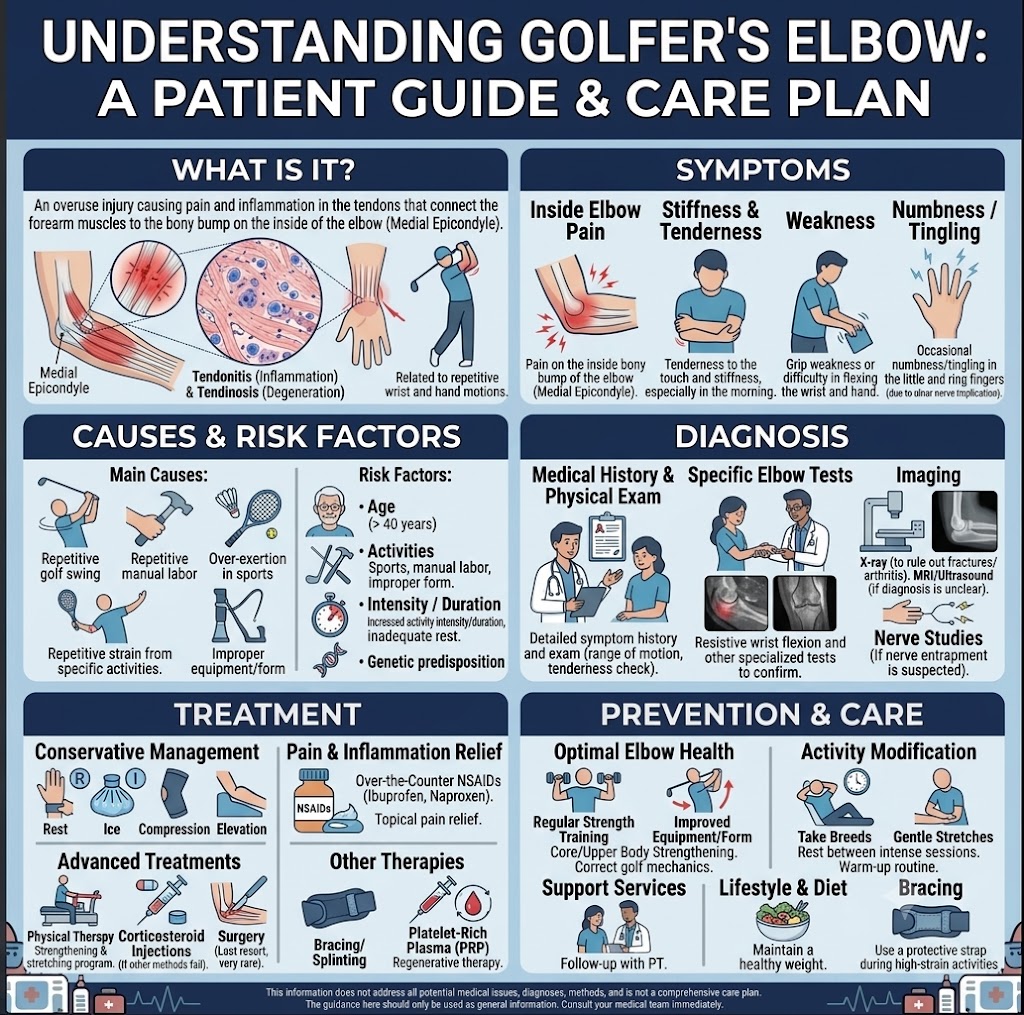
Golfer's elbow, also known as medial epicondylitis, is a common condition causing pain on the inner side of the elbow, where forearm tendons connect to a bony knob. This pain can extend down the forearm to the wrist. While often associated with golf, it affects anyone performing repetitive wrist or finger clenching movements, such as tennis players or those in certain occupations. Similar to tennis elbow (which affects the outer elbow), golfer's elbow responds well to rest and treatment, allowing a return to daily activities.
Understanding the Condition
Golfer's Elbow: Understanding and Managing Medial Epicondylitis
Understanding the Condition
Common Symptoms
Pain and Tenderness: Pain is typically felt on the inner side of your elbow and may spread down the inner forearm. It often worsens with specific movements or activities like gripping a golf club or making a fist.
Stiffness: Your elbow might feel stiff, and it could be painful or difficult to make a fist.
Weakness: You may experience noticeable weakness in your hands and wrists.
Numbness or Tingling: Sensations of numbness or tingling can radiate from the elbow down into one or more fingers, most commonly the ring and little fingers.
When to Consult a Doctor: Consult a healthcare provider if rest, ice application, and over-the-counter pain relievers do not ease your elbow pain and tenderness within a few days or weeks.
Seek Immediate Care If: Your elbow is hot, inflamed, and accompanied by a fever; you are unable to bend your elbow; your elbow appears visibly misshapen or deformed; or you suspect a bone might be broken in the area.
Consultation Guide
Which Specialist to Meet
Before your appointment, prepare a detailed list of your symptoms, including when they started and what activities worsen or improve them. Note any medications you are currently taking and compile a list of questions you have for the doctor. Be ready to discuss your daily activities, work tasks, and exercise routines.
Book a doctor visit near me
Rest: Avoid activities that worsen your pain, especially those involving repetitive gripping or wrist movements. Giving your elbow a break allows the damaged tendons to heal. (Duration: Days to several weeks, depending on the severity of symptoms and pain reduction.)
Ice Application: Apply ice packs to the inner side of the elbow for 15-20 minutes several times a day. This helps to reduce pain and swelling in the affected area. (Duration: As needed for pain relief, typically for the first few days or weeks after symptom onset or flare-up.)
Consultation Guide
An X-ray is a quick, painless imaging test that uses a small amount of radiation to create pictures of the structures inside your body, especially bones. For golfer's elbow, it's primarily used to rule out other potential causes of elbow pain, such as fractures, arthritis, or bone spurs, rather than to directly diagnose the soft tissue tendon injury.
Diagnostic Procedures
What to Expect
During an X-ray, you will be asked to position your arm in various ways on an X-ray table or against a special plate. A technologist will operate the X-ray machine from behind a protective shield. You will need to remain still for a few seconds while the image is taken. The procedure is generally quick and painless, and you won't feel anything during the X-ray itself. You may be asked to remove jewelry or clothing items that could interfere with the image.
Treatment Options
Golfer's elbow, also known as medial epicondylitis, is a common condition causing pain on the inner side of the elbow, where forearm tendons connect to a bony knob. This pain can extend down the forearm to the wrist. While often associated with golf, it affects anyone performing repetitive wrist or finger clenching movements, such as tennis players or those in certain occupations. Similar to tennis elbow (which affects the outer elbow), golfer's elbow responds well to rest and treatment, allowing a return to daily activities.
Initially, you should consult your primary care physician. If further evaluation or specialized treatment is required, they may refer you to an orthopedic specialist, a sports medicine doctor, or a physical therapist.
Preparations Before Your Visit
Medications
Over-the-Counter Pain Relievers: Non-prescription anti-inflammatory medications can help manage pain and reduce inflammation in the elbow. (Duration: As needed for pain, generally for short periods to avoid potential side effects with prolonged use.)
Corticosteroid Injections: These injections deliver a powerful anti-inflammatory medicine directly into the affected area of the elbow to reduce pain and swelling. They often contain a local anesthetic for immediate relief and a corticosteroid for longer-term effects. Due to potential side effects and to preserve tendon integrity, the number of injections given per year is usually limited. (Duration: Relief can last weeks to several months; injections are typically limited to 2-3 per year in the same area.)
Therapies
Prevention & Long-Term Wellbeing
Physical Therapy and Specific Exercises: A physical therapist can guide you through specific stretching and strengthening exercises for your forearm muscles and tendons. This therapy aims to improve flexibility, build strength, and teach proper movement patterns to aid recovery and prevent re-injury. (Duration: Several weeks to months, depending on individual progress, adherence to the program, and the severity of the condition.)
Prevention
Strengthen Forearm Muscles: Incorporate exercises using light weights or by squeezing a tennis ball to build muscle strength in your forearms. Stronger muscles can better absorb physical stress and protect the tendons from injury.
Warm-up and Stretch Before Activity: Before engaging in any strenuous activity or sport, warm up with light cardio for a few minutes (e.g., walking or jogging). Follow this with gentle stretches for your forearm muscles and wrist to improve flexibility.
Improve Technique for Sports and Tasks: For sports or work activities, have an instructor or expert assess your form. Correcting improper technique, especially in sports like golf or tennis, can significantly reduce excessive strain on your elbow tendons.
Use Appropriate Equipment: Ensure your sports equipment, such as golf clubs or tennis rackets, is the correct size and weight for you. Lighter clubs or a properly gripped racket can reduce the force transmitted to your elbow.
Lift Objects Correctly: When lifting anything, including free weights, keep your wrist rigid and stable. This helps distribute the load more evenly and lessens the stress on your elbow and forearm tendons.
Recognize and Respect Pain Signals: Avoid overusing your elbow. If you start to feel pain or discomfort, take a break from the activity immediately. Continuing through pain can worsen the injury and prolong recovery.
Tags & Topics
Notice an error or need an update?
Help us keep medical information accurate. Report incorrect info or suggest an edit.


