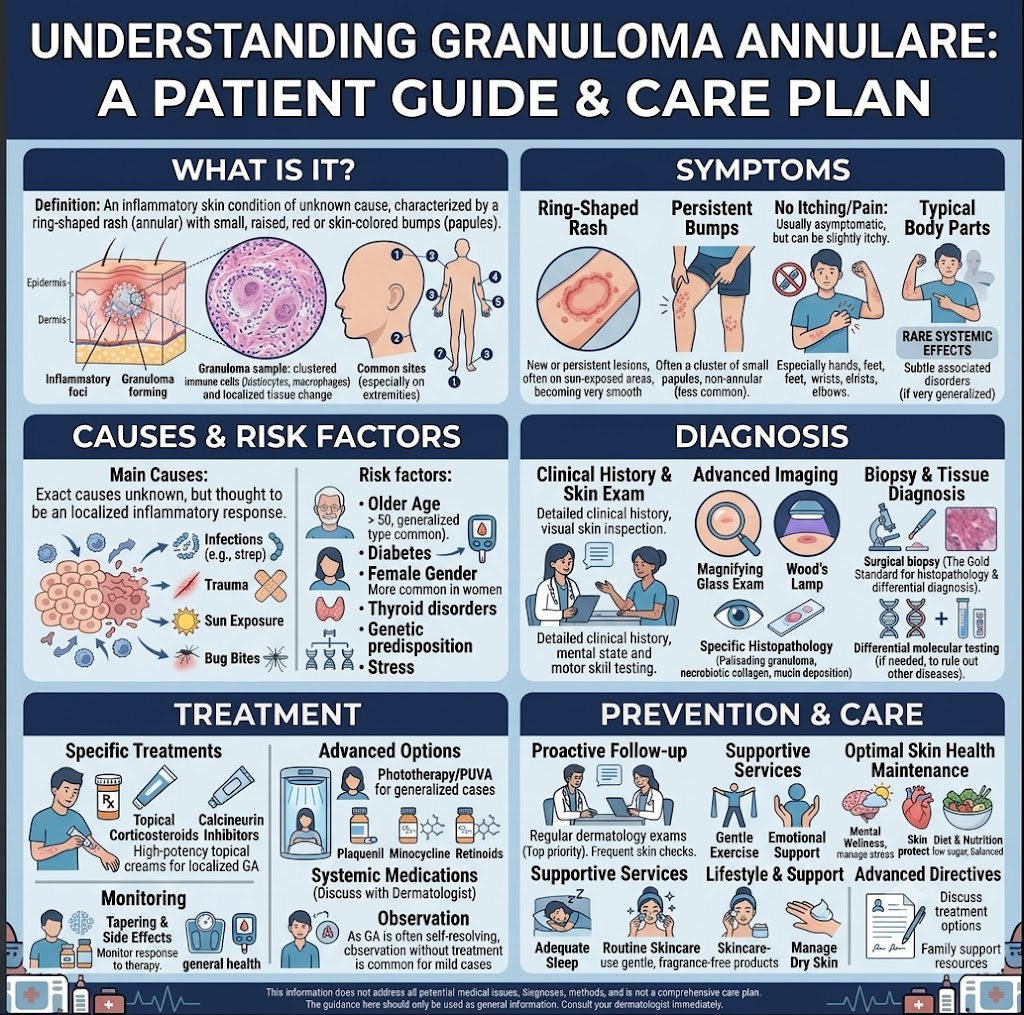
Granuloma annulare (pronounced gran-u-LOW-muh an-u-LAR-e) is a non-harmful skin condition characterized by a rash or bumps that often form a ring-like pattern. It most commonly affects young adults, typically appearing on the hands and feet.While the exact cause isn't fully understood, minor skin irritations or certain medications may act as triggers. It is not contagious and usually doesn't cause pain. However, its visible nature can sometimes lead to self-consciousness or emotional distress, especially if it becomes a long-term issue.The condition can resolve on its own over weeks, months, or even years, but the bumps frequently return even after treatment. Without treatment, it can persist for varying durations.
Understanding the Condition
Granuloma Annulare: Understanding This Skin Condition
Understanding the Condition
Common Symptoms
Localized Granuloma Annulare: This is the most common type, featuring circular or semicircular rashes up to 2 inches (5 cm) across. These typically appear on the hands, feet, wrists, and ankles, particularly in young adults.
Before your visit, make a list of your symptoms, including when they started and any potential triggers you've noticed (like insect bites or injuries). Be prepared to discuss your medical history, any existing health conditions (such as diabetes or thyroid issues), and all medications or supplements you are currently taking. It's also helpful to note if anyone in your family has similar skin conditions.
Book a doctor visit near me
Consultation Guide
Granuloma annulare (pronounced gran-u-LOW-muh an-u-LAR-e) is a non-harmful skin condition characterized by a rash or bumps that often form a ring-like pattern. It most commonly affects young adults, typically appearing on the hands and feet.While the exact cause isn't fully understood, minor skin irritations or certain medications may act as triggers. It is not contagious and usually doesn't cause pain. However, its visible nature can sometimes lead to self-consciousness or emotional distress, especially if it becomes a long-term issue.The condition can resolve on its own over weeks, months, or even years, but the bumps frequently return even after treatment. Without treatment, it can persist for varying durations.
Generalized Granuloma Annulare: Less common, this type usually affects adults, causing widespread rashes over much of the body, including the trunk, arms, and legs. This form might cause discomfort or itchiness.
Subcutaneous Granuloma Annulare: Seen mainly in young children, this type causes small, firm lumps under the skin rather than a surface rash. These lumps commonly form on the hands, shins, and scalp.
Consultation Guide
Which Specialist to Meet
If you notice a persistent rash or ring-shaped bumps on your skin, you should consult a dermatologist. A dermatologist is a doctor specializing in skin conditions.
Preparations Before Your Visit
Identify and Avoid Triggers: While the exact cause is unknown, some people find that minor skin injuries, insect bites, or intense sun exposure can trigger outbreaks. If you identify specific triggers, try to minimize exposure to them.
Manage Underlying Health Conditions: Since granuloma annulare can sometimes be linked to conditions like diabetes or thyroid disease, effectively managing these health issues can be important for overall skin health and potentially help prevent flare-ups.
Sun Protection: If sun exposure is a suspected trigger, use broad-spectrum sunscreen, wear protective clothing, and seek shade during peak sun hours.
Gentle Skin Care: Maintain a gentle skin care routine, using mild cleansers and moisturizers to keep the skin hydrated and minimize irritation.
Address Emotional Impact: Because the rash can be visible and persistent, it may cause self-consciousness or emotional distress. Talking to your doctor about these feelings, or seeking support from a counselor or support group, can be beneficial for your mental wellbeing.
Regular Medical Check-ups: Especially for generalized granuloma annulare or if you have other health concerns, regular check-ups with your doctor are important to monitor for any associated conditions.
Diagnostic Procedures
A skin biopsy is a procedure where a small sample of skin tissue is removed from the affected area for examination under a microscope by a specialist called a pathologist. This helps confirm the diagnosis of granuloma annulare and rule out other skin conditions.
What to Expect
**Preparation:** The area of skin to be biopsied will be cleaned, and a local anesthetic will be injected to numb it, so you won't feel pain during the procedure.**During the Procedure:*** **Shave Biopsy:** A doctor uses a small blade to gently scrape off the outermost layers of the skin. This method is usually for surface lesions. Stitches are typically not needed.* **Punch Biopsy:** A special round tool is used to remove a small, deeper core of skin tissue, similar to a hole punch. This allows for examination of all skin layers. Depending on the size of the removed sample, one or two stitches might be used to close the small wound.* **Excisional Biopsy:** For larger or deeper lesions, a scalpel is used to cut out the entire abnormal area along with a small margin of healthy surrounding skin. Stitches are usually required to close the incision.**After the Procedure:** The wound will be bandaged. You'll receive instructions on how to care for the biopsy site, which may include keeping it clean and dry. Minor discomfort or bruising at the site is common. The skin sample is then sent to a lab for analysis, and your doctor will discuss the results with you within a few days or weeks.
Treatment Options
Topical and Injectable Treatments
Corticosteroid Creams or Ointments: These anti-inflammatory medications are applied directly to the rash to help reduce inflammation and flatten the bumps. They are often a first-line treatment for localized granuloma annulare. (Duration: Daily application for several weeks to months, as directed by your doctor.)
Corticosteroid Injections: For thicker or more persistent lesions, a steroid medication can be injected directly into the bumps. This delivers a higher concentration of the medication directly to the affected area. (Duration: Typically, a few injections spaced weeks apart until the rash improves.)
Light and Physical Therapies
Light Therapy (Phototherapy): Exposure to specific types of ultraviolet (UV) light can help clear the rash, especially for widespread or generalized granuloma annulare. This therapy works by affecting the immune cells in the skin. (Duration: Sessions typically occur several times a week for several weeks to months.)
Cryotherapy: This involves freezing the bumps with liquid nitrogen, which can help flatten them. It is usually used for a small number of localized lesions. (Duration: One to a few sessions may be needed, spaced a few weeks apart.)
Oral Medications (for severe cases)
Systemic Medications: For severe, widespread, or very persistent cases that don't respond to other treatments, your doctor might prescribe medications taken by mouth. These work throughout the body to suppress the immune response contributing to the skin condition. (Duration: Treatment duration varies widely, from several weeks to many months, depending on response and severity.)
Monitor Skin Changes: Regularly examine your skin for new rashes or bumps. If you notice any changes, persistent lesions, or if the condition becomes widespread, consult your dermatologist for assessment and possible treatment adjustments.
Prevention & Long-Term Wellbeing
Home Care and Lifestyle
Moisturizing and Gentle Skin Care: Keeping the skin well-moisturized can help with discomfort. Avoid harsh soaps or vigorous scrubbing that could irritate the skin further. (Duration: Ongoing as needed.)
Prevention and Self-Care
Tags & Topics
Notice an error or need an update?
Help us keep medical information accurate. Report incorrect info or suggest an edit.


