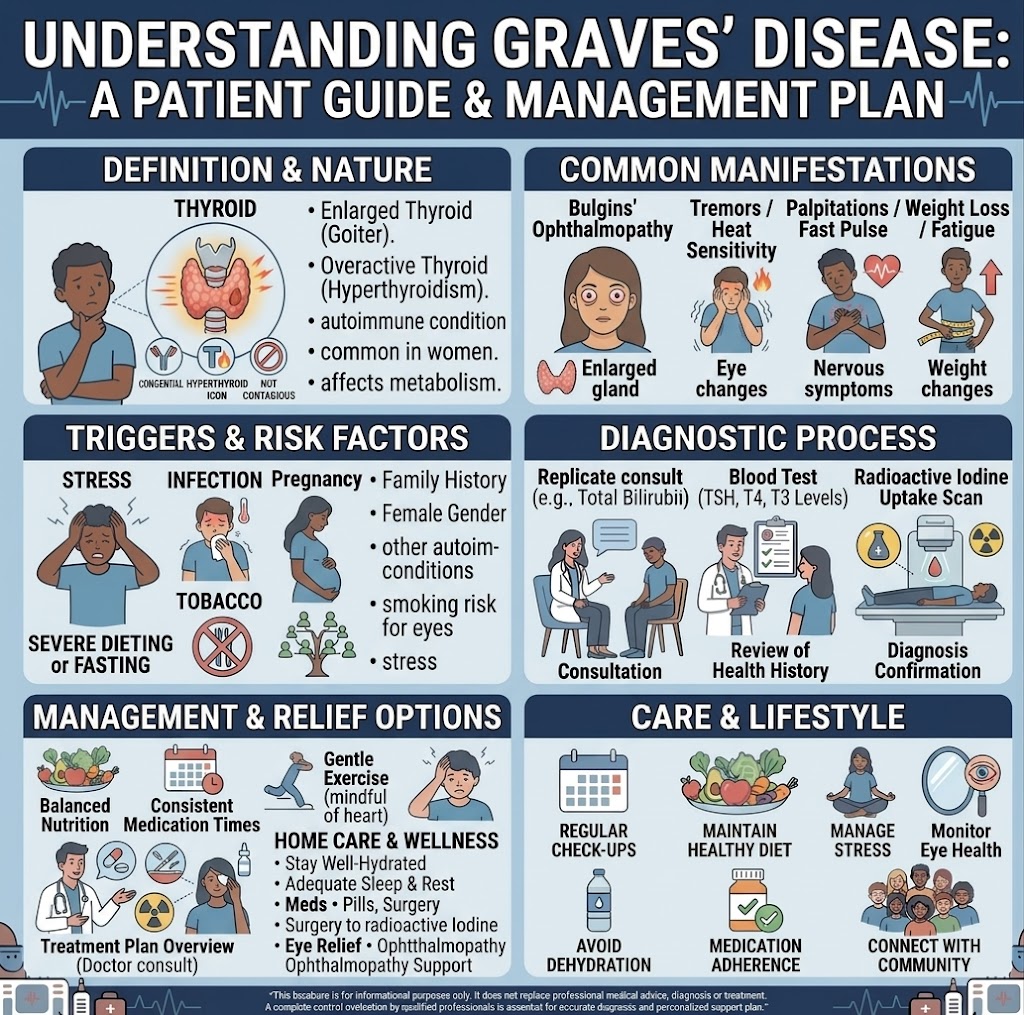
Graves' disease is an autoimmune condition where the body's immune system mistakenly attacks the thyroid gland, a small butterfly-shaped gland located in your neck. This attack causes the thyroid to produce too much thyroid hormone, leading to a condition called hyperthyroidism. Thyroid hormones play a vital role in regulating many bodily functions, so an excess can affect various organs. While anyone can develop Graves' disease, it is more common in women and individuals over the age of 30. Treatment focuses on lowering thyroid hormone levels and easing symptoms.
Understanding the Condition
Graves' Disease: Understanding an Overactive Thyroid
Understanding the Condition
Graves' disease is an autoimmune condition where the body's immune system mistakenly attacks the thyroid gland, a small butterfly-shaped gland located in your neck. This attack causes the thyroid to produce too much thyroid hormone, leading to a condition called hyperthyroidism. Thyroid hormones play a vital role in regulating many bodily functions, so an excess can affect various organs. While anyone can develop Graves' disease, it is more common in women and individuals over the age of 30. Treatment focuses on lowering thyroid hormone levels and easing symptoms.
Common Symptoms
Anxiety and Irritability: Feeling nervous, anxious, irritable, or experiencing mood swings.
Tremors: A fine trembling of the hands or fingers.
Heat Sensitivity and Sweating: Increased sensitivity to heat, excessive sweating, and skin that feels warm and moist.
Weight Loss: Unexplained weight loss despite an increased appetite.
Goiter: An enlarged thyroid gland, visible as a swelling in the neck, known as a goiter.
Menstrual Changes: Changes in menstrual patterns or irregular periods for women.
Erectile Dysfunction/Reduced Sex Drive: Difficulty getting or maintaining an erection (erectile dysfunction) or a decreased desire for sex in men.
Frequent Bowel Movements: More frequent trips to the bathroom due to increased bowel movements.
Bulging Eyes (Thyroid Eye Disease): Eyes that appear to bulge outwards, known as thyroid eye disease or Graves' ophthalmopathy. This condition may also cause redness, dryness, or a feeling of grittiness in the eyes, and can appear before, during, or after thyroid symptoms.
Fatigue: Persistent tiredness and lack of energy.
Skin Thickening (Graves' Dermopathy): Rarely, thickened, reddish, or discolored skin with an orange-peel texture, most often on the shins or tops of the feet, called Graves' dermopathy.
Heart Palpitations: A rapid, pounding, or irregular heartbeat.
Sleep Problems: Difficulty falling or staying asleep (insomnia).
Consultation Guide
Which Specialist to Meet
Your primary care doctor can refer you to an endocrinologist, a specialist in hormone disorders. If you experience eye symptoms, an ophthalmologist (eye doctor) specializing in thyroid eye disease may also be involved. For heart-related issues, a cardiologist might be consulted.
Preparations Before Your Visit
Before your appointment, prepare a detailed list of all your symptoms, noting when they started and how frequently they occur. Bring a complete list of any medications, vitamins, and supplements you are currently taking. Be ready to discuss your medical history, including any family history of thyroid conditions or other autoimmune diseases. Write down any questions you have about the diagnosis, treatment options, and long-term management.
Book a doctor visit near me
Antithyroid Medications: These medications work by reducing the amount of thyroid hormone produced by your thyroid gland. They help to control hyperthyroidism symptoms and are often the first line of treatment. Regular blood tests are necessary to monitor hormone levels and adjust the dosage. (Duration: Typically taken for 1 to 2 years, sometimes longer. Some individuals may require lifelong treatment.)
Beta-Blockers: These medications do not affect thyroid hormone production but help to quickly alleviate symptoms of hyperthyroidism such as rapid heart rate, tremors, and nervousness. (Duration: Used short-term for symptom relief, usually until antithyroid medications take effect, or as needed.)
Lifestyle Adjustments for Symptom Management: While not a cure, managing stress, eating a balanced diet, and avoiding caffeine and nicotine can help alleviate some symptoms like nervousness and palpitations. For eye irritation or dryness from thyroid eye disease, over-the-counter lubricating eye drops can provide relief. (Duration: As advised)
Eye Care for Thyroid Eye Disease: If you have thyroid eye disease, consistent visits to an ophthalmologist are important to monitor eye health, manage symptoms like dryness, irritation, or double vision, and address any changes in vision or eye structure. Protective eyewear and elevating your head during sleep can also help.
Bone Health Management: Untreated or long-standing hyperthyroidism can weaken bones and increase the risk of osteoporosis (brittle bones). Discuss bone density screening and strategies such as calcium and vitamin D supplementation or weight-bearing exercises with your doctor to maintain bone strength.
Stress Reduction Techniques: Stress can exacerbate symptoms of Graves' disease. Incorporating relaxation techniques such as meditation, yoga, mindfulness, or deep breathing exercises can help manage anxiety, improve sleep quality, and enhance overall well-being.
Consultation Guide
These tests measure the levels of thyroid hormones (thyroxine/T4 and triiodothyronine/T3) and thyroid-stimulating hormone (TSH) in your blood. In Graves' disease, TSH levels are typically low, while T4 and T3 levels are high. Blood tests can also identify specific antibodies, such as the thyrotropin receptor antibody (TRAb), which directly causes Graves' disease by stimulating the thyroid gland.
This test measures how much iodine your thyroid gland absorbs from your bloodstream. An overactive thyroid, characteristic of Graves' disease, will take up a significantly higher amount of iodine compared to a normal thyroid. This helps confirm hyperthyroidism and differentiate Graves' disease from other causes of an overactive thyroid.
For individuals with thyroid eye disease, a CT (Computed Tomography) scan or MRI (Magnetic Resonance Imaging) of the eye sockets may be performed. These imaging tests provide detailed cross-sectional pictures of the muscles and tissues behind the eyes, helping to assess any inflammation, swelling, or enlargement caused by the autoimmune response.
For a CT scan, you will lie on a table that slides into a large, donut-shaped machine that uses X-rays. You may be asked to hold your breath briefly. An MRI involves lying on a table that slides into a large, tube-shaped machine that uses powerful magnets and radio waves. Both procedures are generally painless, but an MRI can be noisy, so earplugs may be offered. Sometimes, a contrast dye may be injected intravenously to enhance the images, which might cause a temporary warm sensation.
Diagnostic Procedures
Blood Tests for Thyroid Hormones and Antibodies
What to Expect
A healthcare professional will draw a small sample of blood, usually from a vein in your arm. The process is quick and generally involves minimal discomfort, similar to any routine blood draw.
Radioactive Iodine Uptake Test (RAIU)
What to Expect
You will swallow a small, safe dose of radioactive iodine, typically in liquid or capsule form. This iodine is not harmful and delivers a very low level of radiation. After several hours and again after 24 hours, a special camera will be placed over your neck to measure how much iodine your thyroid has absorbed. You may need to fast for several hours before the test.
An ultrasound uses high-frequency sound waves to create images of your thyroid gland. This helps your doctor visualize the size and structure of the gland, check for any enlargement (goiter), or identify nodules.
What to Expect
You will lie on your back with your neck slightly extended. A gel will be applied to your neck, and a small handheld device (transducer) will be gently moved over the area to capture images. The procedure is typically painless and takes about 15-30 minutes.
CT Scan or MRI for Thyroid Eye Disease
What to Expect
Regular Follow-up Appointments: Ongoing monitoring with an endocrinologist is essential to ensure thyroid hormone levels remain stable, especially after treatment. Regular blood tests are performed to adjust medication dosages and detect any recurrence or development of hypothyroidism.
Treatment Options
Medications
Radioactive Iodine Therapy: This treatment involves taking a single dose of radioactive iodine, usually as a pill. The thyroid gland absorbs the iodine, which then slowly damages the overactive thyroid cells, causing the gland to shrink and hormone production to decrease. This often leads to an underactive thyroid (hypothyroidism), which requires lifelong thyroid hormone replacement. (Duration: Effects develop over several weeks to months. Lifelong thyroid hormone replacement therapy is usually required afterwards.)
Surgical Procedures
Thyroidectomy (Thyroid Gland Removal): This surgery involves removing all or part of the thyroid gland. It is a permanent solution for Graves' disease, particularly if other treatments are ineffective, a large goiter is present, or there's concern about thyroid cancer. If the entire gland is removed, lifelong thyroid hormone replacement is necessary. (Duration: One-time surgery. Lifelong thyroid hormone replacement therapy is usually required afterwards if the entire gland is removed.)
Pregnancy Planning and Management: If you plan to become pregnant, or are pregnant, it is crucial to manage Graves' disease closely with your doctor to prevent complications such as miscarriage, early birth, or issues for both the mother and the baby. Adjustments to treatment may be necessary.
Heart Health Monitoring: Untreated Graves' disease can lead to heart complications like irregular heart rhythms and heart failure. Regular monitoring of your heart health by a doctor is important, especially if you experience palpitations or shortness of breath.
Prevention & Long-Term Wellbeing
Home Remedies/Lifestyle
Prevention
Smoking Cessation: Smoking significantly increases the risk of developing Graves' disease and worsening thyroid eye disease. Quitting smoking is crucial for prevention and managing the condition effectively.
Long-Term Monitoring
Lifestyle Adjustments
Balanced Diet and Exercise: Maintaining a healthy lifestyle with a balanced diet rich in fruits, vegetables, and lean proteins, combined with moderate, regular exercise (as advised by your doctor), can support overall health, energy levels, and mood management.
Tags & Topics
Notice an error or need an update?
Help us keep medical information accurate. Report incorrect info or suggest an edit.


