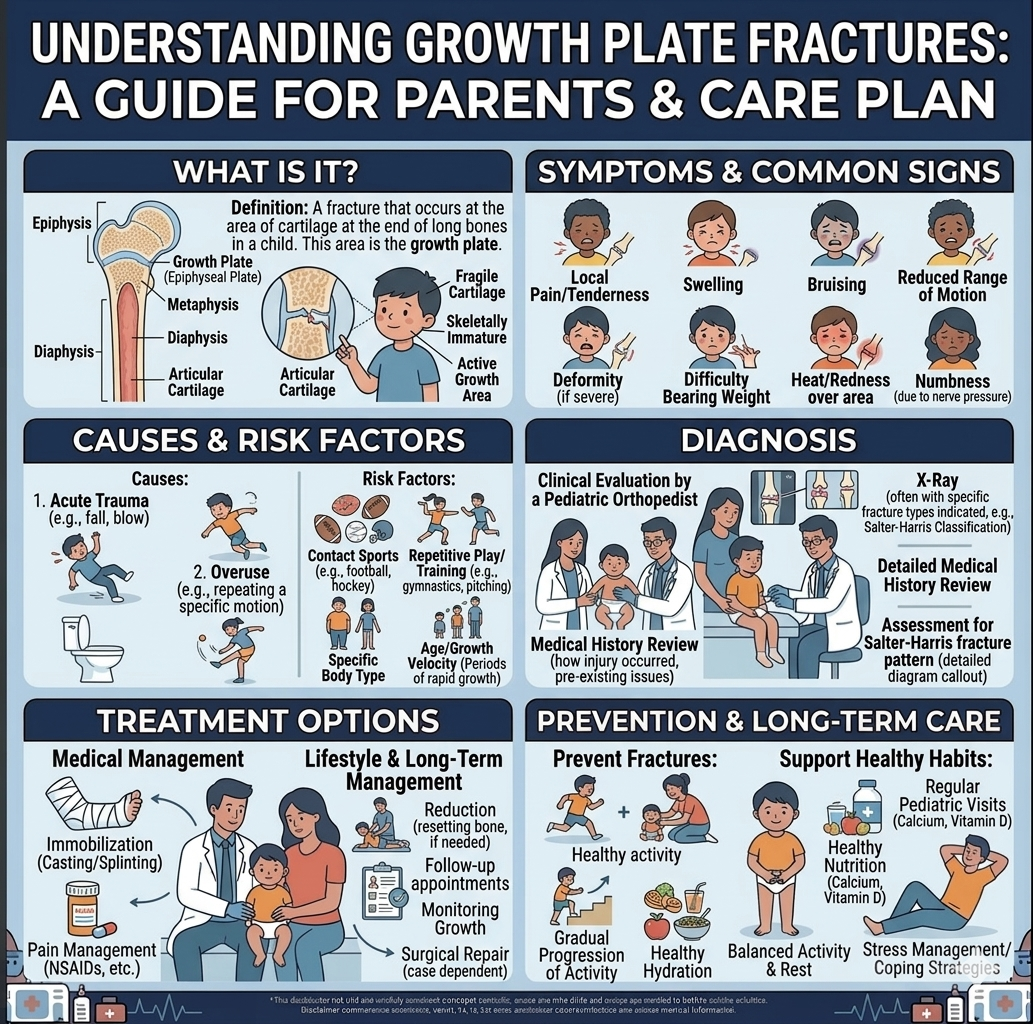
Growth plate fractures occur in the soft, growing tissue near the ends of bones in children and adolescents. These 'growth plates' are the weakest parts of a child's skeleton, sometimes even more fragile than the surrounding ligaments and tendons. An injury that might only cause a sprain in an adult can lead to a growth plate fracture in a child. Because these fractures affect the area responsible for bone growth, immediate and proper treatment is crucial. If left untreated or improperly managed, a growth plate fracture can lead to the affected bone growing crooked, shorter, or longer than the opposite limb. While most growth plate fractures heal completely without lasting problems, the risk of complications like crooked or stunted growth increases with the severity of the injury, the child's age (younger children have more growth remaining), and the location of the fracture (those near the knee are particularly sensitive to permanent damage).
Understanding the Condition
Growth Plate Fractures in Children
Understanding the Condition
Common Symptoms
Pain and Tenderness: Especially when pressure is applied to the area near the end of a bone or joint.
Limited Movement: Difficulty moving the injured body part, or inability to put weight or pressure on the affected limb.
Swelling and Warmth: Noticeable swelling and a warm feeling around the end of the bone near a joint.
Visible Deformity or Persistent Pain: Seek medical evaluation promptly if you notice any visible deformity, or if your child experiences persistent pain that hinders their activities, even if no obvious fracture is seen.
Consultation Guide
Which Specialist to Meet
Before your visit, make a list of your child's symptoms, any recent injuries, and their medical history, including any current medications. Be prepared to answer questions about when the injury occurred and how it happened. You might also want to prepare a list of questions for the doctor regarding diagnosis, treatment options, and expected recovery. Wear loose-fitting clothing.
Book a doctor visit near me
Consultation Guide
Growth plate fractures occur in the soft, growing tissue near the ends of bones in children and adolescents. These 'growth plates' are the weakest parts of a child's skeleton, sometimes even more fragile than the surrounding ligaments and tendons. An injury that might only cause a sprain in an adult can lead to a growth plate fracture in a child. Because these fractures affect the area responsible for bone growth, immediate and proper treatment is crucial. If left untreated or improperly managed, a growth plate fracture can lead to the affected bone growing crooked, shorter, or longer than the opposite limb. While most growth plate fractures heal completely without lasting problems, the risk of complications like crooked or stunted growth increases with the severity of the injury, the child's age (younger children have more growth remaining), and the location of the fracture (those near the knee are particularly sensitive to permanent damage).
Your child will lie on a motorized table that slides into a large, doughnut-shaped machine. They will need to lie still during the scan, which may take several minutes. The machine might make some whirring or clicking noises. In some cases, a contrast dye may be injected into a vein to highlight certain structures, which might cause a brief warm sensation.
Ultrasound (Sonography)
Ultrasound uses high-frequency sound waves to create real-time images of structures inside the body. While sound waves don't travel well through bone, ultrasound can be useful for assessing soft tissues around the growth plate, detecting fluid collections, or sometimes visualizing certain growth plate injuries that are not clearly visible on X-rays. It is a safe procedure that uses low-power sound waves and carries no known risks.
Diagnostic Procedures
For suspected growth plate fractures, an initial evaluation can be done by a primary care physician or in an urgent care setting. However, specialized care by a pediatric orthopedic surgeon (a doctor specializing in children's bone and joint issues) is often necessary for accurate diagnosis and tailored treatment. In emergency situations, an emergency room physician will provide immediate care.
Preparations Before Your Visit
An X-ray is a quick and painless imaging test that uses a small amount of radiation to create pictures of the inside of the body, particularly bones. It helps doctors see fractures, assess bone alignment, and check for signs of damage to the growth plate.
What to Expect
Your child will lie on a table, and a technologist will carefully position the injured body part. They may ask your child to hold very still for a few seconds while the X-ray is taken. You may be asked to remove any metal objects or jewelry. The procedure is typically very fast and involves minimal discomfort.
CT Scan (Computed Tomography Scan)
A CT scan uses a series of X-rays taken from different angles to create detailed cross-sectional images, or 'slices,' of bones, blood vessels, and soft tissues. It provides more detailed information than a standard X-ray, especially for complex fractures, when assessing the exact extent of damage to the growth plate, or when the fracture is difficult to see on a plain X-ray.
What to Expect
What to Expect
Your child will lie on an examination table. A clear gel will be applied to the skin over the affected area. A small handheld device called a transducer will be moved over the gel, sending and receiving sound waves. The images are displayed on a monitor. The procedure is usually painless, though there might be some pressure from the transducer. Your child might be asked to wear loose clothing or remove jewelry.
Treatment Options
Rest and Support: Limiting movement of the injured limb is crucial for proper healing. Following the RICE protocol (Rest, Ice, Compression, Elevation) can help manage initial pain and swelling. (Duration: Ongoing throughout the healing process, especially in the first few days post-injury.)
Medications
Pain Relievers: Over-the-counter pain medications, such as acetaminophen or nonsteroidal anti-inflammatory drugs (NSAIDs), can help manage pain and reduce swelling. Stronger prescription pain relievers may be used for more severe pain for a short period, as advised by a doctor. (Duration: As needed for pain relief, typically for several days to a few weeks following the injury.)
Bone Realignment (Reduction): If the fractured bone pieces are displaced (out of alignment), a doctor may need to manually realign them. This is often done without surgery (closed reduction), but sometimes an open reduction (surgical intervention) is required for precise alignment. (Duration: A one-time procedure.)
Immobilization (Casting or Splinting): Once the bone is realigned, the injured limb is typically placed in a cast or splint to keep it stable and protected while it heals. This prevents movement that could disrupt the healing process and ensures proper bone fusion. (Duration: Typically 3 to 8 weeks, depending on the severity and location of the fracture, and the child's age.)
Therapies
Fracture Fixation Surgery: For severe, unstable, or complex growth plate fractures, surgery may be necessary. This can involve using pins, screws, plates, or rods to hold the bone fragments in place and stabilize the growth plate during healing, ensuring optimal alignment. (Duration: A one-time procedure, followed by immobilization and rehabilitation. Hardware may be removed in a second procedure later, if necessary.)
Prevention & Long-Term Wellbeing
Physical Therapy: After the cast or splint is removed, physical therapy may be recommended. This helps to restore strength, flexibility, and full range of motion to the injured limb, and to rebuild muscle that may have atrophied during immobilization. (Duration: Several weeks to a few months, depending on the individual's recovery needs and the extent of the injury.)
Prevention
Sports Safety Practices: Encourage children to use appropriate protective gear (helmets, pads) during sports and recreational activities. Emphasize proper training techniques, warm-up before activities, and cool-down afterward to prevent injuries. Avoid overtraining or repetitive stress that could lead to overuse injuries on growth plates.
Injury Awareness and Environment: Teach children about safe practices during recreational activities like biking, sledding, or skateboarding. Supervise activities and ensure safe environments to reduce the risk of falls or direct impacts. Maintain a healthy diet to support strong bones.
Long-Term Monitoring
Regular Follow-Up Appointments: After a growth plate fracture, regular follow-up visits with a pediatric orthopedic specialist are crucial. These appointments often include X-rays to monitor the healing process and ensure the bone is growing correctly, helping to detect any potential growth discrepancies early.
Addressing Growth Discrepancies: If the growth plate is permanently damaged, the child's doctor will closely monitor for potential limb length differences or angulation as the child grows. In some cases, further interventions might be needed later in life to correct significant growth problems and ensure proper function.
Tags & Topics
Notice an error or need an update?
Help us keep medical information accurate. Report incorrect info or suggest an edit.


