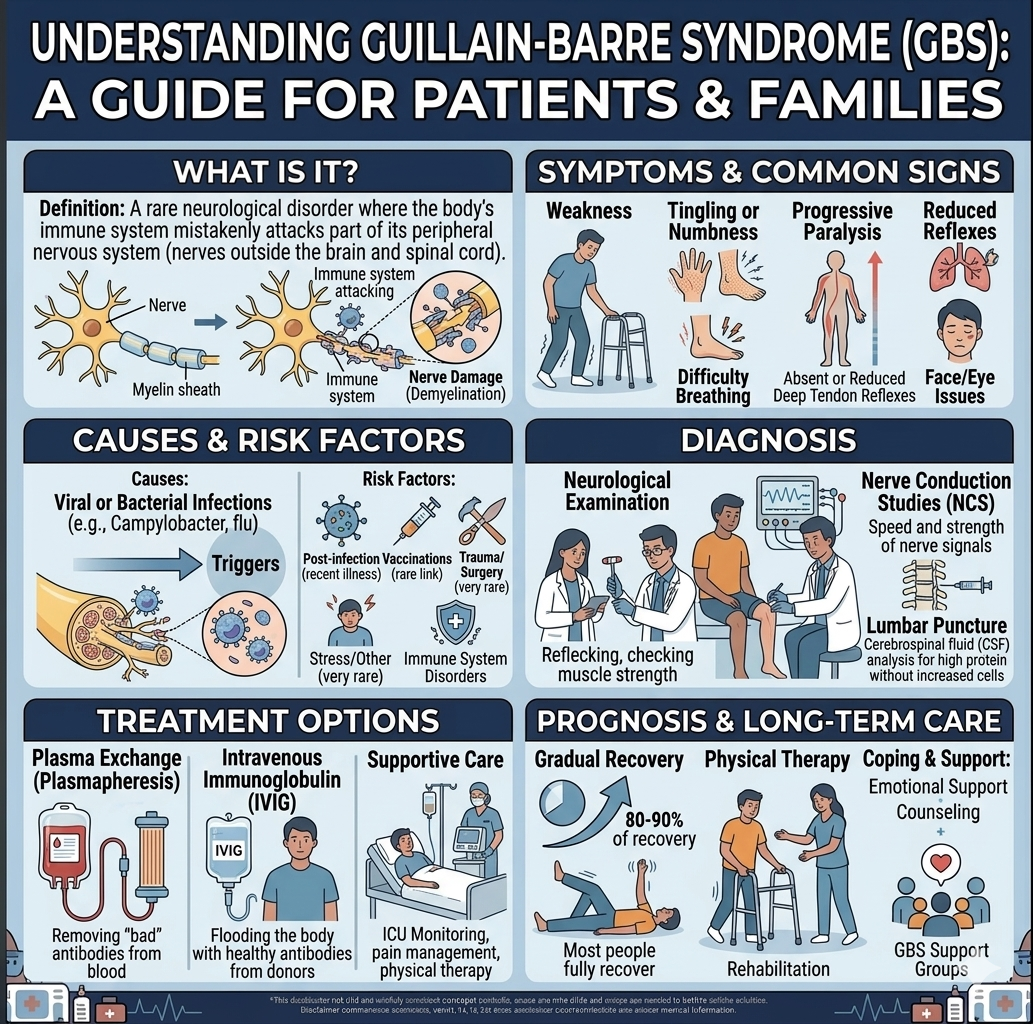
Guillain-Barre (gee-YAH-buh-RAY) syndrome is a rare but serious condition where your body's immune system mistakenly attacks its own healthy nerves. This attack damages the protective covering of the nerves, called the myelin sheath, which prevents nerve signals from traveling properly. This disruption leads to muscle weakness, numbness, and can even cause paralysis. While the exact cause is unknown, it often develops days or weeks after an infection, such as a respiratory illness, stomach flu, or viruses like COVID-19 or Zika. Symptoms usually begin in the hands and feet and can rapidly spread, sometimes escalating into a life-threatening medical emergency that requires hospital care. Most people fully recover, though recovery can take months to years, and some may experience lasting weakness or fatigue. The risk slightly increases with age and is somewhat more common in males.
Understanding the Condition
Guillain-Barre Syndrome: Understanding a Rare Nerve Condition
Understanding the Condition
Guillain-Barre (gee-YAH-buh-RAY) syndrome is a rare but serious condition where your body's immune system mistakenly attacks its own healthy nerves. This attack damages the protective covering of the nerves, called the myelin sheath, which prevents nerve signals from traveling properly. This disruption leads to muscle weakness, numbness, and can even cause paralysis. While the exact cause is unknown, it often develops days or weeks after an infection, such as a respiratory illness, stomach flu, or viruses like COVID-19 or Zika. Symptoms usually begin in the hands and feet and can rapidly spread, sometimes escalating into a life-threatening medical emergency that requires hospital care. Most people fully recover, though recovery can take months to years, and some may experience lasting weakness or fatigue. The risk slightly increases with age and is somewhat more common in males.
Common Symptoms
Tingling Sensations: A 'pins and needles' feeling, often starting in the fingers, toes, ankles, or wrists and spreading upwards.
Progressive Muscle Weakness: Weakness typically begins in the legs and can spread to the upper body and arms, sometimes quickly.
Difficulty Walking: An unsteady gait, trouble walking, or inability to walk or climb stairs.
Facial Muscle Problems: Trouble with movements like speaking, chewing, or swallowing.
Vision Issues: Double vision or difficulty moving the eyes.
Severe Pain: Aching, shooting, or cramp-like pain, often worse at night.
Bladder and Bowel Control Issues: Difficulty controlling bladder or bowel function.
Heart Rate Changes: A rapid or irregular heartbeat.
Blood Pressure Fluctuations: Episodes of unusually low or high blood pressure.
Breathing Difficulties: Trouble taking a full breath, which can become severe and require medical assistance.
Consultation Guide
Which Specialist to Meet
Be prepared to describe your symptoms in detail, including when they started, how they've progressed, and any recent illnesses or vaccinations. Bring a list of all current medications. You may need to undergo immediate diagnostic tests.
Book a doctor visit near me
The doctor will ask about your medical history and symptoms. They will then perform various tests, such as tapping your knees to check reflexes, asking you to push or pull against their hand to assess muscle strength, checking your balance by asking you to walk, and testing your sensation with a light touch or pinprick. The exam may take a few minutes to over an hour.
Electromyography (EMG) and Nerve Conduction Study (NCS)
Plasma Exchange (Plasmapheresis): This procedure involves removing a portion of your blood, separating the plasma (the liquid part containing antibodies that attack your nerves), and then returning the blood cells to your body, often with replacement fluid. This helps remove harmful antibodies to ease symptoms and speed recovery. (Duration: Typically performed over several days, with multiple sessions.)
Pain Management: Medications are used to manage severe nerve pain, which can be a significant symptom of the syndrome. (Duration: As needed throughout the acute phase and recovery.)
Managing Lasting Symptoms: Some individuals may experience residual weakness, numbness, or fatigue. Working with your healthcare team to develop strategies and treatments for these long-term effects is important for maintaining quality of life.
Monitoring for Complications: Be vigilant for potential complications such as breathing difficulties, blood pressure changes, heart rhythm abnormalities, bowel/bladder issues, and nerve pain. Report any new or worsening symptoms to your doctor immediately.
Relapse Awareness: A small percentage of people may experience a relapse, sometimes years later. Being aware of this possibility and seeking prompt medical attention for returning symptoms is important.
Consultation Guide
For an NCS, sticky electrode patches will be placed on your skin over the nerves to be tested. Small electrical pulses will be delivered, which may cause a brief, mild tingling or twitching sensation. For a needle EMG, a very thin needle electrode will be gently inserted into several muscles. You may feel a slight prick, and then the doctor will ask you to relax and then slightly contract the muscle. The electrical activity will be recorded and displayed as graphs or sounds. The entire procedure usually takes 30 to 90 minutes.
Lumbar Puncture (Spinal Tap)
Diagnostic Procedures
If you experience rapid-onset weakness, tingling, or numbness, especially if it's spreading, you should immediately see a general practitioner or visit an emergency room. They will likely refer you to a neurologist, a doctor specializing in nervous system conditions, for diagnosis and treatment.
Preparations Before Your Visit
Neurological Examination
This is a comprehensive check of your nervous system to assess its function. It involves a series of tests to evaluate your reflexes, muscle strength, balance, coordination, sensation, and mental status.
What to Expect
An EMG evaluates the health of your muscles and the nerves that control them. A nerve conduction study measures how quickly and strongly electrical signals travel through your nerves. Together, these tests can identify nerve damage, which is characteristic of Guillain-Barre syndrome.
What to Expect
This procedure involves collecting a small sample of cerebrospinal fluid (CSF) – the fluid surrounding your brain and spinal cord – for laboratory testing. In Guillain-Barre syndrome, CSF often shows an abnormally high protein level with a normal white blood cell count, which is a key diagnostic indicator.
What to Expect
You will typically lie on your side with your knees pulled up to your chest, or sometimes sit bent forward. The doctor will clean your lower back and numb the skin with a local anesthetic. A thin, hollow needle will then be carefully inserted between two bones in your lower spine to collect a small amount of CSF. You may feel pressure during the needle insertion. The actual fluid collection is brief, though the overall procedure takes about 30-45 minutes. Afterwards, you will typically be asked to lie flat for an hour or more to help prevent a headache.
Treatment Options
Intravenous Immunoglobulin (IVIg): This treatment involves giving you healthy antibodies through a vein. These antibodies can block the harmful antibodies that are attacking your nerves, helping to reduce nerve damage and accelerate recovery. (Duration: Usually administered as a series of infusions over 2-5 days.)
Supportive Care and Therapies
Respiratory Support: If muscle weakness affects breathing, a breathing machine (ventilator) may be necessary to assist or take over breathing until natural strength returns. (Duration: Temporary, potentially weeks, until natural breathing strength returns.)
Blood Clot Prevention: For individuals with limited mobility, medications to thin the blood and compression stockings may be used to prevent dangerous blood clots. (Duration: Until mobility is restored.)
Infection Awareness: While Guillain-Barre syndrome is not directly preventable, understanding that it often follows infections highlights the importance of general hygiene and prompt treatment of illnesses to minimize risks.
Vaccination Discussion: Discuss any concerns about extremely rare vaccine-related triggers with your doctor. The benefits of recommended vaccinations generally far outweigh the minimal risks associated with GBS.
Prevention & Long-Term Wellbeing
Rehabilitation Therapies (Physical, Occupational, and Speech): As recovery begins, these therapies are crucial. Physical therapy helps restore muscle strength, flexibility, and mobility. Occupational therapy assists with daily activities, and speech therapy addresses difficulties with speaking or swallowing. (Duration: Begins in the hospital and continues for months to years during recovery, tailored to individual needs.)
Other Supportive Measures
Pressure Sore Prevention: Regular repositioning and specialized mattresses help prevent bedsores (pressure sores) if mobility is significantly impaired. (Duration: As long as mobility is limited.)
Prevention and Risk Reduction
Long-Term Monitoring and Recovery
Consistent Rehabilitation: Adhering to prescribed physical, occupational, and speech therapy programs is vital for regaining strength and function. This can be a long and demanding process, requiring persistence.
Psychological Support: Dealing with a serious illness and a long recovery can be emotionally challenging. Seeking support from mental health professionals, support groups, or family and friends can be very beneficial for coping and mental well-being.
Tags & Topics
Notice an error or need an update?
Help us keep medical information accurate. Report incorrect info or suggest an edit.


