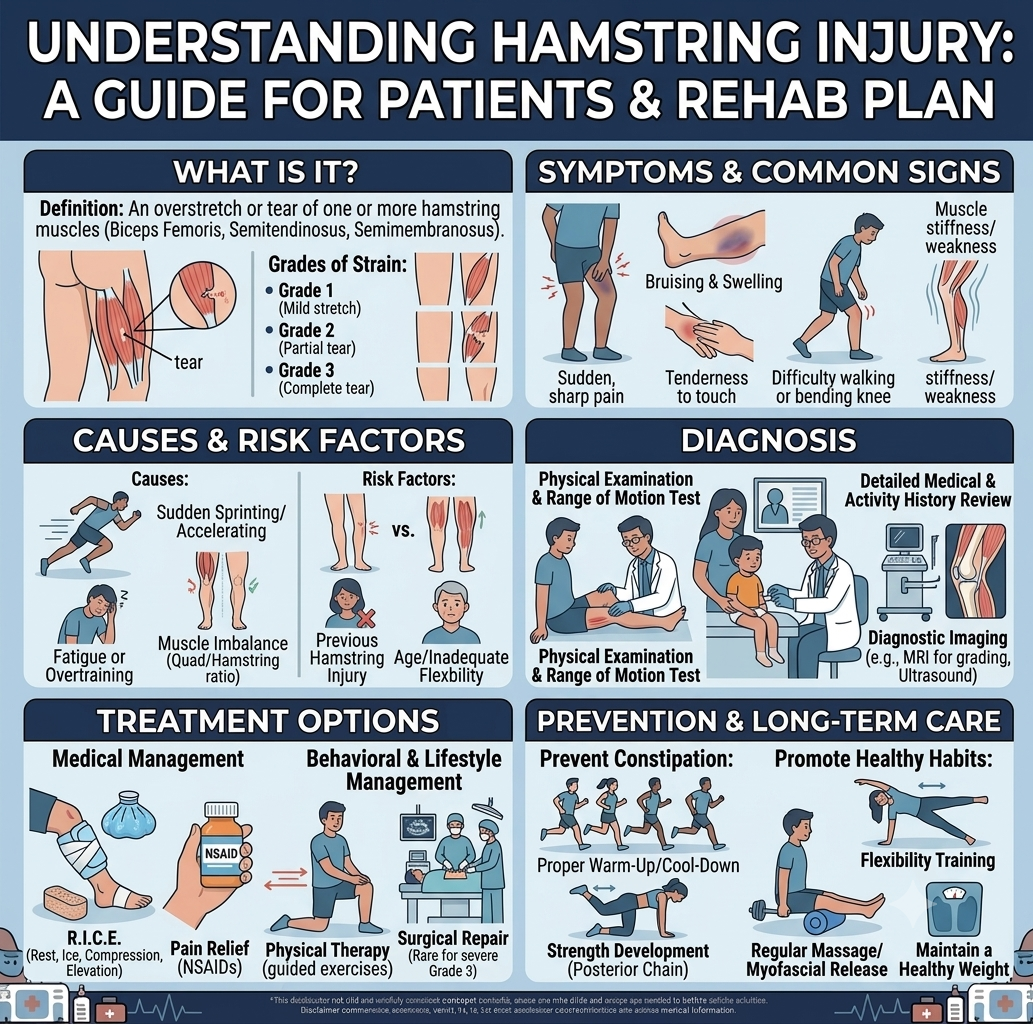
A hamstring injury occurs when one of the three muscles at the back of your thigh is strained or pulled. These muscles run from your hip bone down to just below your knee, allowing you to bend your knee and extend your leg backward. Such injuries are common in sports requiring sudden sprints, stops, and starts, like soccer, basketball, football, and tennis, as well as in runners and dancers. While most mild hamstring injuries improve with home care, severe cases, like a complete tear from the bone, may require medical intervention or surgery.
Understanding the Condition
Common Symptoms
Sudden Thigh Pain: A sharp, immediate pain felt at the back of the thigh.
“Popping” or Tearing Sensation: You might feel or hear a distinct 'pop' at the time of injury.
Swelling and Tenderness: Bruising or discoloration may appear along the back of the leg within a few hours. The area will also be sensitive to touch.
Muscle Weakness: The injured leg may feel weak, or you might struggle to put weight on it.
Difficulty Walking: Inability to walk more than a few steps without significant pain.
Consultation Guide
Which Specialist to Meet
For a hamstring injury, you would typically consult your primary care doctor first. They may then refer you to specialists such as an orthopedic surgeon (a bone and joint specialist), a sports medicine physician, or a physical therapist.
Preparations Before Your Visit
Before your visit, make a list of your symptoms, including when they started and what makes them better or worse. Note any recent activities or injuries. Be ready to discuss your medical history and any medications you are taking. Wear comfortable clothing that allows for easy movement so the doctor can assess your leg.
Book a doctor visit near me
Consultation Guide
Rest: Avoid activities that cause pain and give your leg time to heal. This is crucial for the initial days to weeks. (Duration: Days to several weeks, depending on severity)
Ice Application: Apply an ice pack wrapped in a cloth to the injured area to reduce swelling and pain. (Duration: 15-20 minutes several times a day for the first 24-72 hours)
Compression: Use an elastic bandage to gently compress the injured thigh, which can help minimize swelling. (Duration: During the day for the first few days to a week)
Elevation: Whenever possible, raise your injured leg above the level of your heart to reduce swelling. (Duration: Frequently during the initial days)
Diagnostic Procedures
Your doctor will examine your leg, check for tenderness, swelling, and bruising, and assess your range of motion and strength.
What to Expect
During the examination, you will likely be asked to move your leg in various ways, and the doctor will gently press on different areas of your thigh to pinpoint the source of pain and evaluate muscle function. This helps gauge the severity and location of the injury.
This non-invasive test uses high-frequency sound waves to create live images of the soft tissues, including muscles, tendons, and ligaments. It can help visualize the extent of a muscle tear or swelling and check for fluid collection.
What to Expect
You will lie on an examination table. A gel will be applied to the skin over the back of your thigh. A small, handheld device called a transducer will be moved gently over the gel, sending sound waves into your body and capturing their echoes to create real-time images on a screen. The procedure is generally painless, though you might feel slight pressure from the transducer. It typically takes 15-30 minutes.
An X-ray is a quick, painless imaging test that uses a small amount of radiation to create pictures of the structures inside your body, primarily bones. While it doesn't show soft tissues like muscles or tendons directly, it can rule out other issues such as a bone fracture or a piece of bone being pulled away by a tendon (avulsion fracture), which can sometimes accompany severe hamstring injuries.
What to Expect
You will be asked to remove any jewelry or metal objects that could interfere with the images. You will stand, sit, or lie on an examination table, and a technician will position your leg carefully. You may need to hold your breath for a few seconds while the X-ray is taken to ensure clear images. The process is very quick, usually taking only a few minutes, and is painless.
Treatment Options
Hamstring Injury: Understanding, Treatment, and Prevention
Understanding the Condition
A hamstring injury occurs when one of the three muscles at the back of your thigh is strained or pulled. These muscles run from your hip bone down to just below your knee, allowing you to bend your knee and extend your leg backward. Such injuries are common in sports requiring sudden sprints, stops, and starts, like soccer, basketball, football, and tennis, as well as in runners and dancers. While most mild hamstring injuries improve with home care, severe cases, like a complete tear from the bone, may require medical intervention or surgery.
Medications
Over-the-counter Pain Relievers: Medications that reduce pain and inflammation can be used. (Duration: A few days to a week, or as needed for discomfort)
Therapies
Physical Therapy: A structured program of stretching and strengthening exercises, guided by a physical therapist, is essential for regaining full function and preventing re-injury. (Duration: Several weeks to months, depending on injury severity)
Surgical Procedures
Tendon Reattachment Surgery: Rarely needed, but if a hamstring tendon has completely torn away from the bone (pelvis or shin bone), surgery may be performed to reattach it. This is usually reserved for severe cases, often in athletes. (Duration: Followed by several months of rehabilitation)
Prevention & Long-Term Wellbeing
Prevention
Regular Exercise: Maintain good overall physical condition through consistent exercise.
Stretching and Strengthening: Incorporate specific hamstring stretches and strengthening exercises into your routine. This builds flexibility and muscle resilience. A common stretch involves lying on your back near a wall, extending your leg up the wall with a slight bend in the knee, and gently straightening until you feel a stretch along the back of the thigh. Hold for about 30 seconds and repeat on the other leg. Perform these daily or several times a week.
Proper Warm-up: Always warm up thoroughly before engaging in sports or strenuous activities. A warm-up should include light aerobic activity and dynamic stretches.
Gradual Increase in Activity: Increase the intensity and duration of your workouts or sports activities gradually. Avoid sudden increases that can overload muscles.
Listen to Your Body: Do not push through pain or severe fatigue. Give your muscles adequate rest to recover.
Long-Term Wellbeing
Complete Healing: Ensure your hamstring is fully healed before returning to demanding activities. Returning too soon significantly increases the risk of re-injury. A physical therapist can help determine when you are ready.
Address Muscle Imbalances: Work to strengthen weaker muscles, especially the hamstrings, if they are less developed than your quadriceps (thigh muscles).
Maintain Flexibility and Strength: Continue with a regular program of hamstring stretches and strengthening exercises even after recovery to maintain muscle health and prevent future injuries.
Proper Technique: Learn and use correct form and technique for your sport or activity to minimize strain on the hamstrings.
Tags & Topics
Notice an error or need an update?
Help us keep medical information accurate. Report incorrect info or suggest an edit.


