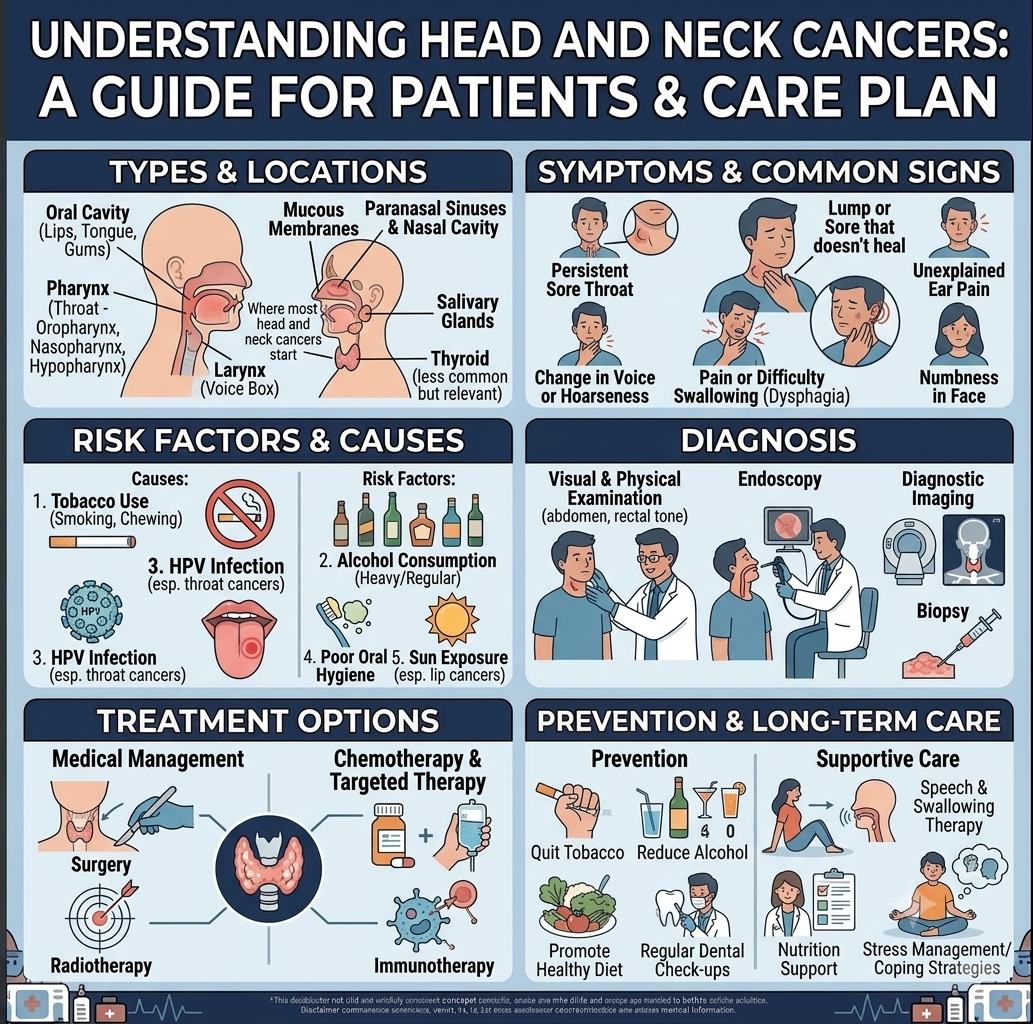
Head and neck cancers are a group of diseases originating in the head or neck region. They are unified by shared risk factors, symptoms, and treatments. These cancers most commonly start in the moist lining (squamous cells) of the mouth, throat, voice box, sinuses, or salivary glands. Abnormal and uncontrolled cell growth forms tumors that can invade and spread. Tailored treatment depends on the cancer's specific type, location, and stage.
Understanding the Condition
Head and Neck Cancers: Comprehensive Guide
Understanding the Condition
Head and neck cancers are a group of diseases originating in the head or neck region. They are unified by shared risk factors, symptoms, and treatments. These cancers most commonly start in the moist lining (squamous cells) of the mouth, throat, voice box, sinuses, or salivary glands. Abnormal and uncontrolled cell growth forms tumors that can invade and spread. Tailored treatment depends on the cancer's specific type, location, and stage.
Common Symptoms
Lump in the Neck: Often painless, felt through the skin.
Mouth Sore That Won't Heal: A persistent ulcer or sore spot in the mouth.
Pain When Swallowing: Discomfort or difficulty moving food down the throat.
Hoarse Voice: Lasting changes in voice quality.
Loose Teeth: Unexplained tooth instability.
Coughing Up Blood: Presence of blood when coughing.
Nosebleeds: Frequent or unexplained bleeding from the nose.
Stuffy or Blocked Nose: Persistent nasal congestion not improving.
Consultation Guide
Which Specialist to Meet
You might see an Ear, Nose, and Throat (ENT) specialist (Otolaryngologist), a medical oncologist, a radiation oncologist, an oral surgeon, a head and neck surgeon, a dietitian for nutritional support, and a speech-language pathologist for swallowing or voice issues. Palliative care specialists can also assist with symptom management.
Preparations Before Your Visit
List all symptoms (start, changes), gather medical history (past illnesses, treatments), list all medications/supplements, write down questions. Consider bringing a trusted family member or friend for support and note-taking.
Book a doctor visit near me
Palliative Care: Specialized care providing relief from pain and symptoms of serious illness, enhancing quality of life for patients and families. (Duration: Ongoing, provided throughout the illness and treatment.)
Diagnostic Procedures
Your doctor will examine your mouth, throat, and neck to look for abnormalities, lumps, or sores, often using a light and mirror for internal viewing.
What to Expect
The doctor will visually inspect and gently feel areas of your head and neck. This is usually quick and painless, though some areas might feel slightly uncomfortable if they are sore.
A thin, flexible tube with a camera (endoscope) is gently inserted through your nose or mouth to view the throat, voice box, and surrounding areas, revealing areas difficult to examine otherwise.
What to Expect
You may receive a numbing spray to your nose or throat. You might feel a sensation of pressure or gagging, but the procedure is usually brief. In some cases, a more extensive endoscopy might be done under general anesthesia.
Imaging Scans (CT, MRI, PET Scan)
These advanced scans create detailed images of your body's interior. A CT scan uses X-rays, an MRI uses strong magnets, and a PET scan uses a special dye to highlight cancerous cells. They help determine cancer's location, size, and spread.
What to Expect
You will lie still on a table that slides into a large machine. For CT and MRI, you might hear loud noises. You may receive an injection of a contrast dye. A PET scan involves an injection of a small amount of radioactive sugar. These scans are generally painless but can take 30 minutes to an hour or more.
A biopsy involves taking a small tissue sample from a suspicious area for microscopic examination to check for cancer cells. This is the only definitive way to diagnose cancer.
What to Expect
Depending on the location, a biopsy might be done with a local anesthetic in the doctor's office, or it might require a minor surgical procedure under general anesthesia. For a lump in the neck, a thin needle (fine needle aspiration) might be used. You might feel a brief sting or pressure; afterwards, there might be some soreness or minor bleeding.
Home Enteral Nutrition (Tube Feeding): Delivers liquid nutrition directly to the stomach or small intestine via a tube when normal eating is difficult. (Duration: Can be short-term (weeks) or long-term (months/years) depending on need.)
Treatment Options
Surgical Procedures
Tumor Removal Surgery: Physical removal of cancerous tissue, often with a margin of healthy tissue. Extent depends on tumor size and location. (Duration: Typically a one-time procedure; recovery varies from weeks to months based on complexity.)
Transoral Robotic Surgery (TORS): Minimally invasive surgery using robot-guided tools through the mouth for precise tumor removal in hard-to-reach throat/mouth areas. (Duration: One-time procedure, often with quicker recovery (weeks) than open surgery.)
Therapies
Radiation Therapy: Uses high-energy beams (X-rays or protons) to kill cancer cells. Includes: External Beam Radiation (beams aimed from outside the body), Intensity-Modulated Radiation Therapy (IMRT, custom-shaped beams precisely match tumor), and Proton Therapy (positively charged particles for highly precise targeting, potentially fewer side effects). (Duration: Often daily, five days a week, for several weeks (e.g., 5-7 weeks).)
Chemotherapy: Powerful medications kill fast-growing cancer cells systemically (oral or intravenously). (Duration: Administered in cycles (treatment then rest), spanning several months to over a year.)
Biological Therapy (Immunotherapy): Helps the body's own immune system recognize and attack cancer cells. (Duration: Given intravenously in cycles, can continue for months or years.)
Regular Follow-up Care: Consistent monitoring with your healthcare team is vital after treatment to check for any recurrence of cancer and manage long-term side effects.
Prevention & Long-Term Wellbeing
Prevention
Avoid Tobacco: Do not smoke or use any form of tobacco. Seek professional support to quit if you currently use.
Limit Alcohol: If you drink alcohol, do so in moderation: up to one daily for women, two for men.
HPV Vaccination: Discuss with your doctor whether the Human Papillomavirus (HPV) vaccine is right for you, as it can prevent some throat cancers.
Sun Protection: Wear a wide-brimmed hat, use SPF 30+ broad-spectrum sunscreen, and reapply frequently to protect your head and neck.
Minimize Chemical Exposure: Reduce contact with airborne chemicals linked to increased cancer risk, especially for cancers of the nose and sinuses.
Long-Term Wellbeing
Rehabilitation Services: Work with speech-language pathologists, dietitians, and physical therapists to address any challenges with speaking, swallowing, eating, or neck mobility.
Nutritional Support: Maintain a healthy diet. If needed, a dietitian can help manage eating difficulties or recommend nutritional supplements or tube feeding.
Psychological and Emotional Support: Dealing with cancer can be emotionally challenging. Seek support from counselors, support groups, or mental health professionals.
Healthy Lifestyle: Continue to follow healthy lifestyle habits, including regular physical activity and a balanced diet, to support overall health and recovery.
Tags & Topics
Notice an error or need an update?
Help us keep medical information accurate. Report incorrect info or suggest an edit.


