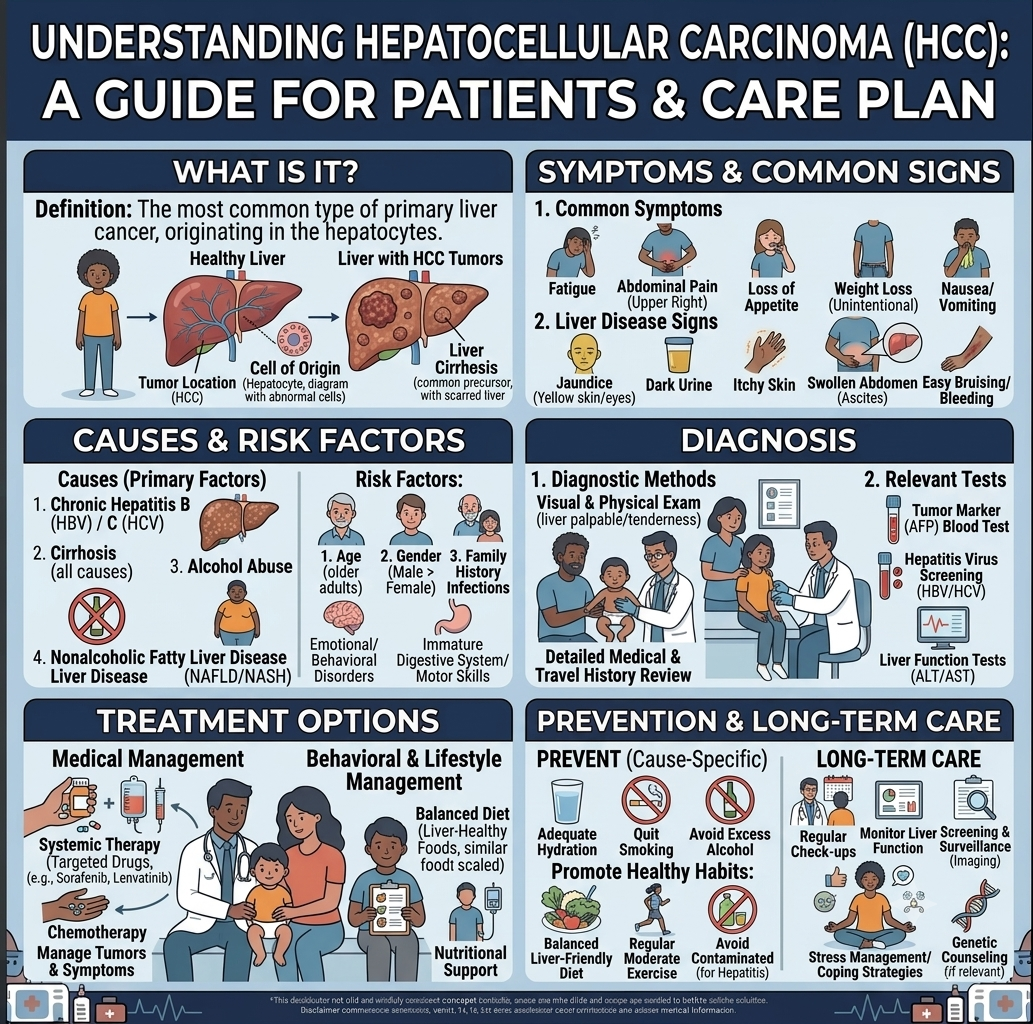
Hepatocellular carcinoma (HCC) is the most common type of liver cancer, originating from liver cells. The liver, located under the right rib cage, is vital for digestion and waste removal. HCC often develops in individuals with chronic liver conditions, particularly cirrhosis caused by hepatitis B or C. It's a serious cancer that can grow silently and spread, making early detection and treatment challenging.
Understanding the Condition
Liver Cancer (Hepatocellular Carcinoma): A Guide for Non-Medical Persons
Understanding the Condition
Common Symptoms
Early Symptoms (often absent): Higher than normal levels of alpha-fetoprotein (AFP) in blood tests, sometimes found during routine screening for high-risk individuals. Growths (nodules) on the liver detected during imaging tests like ultrasound, often part of screening for those at high risk.
Advanced Symptoms (when disease is advanced): Unexplained weight loss and loss of appetite. Pain in the upper abdomen. A noticeable lump or growth in the abdomen. Yellowing of the skin and eyes (jaundice), caused by bilirubin buildup.
Consultation Guide
Which Specialist to Meet
You should consult a general practitioner first, who can refer you to specialists such as a hepatologist (liver specialist), an oncologist (cancer specialist), or a transplant surgeon if needed.
Preparations Before Your Visit
Before your visit, gather your full medical history, including any chronic conditions, medications you take, and a list of your symptoms and when they started. Prepare questions about diagnosis, treatment options, and long-term care. You may be asked to fast before some blood tests.
Book a doctor visit near me
Consultation Guide
Hepatocellular carcinoma (HCC) is the most common type of liver cancer, originating from liver cells. The liver, located under the right rib cage, is vital for digestion and waste removal. HCC often develops in individuals with chronic liver conditions, particularly cirrhosis caused by hepatitis B or C. It's a serious cancer that can grow silently and spread, making early detection and treatment challenging.
Diagnostic Procedures
Blood Tests (General)
For these tests, a small blood sample is drawn, usually from your arm.
What to Expect
It's a quick procedure, and you might need to fast beforehand.
Alanine Aminotransferase (ALT) Test
Measures ALT, a liver enzyme; high levels suggest liver cell damage.
What to Expect
A small blood sample will be drawn, typically from a vein in your arm.
Alkaline Phosphatase (ALP) Test
Measures ALP, an enzyme from liver and bones; high levels can indicate liver or bone issues.
What to Expect
A small blood sample will be drawn, typically from a vein in your arm.
Aspartate Aminotransferase (AST) Test
Measures AST, an enzyme from liver, heart, muscles; high levels often point to liver damage.
What to Expect
A small blood sample will be drawn, typically from a vein in your arm.
Measures bilirubin, a waste product handled by the liver; high levels can indicate liver, bile duct, or blood cell problems.
What to Expect
A small blood sample will be drawn, typically from a vein in your arm.
Alpha-fetoprotein (AFP) Blood Test
Measures AFP, a protein often elevated in liver cancer, used for screening in high-risk individuals.
What to Expect
A small blood sample will be drawn, typically from a vein in your arm.
Prothrombin Time (PT) Test / INR
Measures blood clotting speed, assessing liver function and impact of blood thinners.
What to Expect
A small blood sample will be drawn, typically from a vein in your arm.
Liver Function Tests (LFTs)
A panel of blood tests, including ALT, AST, ALP, and bilirubin, to check overall liver health.
What to Expect
A small blood sample will be drawn, typically from a vein in your arm.
Uses sound waves to create real-time images of your liver, identifying growths or abnormalities.
What to Expect
You'll lie down while a gel is applied to your abdomen. A technician moves a handheld device (transducer) over the area. It's painless and takes 15-30 minutes.
CT Scan (Computed Tomography)
Uses X-rays and computer processing to create detailed cross-sectional images of the liver and surrounding areas.
What to Expect
You'll lie on a table that slides into a large ring-shaped machine. Contrast dye might be injected to improve image clarity. You'll need to stay still. It's painless and typically takes 10-30 minutes.
PET Scan (Positron Emission Tomography)
Involves injecting a radioactive tracer that highlights areas of high metabolic activity, often indicative of cancer cells, within the body.
What to Expect
After a tracer injection and a short wait, you'll lie on a table that moves into a scanner. This scan usually takes 30-60 minutes and is often combined with a CT scan for better location detail.
Liver Biopsy (Needle Biopsy)
A procedure to remove a small tissue sample from the liver, guided by imaging, for microscopic examination to diagnose cancer or other liver diseases.
What to Expect
The area over your liver will be numbed. Under ultrasound or CT guidance, a thin needle is inserted through your skin to collect a tissue sample. You might feel pressure. The procedure takes about 15-30 minutes, followed by a period of observation.
Regular Screening for High-Risk Individuals: If you have conditions that increase liver cancer risk (like cirrhosis, chronic hepatitis B/C), discuss regular screenings (e.g., blood tests for AFP, ultrasound) with your doctor for early detection.
Treatment Options
Surgical Procedures
Surgery to Remove Cancer: Part of the liver containing the tumor is removed. (Duration: Often a single procedure with recovery over weeks to months, depending on cancer size and location.)
Liver Transplant: The diseased liver is replaced with a healthy liver from a donor, requiring lifelong anti-rejection medications. (Duration: A major surgery taking many hours, with months of recovery.)
Medications / Therapies
Targeted Therapies: Medications that specifically target features of cancer cells to stop their growth while minimizing harm to healthy cells. (Duration: Ongoing, often for months or years, depending on response and side effects.)
Immunotherapy: Treatments that boost your body's immune system to recognize and destroy cancer cells, administered intravenously. (Duration: A course of weeks or months, with ongoing therapy as long as it's effective.)
Local Therapies (Minimally Invasive Procedures)
Radiation Therapy: Uses high-energy beams to kill cancer cells and shrink tumors, delivered externally by a machine or internally with tiny implants. (Duration: A course of treatment usually involves daily sessions over several weeks.)
Prevent Hepatitis C Infection: There's no vaccine for Hepatitis C. Reduce risk by avoiding shared needles (e.g., for drug use, unsafe tattoos/piercings) and practicing safe sex. Seek treatment if infected.
Manage Chronic Liver Conditions: Work closely with your doctor to manage any existing chronic liver conditions, as treatment can reduce HCC risk.
Prevention & Long-Term Wellbeing
Ablation (Radiofrequency or Cryoablation): Uses heat (radiofrequency) or extreme cold (cryoablation) delivered directly to the tumor to destroy cancer cells. (Duration: Often completed in a single session with recovery over days to weeks.)
Embolization: Blocks the blood supply to the tumor, starving it of nutrients, delivered through a catheter. (Duration: Typically a single procedure or a few sessions, with recovery over days.)
Prevention
Moderate Alcohol Consumption: Limit or avoid alcohol to reduce liver damage and cirrhosis risk. For healthy adults, this means up to one drink daily for women and two for men.
Maintain a Healthy Weight: Achieve and maintain a healthy body weight through balanced diet and regular exercise to prevent fatty liver disease and its complications.
Hepatitis B Vaccination: Get vaccinated against Hepatitis B virus. The vaccine is available for all ages and significantly reduces infection risk.
Tags & Topics
Notice an error or need an update?
Help us keep medical information accurate. Report incorrect info or suggest an edit.


