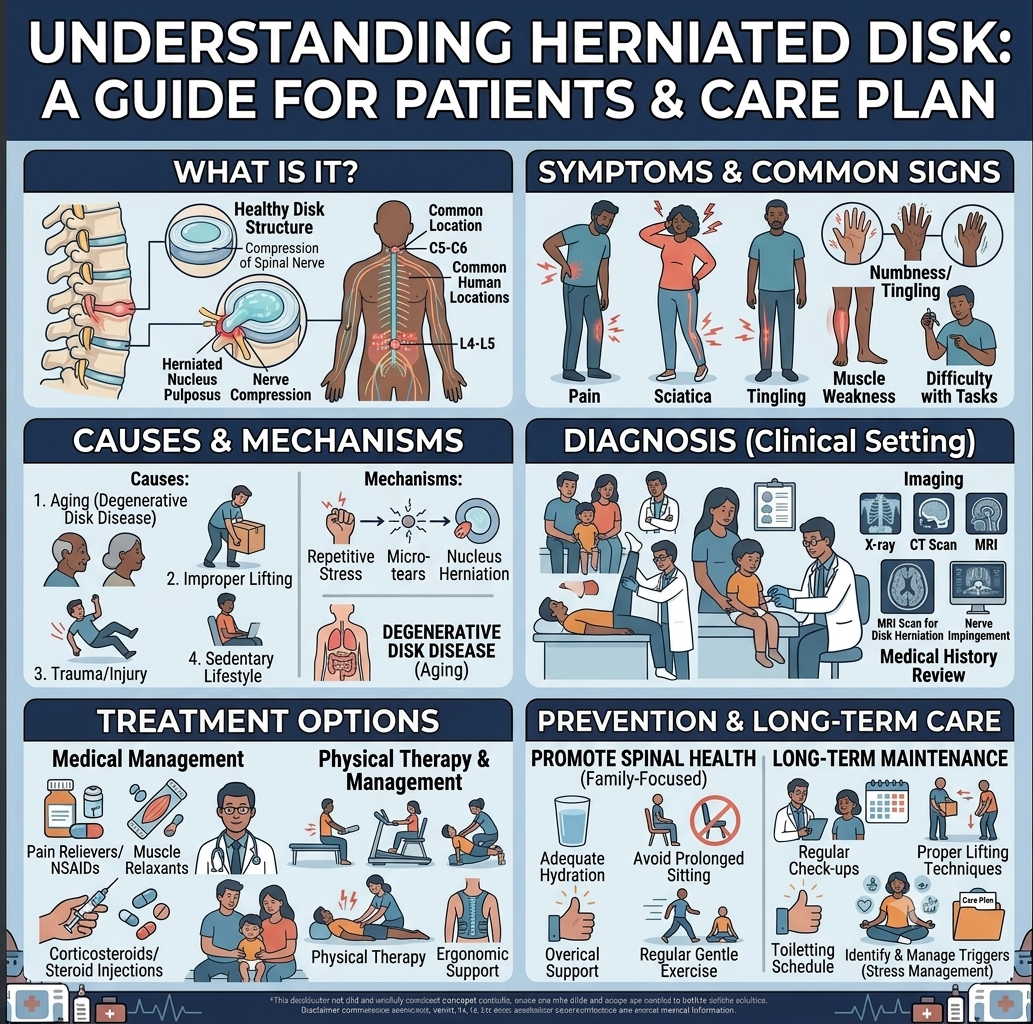
Your spine is made up of bony building blocks called vertebrae. In between each of these bones sits a rubbery cushion called a spinal disk. These disks act as shock absorbers for your back. They consist of a soft, jelly-like center (the nucleus) enclosed in a tough, rubbery outer ring (the annulus). A herniated disk (sometimes called a slipped or ruptured disk) occurs when a crack in the tough outer ring allows some of the soft inner jelly to squeeze out. This can compress or irritate nearby nerves. In contrast, a bulging disk occurs when the outer ring remains intact but swells outward, looking like a hamburger too big for its bun. While bulging disks are common parts of aging, herniated disks are more likely to press on nerves, resulting in localized or radiating pain.
Understanding the Condition
Understanding Herniated and Bulging Disks: Your Guide to Spinal Health
Understanding the Condition
Your spine is made up of bony building blocks called vertebrae. In between each of these bones sits a rubbery cushion called a spinal disk. These disks act as shock absorbers for your back. They consist of a soft, jelly-like center (the nucleus) enclosed in a tough, rubbery outer ring (the annulus). A herniated disk (sometimes called a slipped or ruptured disk) occurs when a crack in the tough outer ring allows some of the soft inner jelly to squeeze out. This can compress or irritate nearby nerves. In contrast, a bulging disk occurs when the outer ring remains intact but swells outward, looking like a hamburger too big for its bun. While bulging disks are common parts of aging, herniated disks are more likely to press on nerves, resulting in localized or radiating pain.
Common Symptoms
Arm or Leg Pain: If the affected disk is in your lower back, you will typically feel intense, sharp, or burning pain in your buttocks, thigh, calf, and sometimes the foot. If the damaged disk is in your neck, the pain will be most intense in your shoulder and arm. This pain may shoot down your arm or leg when you cough, sneeze, or change positions.
Numbness or Tingling: You may experience a pins-and-needles sensation or numbness that radiates down the specific pathway of the pinched nerve.
Asymptomatic Disk Issues: Many people have herniated or bulging disks without realizing it. You might have no pain or discomfort at all, only discovering the issue during an imaging scan for another health concern.
Emergency Symptoms (Cauda Equina Syndrome): In rare cases, a massive herniation can compress the entire bundle of nerves at the base of the spine. Seek immediate emergency care if you experience worsening weakness, a loss of sensation in your inner thighs and groin (saddle anesthesia), or difficulty urinating or controlling your bowels.
Consultation Guide
Which Specialist to Meet
You should consult a primary care doctor first, who may refer you to a neurologist (nerve specialist), a physical medicine and rehabilitation physician (physiatrist), or an orthopedic or neurosurgical spine specialist.
Preparations Before Your Visit
Before your appointment, write down a timeline of your symptoms, what activities make the pain better or worse, and a list of all your current medications. Bring any previous back imaging scans or reports you have.
Book a doctor visit near me
Symptomatic Pain Relief: The use of oral over-the-counter or prescription pain relievers, nonsteroidal anti-inflammatory drugs, muscle relaxants, or nerve pain medications to ease discomfort and reduce muscle spasms. (Duration: A few days to 4 weeks, used only during painful flare-ups.)
Consultation Guide
Muscle Weakness: Nerves send signals to your muscles. When a nerve is compressed, the muscles it serves can weaken. This might cause you to stumble, struggle to lift your foot, or have difficulty holding or lifting items.
An imaging test that uses safe, low-dose radiation to capture pictures of your bones. While it cannot show soft disks directly, it helps rule out other causes of back pain like fractures or bone spurs.
Diagnostic Procedures
Neurological Examination
A physical assessment of your nervous system function, checking your reflexes, muscle strength, walking ability, and sensitivity to touch.
What to Expect
During the exam, the doctor will tap your knees and ankles with a small rubber hammer, test your muscle strength by having you push against their hands, and ask you to walk on your heels or toes.
What to Expect
You will lie, sit, or stand still against a metal plate while an imaging technologist takes quick pictures. This is entirely painless and takes only a few minutes.
CT Scan (Computerized Tomography)
An advanced imaging technique that combines multiple X-ray images from different angles to construct highly detailed, cross-sectional views of your spine and surrounding tissues.
What to Expect
You will lie on a motorized table that slowly slides into a large, ring-shaped scanner. You must remain completely still for 10 to 15 minutes while the machine captures the images.
Electromyography (EMG) and Nerve Conduction Studies
A diagnostic procedure that measures the electrical activity in your muscles and nerves to determine exactly which nerve root is compressed or damaged.
What to Expect
First, a technician will place small electrode stickers on your skin and deliver mild, safe electrical pulses to measure nerve speed. Next, a specialist will insert a very thin needle electrode into specific muscles to record electrical activity. You may feel a slight pinching sensation.
Treatment Options
Medications
Diskectomy: A surgical procedure to remove the damaged, protruding portion of a herniated disk that is pinching a spinal nerve. This is often done using a microscope through a tiny, minimally invasive incision. (Duration: 1 to 2 hours of surgery; 4 to 8 weeks for recovery.)
Laminectomy: A surgery where the doctor removes the bony arch (lamina) on the back of the vertebrae to expand the spinal canal and relieve severe pressure on the spinal cord or nerves. (Duration: 1 to 3 hours of surgery; 6 to 12 weeks for recovery.)
Spinal Fusion: A procedure to permanently join two or more vertebrae together using bone grafts and metal hardware, stabilizing the spine and preventing painful movements. (Duration: 2 to 4 hours of surgery; 3 to 12 months for complete bone fusion.)
Prevention & Long-Term Wellbeing
Home Remedies & Lifestyle Support
Thermal Therapy and Activity Modification: Using cold packs initially to reduce pain and inflammation, followed by heating pads to relax stiff muscles. Staying active within pain-free limits is highly recommended over strict bed rest. (Duration: 1 to 2 weeks for acute flare-ups.)
Physical Therapy: A structured program of stretching, core strengthening, and posture correction designed to support your spine and relieve pressure on irritated nerves. (Duration: 4 to 8 weeks, with lifelong home exercises.)
Core Muscle Strengthening: Incorporate regular low-impact exercises like walking, swimming, and core stabilization routines to build strong trunk muscles that support and protect your spine.
Ergonomic Posture: Maintain a neutral spinal alignment when standing or sitting. Keep your back straight, utilize chairs with good lower-back support, and take frequent breaks to stand and stretch.
Proper Lifting Mechanics: Always bend your knees and hips—not your back—when lifting heavy objects. Keep the load close to your body and avoid twisting your torso while carrying items.
Weight Control: Achieve and maintain a healthy body weight to minimize excess mechanical stress and daily wear on your lower back's spinal disks.
Smoking Cessation: Avoid all tobacco products. Smoking restricts blood and oxygen flow to your spine, causing spinal disks to break down and age more rapidly.
Tags & Topics
Notice an error or need an update?
Help us keep medical information accurate. Report incorrect info or suggest an edit.


