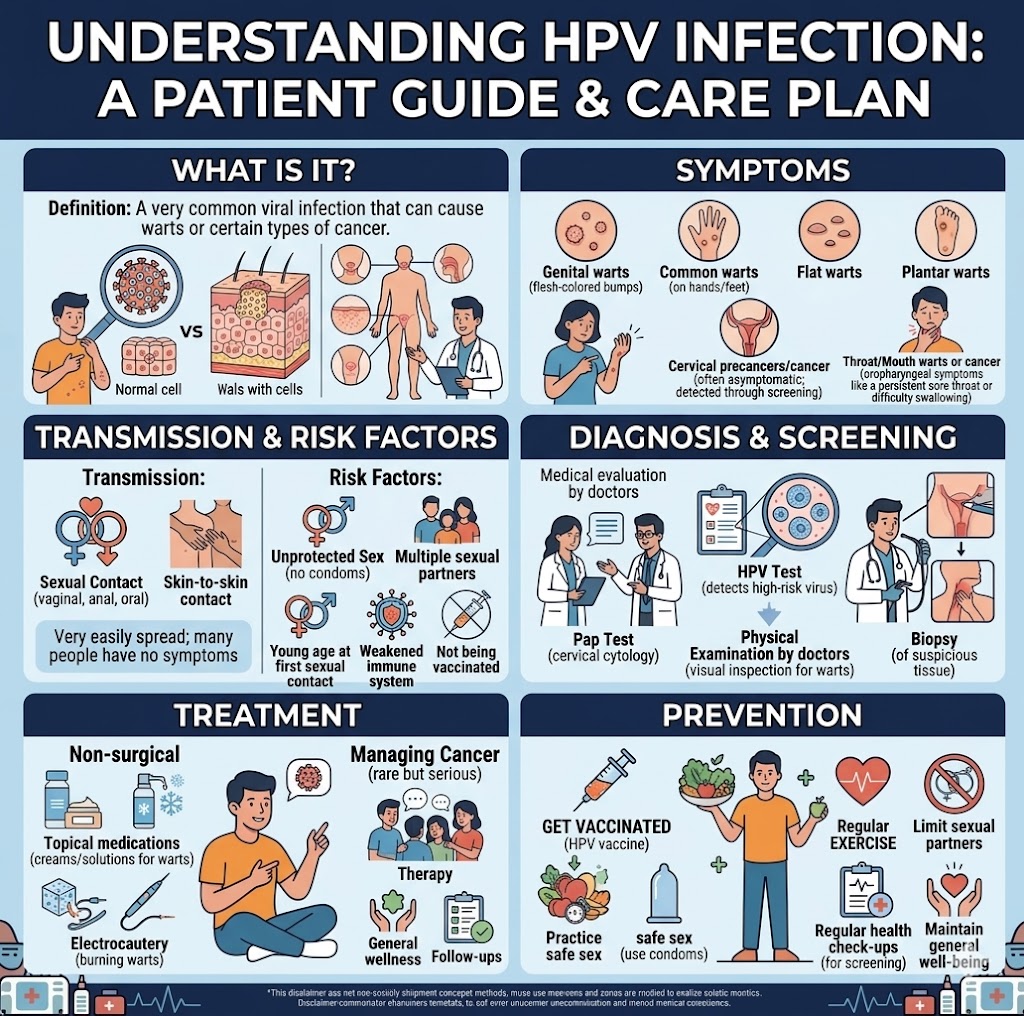
Human Papillomavirus (HPV) is a very common viral infection with over 100 types. While some HPV types cause non-cancerous skin growths called warts, others can lead to certain cancers, including those of the cervix, anus, penis, vagina, vulva, and throat. Most HPV infections are temporary and cleared by the body's immune system without issues. However, persistent infections with high-risk types can lead to cancer. HPV spreads primarily through sexual and skin-to-skin contact. Vaccination offers protection against the HPV types most likely to cause serious health problems.
Understanding the Condition
Common Symptoms
Genital Warts: These appear on or around the genitals and anus. In women, they are often on the vulva, near the anus, or inside the vagina/on the cervix. In men, they can be on the penis, scrotum, or around the anus. They vary in appearance (flat, cauliflower-like, stem-like) and may itch or feel tender, but are usually not painful.
Common Warts: Typically on hands and fingers, these are small, grainy, rough bumps, often appearing flesh-colored, white, pink, or tan.
Plantar Warts: Found on the soles of the feet, these can be painful due to pressure from walking and standing.
Flat Warts: Smaller and smoother than other warts, these usually appear on the face or legs. They are more frequently seen in children and teenagers.
Consultation Guide
Which Specialist to Meet
Self-Examination and Doctor Visits: Be aware of your body and report any new or changing warts, unusual growths, or persistent symptoms (like unexplained pain, bleeding, or voice changes) to your doctor. Regular medical check-ups are important for overall health and early detection.
Consultation Guide
Human Papillomavirus (HPV) is a very common viral infection with over 100 types. While some HPV types cause non-cancerous skin growths called warts, others can lead to certain cancers, including those of the cervix, anus, penis, vagina, vulva, and throat. Most HPV infections are temporary and cleared by the body's immune system without issues. However, persistent infections with high-risk types can lead to cancer. HPV spreads primarily through sexual and skin-to-skin contact. Vaccination offers protection against the HPV types most likely to cause serious health problems.
You will lie on an exam table. A doctor or nurse will insert a tool called a speculum into your vagina to gently hold the vaginal walls apart. Then, a soft brush and a flat scraping device will be used to collect a sample of cells from your cervix. This usually takes only a few seconds and might cause some mild pressure or discomfort, but it is not typically painful.
This test specifically looks for high-risk types of HPV that can cause cervical cancer. It can be done alone or at the same time as a Pap test, often using the same collected cell sample.
Diagnostic Procedures
For initial assessment, general health concerns, or vaccination, consult your Primary Care Physician. Women may need to see a Gynecologist for cervical screenings or genital warts. Men with penile or anal concerns may consult a Urologist or Proctologist. A Dermatologist can address common skin warts. If cancer is suspected or diagnosed, an Oncologist or relevant specialist (e.g., an ENT for throat cancer) will be involved.
Preparations Before Your Visit
Before your appointment, gather your medical history, including any previous HPV tests or abnormal results, and be ready to discuss your sexual health history openly and honestly. Prepare a list of questions you want to ask your doctor. For gynecological exams (like a Pap test), avoid douching, using vaginal medicines or creams, tampons, or having sexual intercourse for at least 24-48 hours prior to the appointment.
Book a doctor visit near me
A doctor examines the skin, including genital and anal areas, to identify characteristic wart growths. Sometimes, a special vinegar solution may be applied to help make warts or other abnormal areas more visible.
What to Expect
During a physical examination, the doctor will visually inspect the affected or at-risk areas. For genital warts, this involves a check of the external genitals and potentially the anal area. This is typically a quick and painless inspection.
This procedure collects cells from the cervix (the lower part of the uterus that connects to the vagina) to screen for cervical cancer and precancerous changes.
What to Expect
What to Expect
The procedure is identical to a Pap test. A speculum is used, and a sample of cells is collected from the cervix. This sample is then sent to a lab to check for the presence of high-risk HPV DNA.
If a doctor finds suspicious growths (like certain warts) or abnormal cervical cells, a small tissue sample is taken and examined under a microscope to confirm a diagnosis or identify cancerous/precancerous cells.
What to Expect
Depending on the location, a local anesthetic will be used to numb the area. A small piece of tissue will then be removed. You might feel some pressure or a brief pinch. For cervical biopsies, this might be done during a colposcopy (a procedure using a magnifying device to view the cervix). The removed tissue is then sent to a lab for analysis.
Close Monitoring: For mild precancerous changes, doctors may recommend regular follow-up tests (e.g., Pap, colposcopy) to see if the changes resolve on their own, which they often do. (Duration: Typically 6-12 months between checks, over 1-2 years.)
Conization (Cone Biopsy): A cone-shaped piece of tissue containing abnormal cells is removed from the cervix, often for more significant changes or diagnosis. (Duration: Single procedure, recovery takes a few weeks.)
Regular Screenings: For individuals with a cervix, regular Pap tests and HPV tests (as recommended by your doctor) are crucial for early detection of precancerous changes and prevention of cervical cancer.
Long-Term Monitoring & Support
Follow-Up for Abnormal Results: If you have had abnormal Pap or HPV test results, it is vital to follow your doctor's recommendations for repeat tests or additional procedures to monitor and manage any precancerous changes effectively.
Treatment Options
Salicylic Acid Preparations: Over-the-counter creams, gels, or patches containing salicylic acid can help remove common warts by slowly peeling away layers. These are not for genital warts. (Duration: Weeks to months of consistent daily application.)
Medical Procedures for Warts
Cryotherapy (Freezing): Liquid nitrogen is applied to freeze the wart, causing it to blister and eventually fall off. (Duration: Typically 1 to 4 sessions, usually a few weeks apart.)
Electrocautery (Burning): Heat is used to burn off the wart. (Duration: Usually a single session.)
Laser Treatment: Intense light beams are used to burn away the wart tissue. (Duration: One or more sessions, depending on the wart.)
Prescription Topical Treatments: Specific creams or solutions applied directly to the wart, either to boost the local immune response or to destroy wart tissue. These are typically prescribed for genital warts. (Duration: Weeks to months, as directed by your doctor.)
Management of Precancerous Changes
Cancer-Specific Treatment: If cancer develops, treatment will depend on the type, location, and stage of cancer. Options may include surgery, radiation therapy, chemotherapy, or a combination. (Duration: Varies significantly, from weeks to many months, depending on the cancer and treatment plan.)
Prevention & Long-Term Wellbeing
Human Papillomavirus (HPV) Infection: Understanding, Prevention, and Care
- Understanding the Condition
Surgical Removal: A doctor cuts out the wart using a scalpel. This is often reserved for larger or stubborn warts. (Duration: Single procedure, recovery takes days to weeks.)
Loop Electrosurgical Excision Procedure (LEEP): A thin wire loop heated by electricity is used to remove abnormal cells from the cervix. (Duration: Single procedure, quick recovery.)
Prevention
HPV Vaccination: Getting vaccinated is the most effective way to prevent HPV infection and related cancers. The vaccine is recommended routinely for children aged 11 or 12, but can be given starting at age 9 and up to age 26. Adults aged 27-45 who were not previously vaccinated should discuss vaccination with their doctor to determine if it's right for them.
Safe Sexual Practices: Using condoms consistently and correctly can reduce the risk of HPV transmission, although they don't offer complete protection as HPV can infect areas not covered by a condom. Limiting the number of sexual partners and knowing your partner's sexual history can also help reduce risk.
Immune System Support: Maintaining a healthy lifestyle through balanced nutrition, regular exercise, adequate sleep, and stress management helps support your body's immune system, which plays a key role in clearing HPV infections and fighting disease.
Tags & Topics
Notice an error or need an update?
Help us keep medical information accurate. Report incorrect info or suggest an edit.


