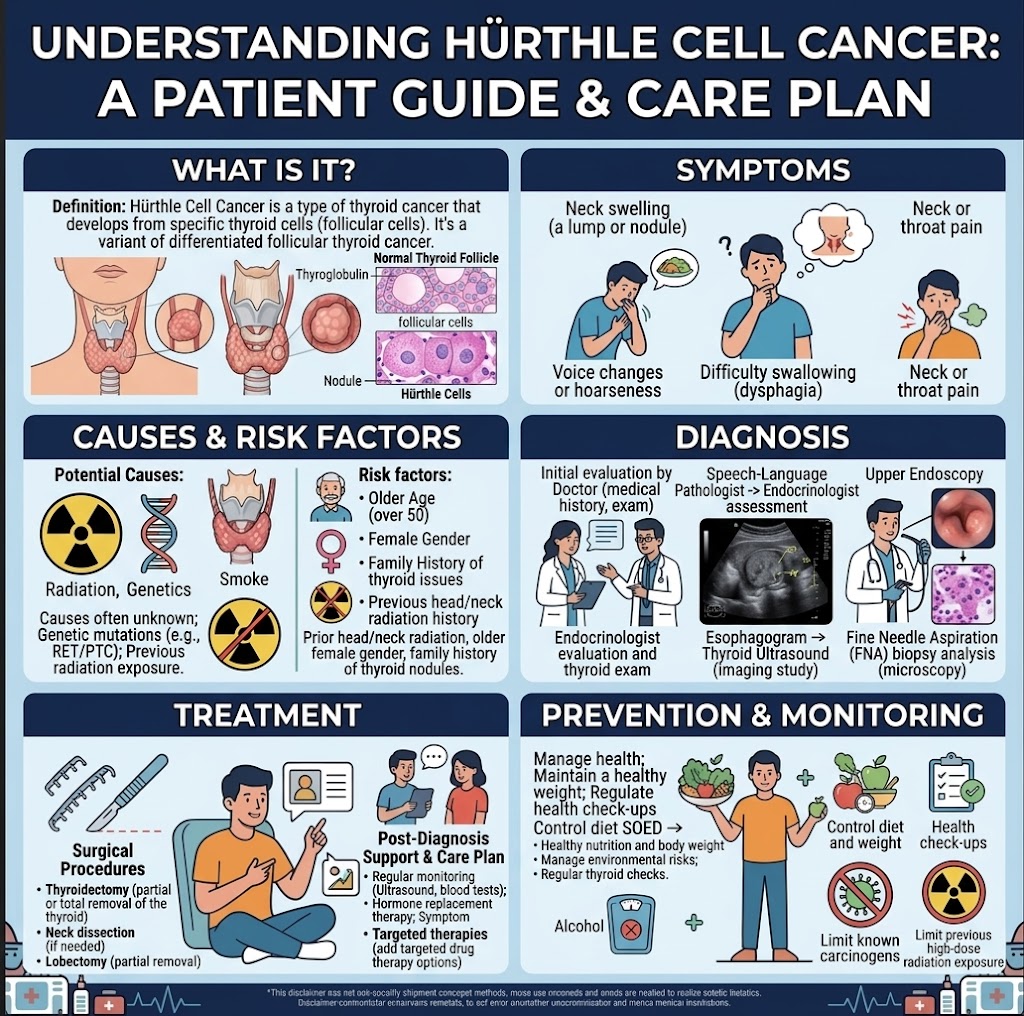
Hürthle cell cancer (HEERT-luh), also called Hürthle cell carcinoma, is a rare cancer affecting the thyroid gland. This butterfly-shaped gland at the base of your neck produces hormones vital for regulating metabolism. Hürthle cell cancer can be more aggressive than other thyroid cancers. The main treatment usually involves surgery to remove the thyroid.
Understanding the Condition
Hurthle Cell Cancer: Patient Guide
Understanding the Condition
Common Symptoms
Neck Lump: A noticeable swelling in the front of the neck.
Neck Pain: Discomfort in the neck area.
Voice Changes: Hoarseness or altered voice.
Difficulty Swallowing: A feeling of obstruction or trouble swallowing.
Difficulty Breathing: Shortness of breath.
Consultation Guide
Which Specialist to Meet
Prepare by listing all your symptoms (when they started, how they've changed), detailing your full medical history (medications, supplements, family history of thyroid issues/cancer), and noting any questions for your doctor.
Book a doctor visit near me
Diagnostic Procedures
An ultrasound uses sound waves to create live images of internal body structures, like the thyroid gland. It helps identify lumps or abnormalities in the neck area.
What to Expect
You'll lie on a table with clear gel applied to your neck. A handheld device (transducer) is moved over the skin, sending sound waves to create images. It's painless, takes 15-30 minutes, and typically requires no special preparation. Wear loose clothing.
CT (Computed Tomography) Scan
A CT scan uses X-rays and a computer to generate detailed cross-sectional images ("slices") of bones, blood vessels, and soft tissues. It helps pinpoint tumor location, assess spread, or guide biopsies.
What to Expect
You'll lie on a table that slides into a doughnut-shaped scanner. You must remain still. A contrast dye might be used for clearer images. The scan takes 10-30 minutes.
PET (Positron Emission Tomography) Scan
A PET scan reveals metabolic activity in tissues. A radioactive tracer is injected, which cancer cells often absorb more due to higher activity, showing as bright spots. It can detect cancer early and is often combined with a CT scan (PET-CT).
What to Expect
After a tracer injection, you'll wait about an hour for it to circulate. Then, you'll lie on a table that slides into a scanner for about 30 minutes, needing to stay very still.
Regular Check-ups: Regular medical check-ups help identify any neck changes early, leading to prompt diagnosis and investigation.
Be Aware of Neck Changes: Monitor for new lumps, swelling, pain, or changes in voice/swallowing. Early detection improves outcomes.
Long-Term Monitoring and Management
Lifelong Hormone Replacement: If your entire thyroid is removed, daily thyroid hormone medication is needed for life. Regular blood tests ensure correct dosage.
Regular Follow-up Appointments: Consistent follow-up with specialists (endocrinologist, oncologist) is crucial. This includes physical exams, blood tests (hormone levels, tumor markers), and periodic imaging scans (ultrasound, CT, PET) to monitor for recurrence.
Emotional Support: Seeking support from family, friends, support groups, or mental health professionals can help cope with the emotional challenges of a cancer diagnosis.
Treatment Options
Hürthle cell cancer (HEERT-luh), also called Hürthle cell carcinoma, is a rare cancer affecting the thyroid gland. This butterfly-shaped gland at the base of your neck produces hormones vital for regulating metabolism. Hürthle cell cancer can be more aggressive than other thyroid cancers. The main treatment usually involves surgery to remove the thyroid.
Start with your primary care doctor. You may then be referred to an endocrinologist (hormone specialist), an ENT (ear, nose, and throat) surgeon, or a general surgeon specializing in neck procedures. An oncologist (cancer specialist) will guide your cancer treatment plan.
Preparations Before Your Visit
Surgical Procedures
Thyroidectomy: Surgical removal of all or part of the thyroid gland. The extent depends on cancer size and spread. (Duration: Surgery takes a few hours, typically with a 1-2 day hospital stay. Total removal requires lifelong daily thyroid hormone replacement.)
Therapies
Radiation Therapy: Uses high-energy beams to destroy cancer cells, targeting them precisely while protecting healthy tissues. Can be external (machine outside body) or internal (implants near cancer). (Duration: Varies; external beam often daily for several weeks, internal therapy might be a single session or shorter period.)
Healthy Lifestyle: A balanced diet, regular exercise, and avoiding smoking/excessive alcohol support overall health, recovery, and long-term well-being post-treatment.
Prevention & Long-Term Wellbeing
Prevention
Tags & Topics
Notice an error or need an update?
Help us keep medical information accurate. Report incorrect info or suggest an edit.


