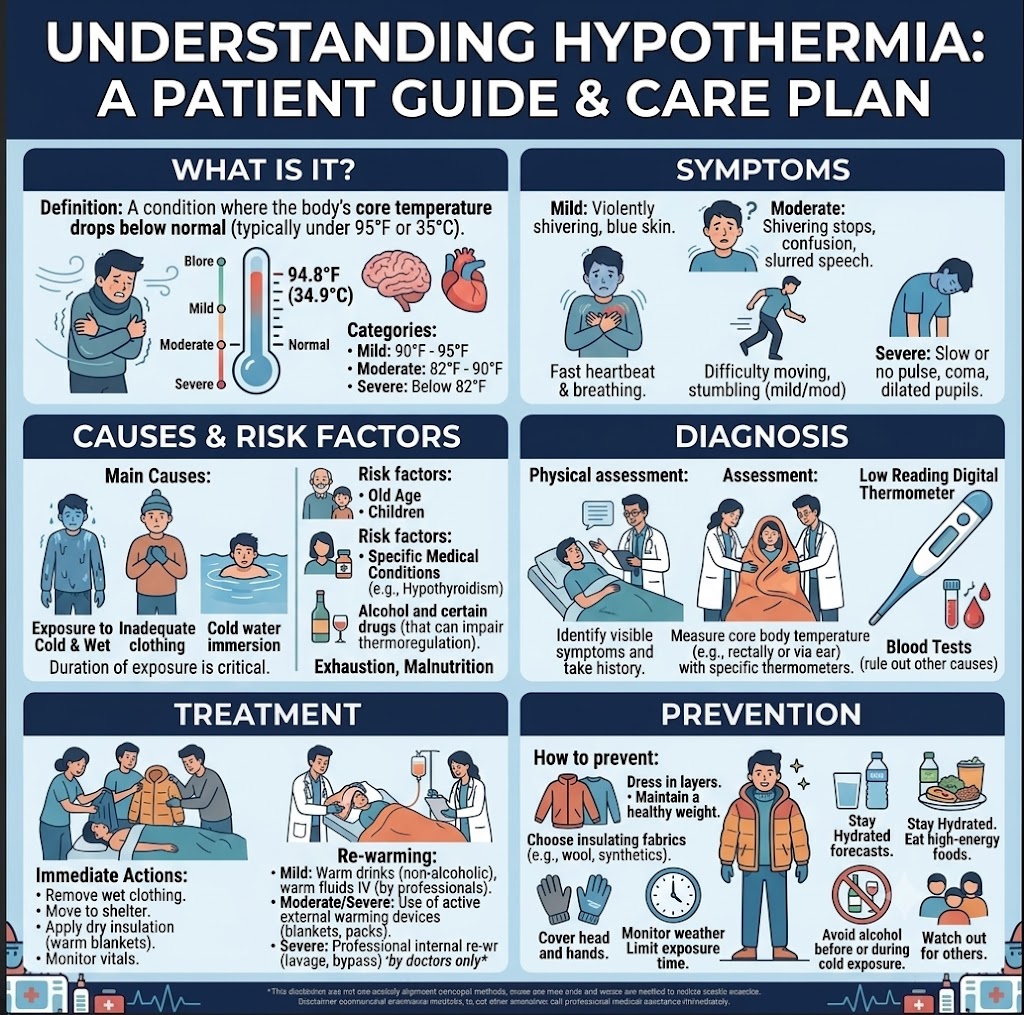
Hypothermia is a serious medical emergency that happens when your body loses heat faster than it can produce it, causing your core body temperature to drop dangerously low, typically below 95 degrees Fahrenheit (35 degrees Celsius). While your normal body temperature is around 98.6°F (37°C), a significant drop affects how vital organs like the heart and brain function. If not treated quickly, hypothermia can lead to heart and breathing failure, and ultimately, death. It commonly results from exposure to cold environments or immersion in cold water. Treatment focuses on safely warming the body back to its normal temperature.
Understanding the Condition
Hypothermia: Understanding and Preventing Dangerous Body Chill
Understanding the Condition
Common Symptoms
Shivering: This is often the first sign, as your body tries to warm itself. It's an automatic response to cold.
Slurred Speech or Mumbling: Difficulty speaking clearly, sounding confused or incoherent.
Slow, Shallow Breathing: Taking fewer breaths or breathing very lightly.
Weak Pulse: Your heartbeat may feel faint or less regular than usual.
Clumsiness or Lack of Coordination: Difficulty with simple movements, stumbling, or appearing uncoordinated.
Drowsiness or Very Low Energy: Feeling extremely tired, sluggish, or wanting to sleep.
Confusion or Memory Loss: Difficulty thinking clearly, remembering things, or knowing where you are.
Loss of Consciousness: Passing out or becoming unresponsive.
Bright Red, Cold Skin (in Infants): Babies may develop skin that looks unusually red and feels cold to the touch, often without shivering.
Consultation Guide
Which Specialist to Meet
If you suspect someone has hypothermia, call emergency services immediately. While waiting for help, gently move the person to a warm, dry place. Remove any wet clothing and cover them with dry blankets or coats. Avoid rubbing or forceful rewarming. If the person is conscious, offer warm, non-alcoholic, non-caffeinated drinks. For a follow-up doctor's visit, be ready to describe when symptoms started, how long the person was exposed to cold, and any other medical conditions or medications they are taking.
Book a doctor visit near me
Consultation Guide
For suspected hypothermia, especially if severe, you should seek immediate medical attention by calling emergency services. Afterwards, a primary care physician can help address any underlying causes or long-term effects. In cases involving severe complications or chronic conditions, you might be referred to specialists like a cardiologist (heart specialist), pulmonologist (lung specialist), neurologist (brain and nervous system specialist), or endocrinologist (hormone specialist).
Preparations Before Your Visit
Diagnostic Procedures
Core Body Temperature Measurement
This is the most critical diagnostic step to confirm hypothermia. A standard oral thermometer may not be accurate enough for low temperatures. Medical professionals will use specialized thermometers.
What to Expect
Your temperature will be taken using a special low-reading thermometer, usually rectally (inserted into the rectum) or esophageal (inserted through the nose into the esophagus) for the most accurate core body temperature reading. This process is quick and may feel a little uncomfortable but is essential for diagnosis.
Blood tests can help assess the severity of hypothermia, check for complications like electrolyte imbalances, kidney function issues, or blood clotting problems, and identify any underlying medical conditions that might contribute to cold sensitivity.
What to Expect
A healthcare professional will draw a small sample of blood, usually from a vein in your arm. You might feel a brief pinch or sting. The blood is then sent to a lab for analysis.
Electrocardiogram (ECG or EKG)
An ECG measures the electrical activity of your heart. Hypothermia can affect heart rhythm and function, so an ECG helps doctors monitor for any dangerous changes or complications.
What to Expect
Small sticky patches (electrodes) will be placed on your chest, arms, and legs. These are connected to a machine that records your heart's electrical signals. The test is painless and takes only a few minutes. You'll simply lie still while the recording is made.
Imaging Tests (e.g., X-ray)
In some cases, imaging tests might be used to check for complications like frostbite, tissue damage, or other injuries sustained during cold exposure.
What to Expect
Depending on the suspected complication, an X-ray or other imaging (like an ultrasound) might be performed. For an X-ray, you will be positioned to capture images of the affected body part. It's a quick, painless procedure.
Treatment Options
Hypothermia is a serious medical emergency that happens when your body loses heat faster than it can produce it, causing your core body temperature to drop dangerously low, typically below 95 degrees Fahrenheit (35 degrees Celsius). While your normal body temperature is around 98.6°F (37°C), a significant drop affects how vital organs like the heart and brain function. If not treated quickly, hypothermia can lead to heart and breathing failure, and ultimately, death. It commonly results from exposure to cold environments or immersion in cold water. Treatment focuses on safely warming the body back to its normal temperature.
Emergency Care and Rewarming
Extracorporeal Membrane Oxygenation (ECMO): For severe hypothermia, especially when the heart and lungs are struggling or have stopped, ECMO is a life-support treatment. Blood is pumped out of the body, warmed, oxygenated by a machine, and then returned, allowing the heart and lungs to rest and recover. This is a highly specialized procedure. (Duration: Days to weeks, depending on recovery and underlying conditions.)
Medication Review: Discuss your medications with your doctor to ensure none are contributing to cold sensitivity or interfering with your body's temperature regulation. Adjustments may be necessary.
Prevention & Long-Term Wellbeing
Removing Wet Clothing and Insulation: The first step is to get the person out of the cold environment and remove any wet clothing, replacing it with warm, dry blankets, towels, or coats to stop further heat loss. (Duration: Initial step, ongoing throughout recovery.)
Warm Beverages and Sugary Foods: If the person is conscious and able to swallow, offering warm (non-alcoholic, non-caffeinated) drinks and easily digestible sugary foods can help generate internal warmth and provide energy. (Duration: As needed, during the initial stages of recovery.)
External Rewarming: This involves using warm blankets, heat packs (applied to the neck, chest, and groin), and placing the person in a warm room. Shivering is a natural rewarming mechanism that should not be suppressed. (Duration: Hours to days, depending on severity.)
Warmed Intravenous (IV) Fluids: Healthcare providers can administer warmed fluids directly into a vein to help warm the body from the inside and address dehydration. (Duration: Hours to days, as medically required.)
Warm, Humidified Oxygen: Providing warm and humidified oxygen through a mask or nasal tube helps warm the airways and core body temperature. (Duration: Hours to days, as medically required.)
Bladder or Stomach Lavage: In more severe cases, doctors might warm saline solution and use tubes to flush warm fluid into the bladder or stomach to transfer heat to the core of the body. (Duration: Hours, performed until core temperature rises.)
Prevention
Cover Up: Wear a hat, scarf, and mittens (better than gloves for retaining heat) to prevent heat loss from your head, face, neck, and hands. Most body heat escapes from unprotected areas.
Avoid Overexertion: Limit activities that make you sweat heavily. Wet clothing loses its insulating properties, causing your body to lose heat much faster in cold weather.
Dress in Layers: Wear loose-fitting, lightweight clothing in multiple layers. An outer layer of tightly woven, water-repellent material provides wind protection. Inner layers of wool, silk, or synthetic materials like polypropylene retain body heat better than cotton.
Stay Dry: Keep your clothing and yourself as dry as possible. Change out of wet clothes immediately. Pay special attention to keeping your hands and feet dry, as they are prone to getting wet.
Protect Children: Dress infants and young children in one more layer than an adult would wear. Bring them indoors if they shiver or to warm up frequently when playing outside. Do not let babies sleep in cold rooms.
Limit Alcohol and Drugs in Cold: Alcohol and certain drugs impair judgment and make your body lose heat faster, increasing the risk of hypothermia. Avoid their use in cold conditions.
Maintain a Warm Home Environment: Ensure your home is adequately heated, especially if you are elderly or have conditions that make you sensitive to cold.
Long-Term Wellbeing
Regular Check-ups: After a hypothermia episode, regular medical check-ups can help monitor your recovery and detect any lingering health issues or underlying conditions that might increase your risk.
Address Underlying Medical Conditions: Work with your doctor to manage chronic conditions like diabetes, thyroid disorders, or circulatory problems that can affect your body's ability to regulate temperature.
Nutritional Support: Maintain a balanced diet to ensure proper nutrition, which is vital for overall health and the body's ability to generate and maintain heat. Address any issues like poor nutrition or eating disorders.
Awareness and Education: Educate yourself and your loved ones about the signs and dangers of hypothermia, especially for at-risk individuals like the elderly, very young children, or those with certain mental or physical conditions.
Tags & Topics
Notice an error or need an update?
Help us keep medical information accurate. Report incorrect info or suggest an edit.


