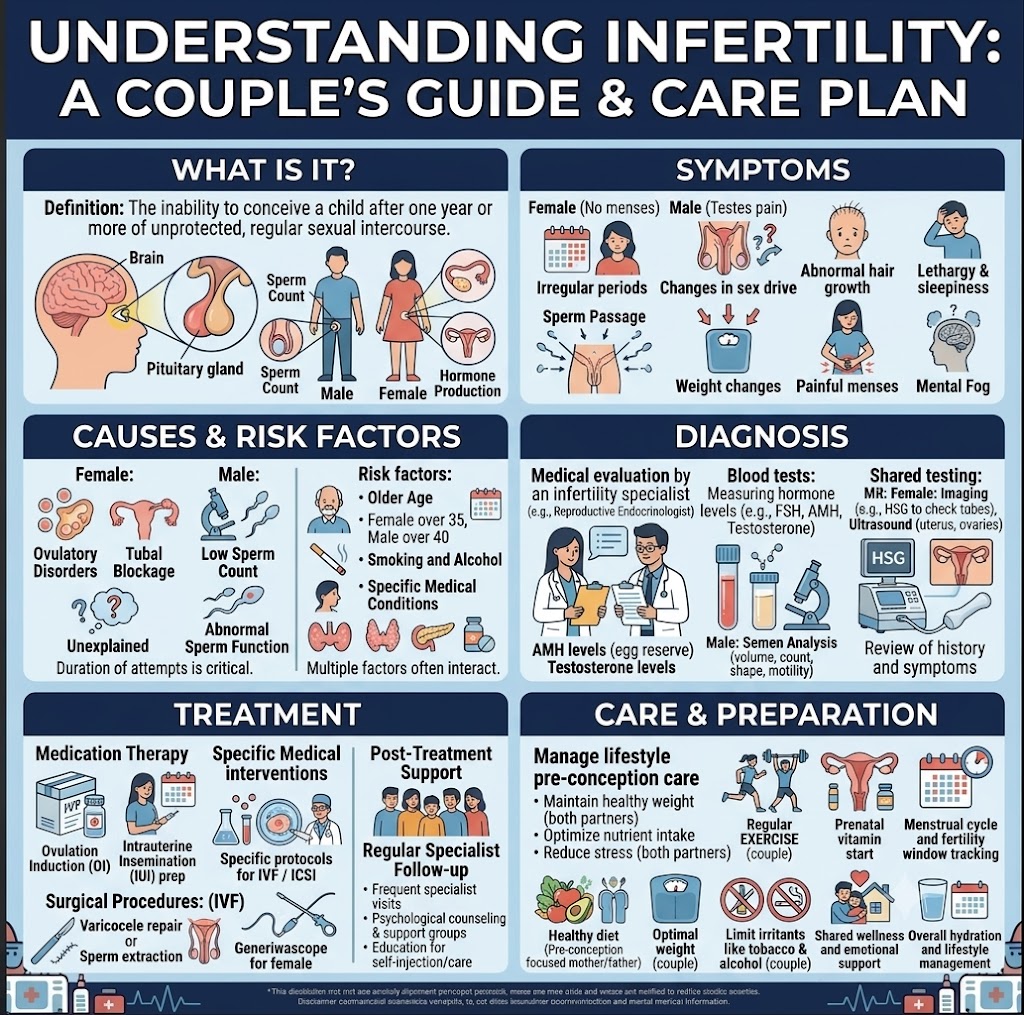
Infertility is a medical term used when a couple is unable to achieve pregnancy after frequent, unprotected sexual intercourse for at least one year (or six months if the woman is 35 or older). This challenge affects millions globally and can stem from health issues in either partner, or a combination of factors. Many safe and effective treatments are available to improve the chances of conception.
Understanding the Condition
Understanding Infertility: A Guide for Non-Medical Persons
Understanding the Condition
Common Symptoms
Difficulty Conceiving: The primary and often only symptom of infertility is not getting pregnant despite regular attempts.
Irregular Menstrual Periods (Women): Some women experiencing infertility may have menstrual cycles that are unpredictable, too short, too long, very painful, or absent altogether.
Hormonal Imbalance Symptoms (Men): Certain men with infertility might notice signs of hormonal issues, such as changes in hair growth patterns or problems with sexual function.
Consultation Guide
Which Specialist to Meet
For concerns about infertility, you should consult with a primary care provider, an obstetrician-gynecologist, a urologist (for male fertility issues), or a reproductive endocrinologist (a fertility specialist). If genetic factors are suspected, a medical geneticist or genetic counselor may also be recommended.
Preparations Before Your Visit
Diagnostic Procedures
Pelvic Exam (for women)
A physical examination to check the health of female reproductive organs, including the vulva, vagina, cervix, uterus, and ovaries. It can help identify signs of infections, growths like uterine fibroids or polyps, or other abnormalities.
What to Expect
You will lie on an exam table with your feet in stirrups. The doctor will visually inspect the external genitals, then use a speculum to gently open the vagina for a clear view of the cervix. A Pap test for cervical cancer may be performed by taking a small cell sample. The doctor will then manually feel the internal organs by placing gloved fingers into the vagina while pressing on the abdomen.
Semen Analysis (for men)
This test evaluates the quantity and quality of sperm. It measures sperm count, movement (motility), shape (morphology), and other characteristics of the semen.
What to Expect
You will be asked to provide a semen sample, usually by masturbating into a sterile container at the clinic or at home. The sample needs to be delivered to the lab within a specific timeframe (typically within an hour) to ensure accuracy. The lab then analyzes the sample under a microscope.
Hormone Testing (for men and women)
Blood tests are used to measure levels of various hormones crucial for reproduction, such as follicle-stimulating hormone (FSH), luteinizing hormone (LH), estrogen, progesterone, testosterone, thyroid hormones, and prolactin. These help identify hormonal imbalances or ovulation problems.
What to Expect
A healthcare professional will draw a blood sample, usually from a vein in your arm. This is a quick procedure and may involve a slight pinch. Depending on the specific hormone being tested, the blood draw might need to occur at a particular time in the menstrual cycle for women.
Ovulation Testing (for women)
Checks if and when ovulation is occurring. This can involve at-home ovulation predictor kits, blood tests for progesterone levels, or ultrasound monitoring of ovarian follicles.
What to Expect
At-home kits involve testing urine daily. Blood tests involve drawing blood samples. For ultrasound monitoring, a transvaginal ultrasound (a small probe inserted into the vagina) is used to visualize the ovaries and measure follicle growth, typically over several days.
Hysterosalpingography (HSG) (for women)
An X-ray procedure that uses a special dye to visualize the uterus and fallopian tubes. It helps check for blockages in the fallopian tubes and abnormalities in the shape or lining of the uterus.
What to Expect
You will lie on an X-ray table. A speculum will be inserted into the vagina to visualize the cervix. A small tube (catheter) is then inserted through the cervix, and a liquid dye is injected. X-ray images are taken as the dye fills the uterus and flows through the fallopian tubes. You might experience cramping or discomfort during the procedure.
Ultrasound (for women)
Uses sound waves to create images of the uterus, ovaries, and fallopian tubes. It can detect uterine fibroids, ovarian cysts, polyps, and other structural issues.
What to Expect
A transvaginal ultrasound is often used, where a slender transducer (probe) is gently inserted into the vagina. This provides clearer images of the pelvic organs. The procedure is generally not painful, though some pressure may be felt.
Genetic Testing (for men and women)
Analyzes your DNA to identify changes (mutations) in genes that could be causing infertility or increasing the risk of passing on genetic conditions.
What to Expect
This typically involves providing a blood sample or a cheek swab. The sample is sent to a lab for analysis. Before testing, a discussion with a genetic counselor can help you understand the potential implications of the results for your health and future family planning.
Hormone Therapies: Medications to address hormonal imbalances in men or women, such as low testosterone in men or thyroid issues. (Duration: Can range from several weeks to months, depending on the specific hormone and condition.)
Treatment Options
Infertility is a medical term used when a couple is unable to achieve pregnancy after frequent, unprotected sexual intercourse for at least one year (or six months if the woman is 35 or older). This challenge affects millions globally and can stem from health issues in either partner, or a combination of factors. Many safe and effective treatments are available to improve the chances of conception.
Before your visit, it's helpful to track how long you've been trying to conceive, your menstrual cycle history, and any relevant medical conditions or past surgeries for both partners. Be prepared to discuss your lifestyle habits and any medications you or your partner are currently taking.
Book a doctor visit near me
Medications
Ovulation-Stimulating Medications: Drugs designed to stimulate the ovaries to produce and release eggs. These are often used for women with ovulation disorders. (Duration: Typically taken for a few cycles, often alongside monitoring.)
Surgery for Endometriosis or Fibroids (for women): Procedures to remove tissue similar to the uterine lining growing outside the uterus (endometriosis) or non-cancerous growths in the uterus (fibroids) that may impede conception. (Duration: A single surgical procedure, with recovery varying from days to weeks.)
Varicocelectomy (for men): Surgery to repair enlarged veins in the scrotum (varicocele) which can affect sperm quality. (Duration: A single surgical procedure, with recovery typically a few days to a week.)
Treatment for Seminal Plasma Hypersensitivity (Semen Allergy): If a woman has an immune reaction to proteins in semen, treatment may involve reducing sensitivity to the partner's semen through repeated exposure, or using assisted reproductive techniques where sperm is washed free of these proteins. (Duration: Sensitivity reduction may take several weeks or months. Assisted reproductive techniques follow specific cycles (e.g., IUI for one cycle, IVF for 2-3 weeks per cycle).)
Assisted Reproductive Technology (ART)
Intrauterine Insemination (IUI): A procedure where specially prepared sperm is placed directly into the uterus around the time of ovulation. (Duration: Each IUI cycle takes about 2-3 weeks, aligning with the woman's menstrual cycle.)
In Vitro Fertilization (IVF): A complex process where eggs are collected from the ovaries and fertilized by sperm in a lab. The resulting embryos are then transferred into the uterus. (Duration: One full IVF cycle typically takes 2-3 weeks, though it can be longer if steps are separated.)
Avoid Tobacco and Illicit Drugs: Smoking (cigarettes, marijuana) and using illicit drugs can negatively impact fertility in both men and women, reduce treatment effectiveness, and increase miscarriage risk. Quitting is highly recommended.
Limit Alcohol and Caffeine: Heavy alcohol use can reduce sperm count and movement in men, and may contribute to infertility in women. For women, no safe level of alcohol is known when trying to conceive or during pregnancy. Moderate caffeine intake is generally advised; discuss specific limits with your healthcare provider.
Manage Exercise Levels: Regular, moderate exercise is beneficial for overall health and fertility. However, excessive or strenuous exercise in women who are not overweight can sometimes disrupt ovulation.
Minimize Exposure to Environmental Toxins: Avoid frequent exposure to pesticides, industrial chemicals, heavy metals (lead, cadmium, mercury), and radiation, as these can negatively impact fertility in both partners.
Stay Cool (for men): Avoid frequent hot baths, saunas, or prolonged exposure to high temperatures, as elevated scrotal temperatures can temporarily impair sperm production and movement.
Review Medications: Discuss all regular medications with your healthcare team, as some drugs (e.g., for bacterial infections, high blood pressure, depression) can potentially affect fertility. Do not stop prescription medications without medical advice.
Time Intercourse: For couples with regular menstrual cycles, having sex daily during the fertile window (5-7 days before ovulation until two days after) can maximize chances of conception.
Prevention & Long-Term Wellbeing
Fallopian Tube Repair (for women): Surgical correction or opening of blocked or damaged fallopian tubes to allow eggs and sperm to meet. (Duration: A single surgical procedure, with recovery varying.)
Vasectomy Reversal (for men): A surgical procedure to reconnect the tubes that carry sperm, aiming to restore sperm to the semen after a previous vasectomy. (Duration: A single surgical procedure, with recovery varying. Pregnancy rates after reversal vary widely (30-90%) based on several factors.)
Prevention and Lifestyle
Maintain a Healthy Weight: Being significantly overweight or underweight can affect hormone balance and ovulation in women, and sperm quality in men. Aim for a healthy body mass index (BMI) through balanced diet and regular exercise.
Tags & Topics
Notice an error or need an update?
Help us keep medical information accurate. Report incorrect info or suggest an edit.


