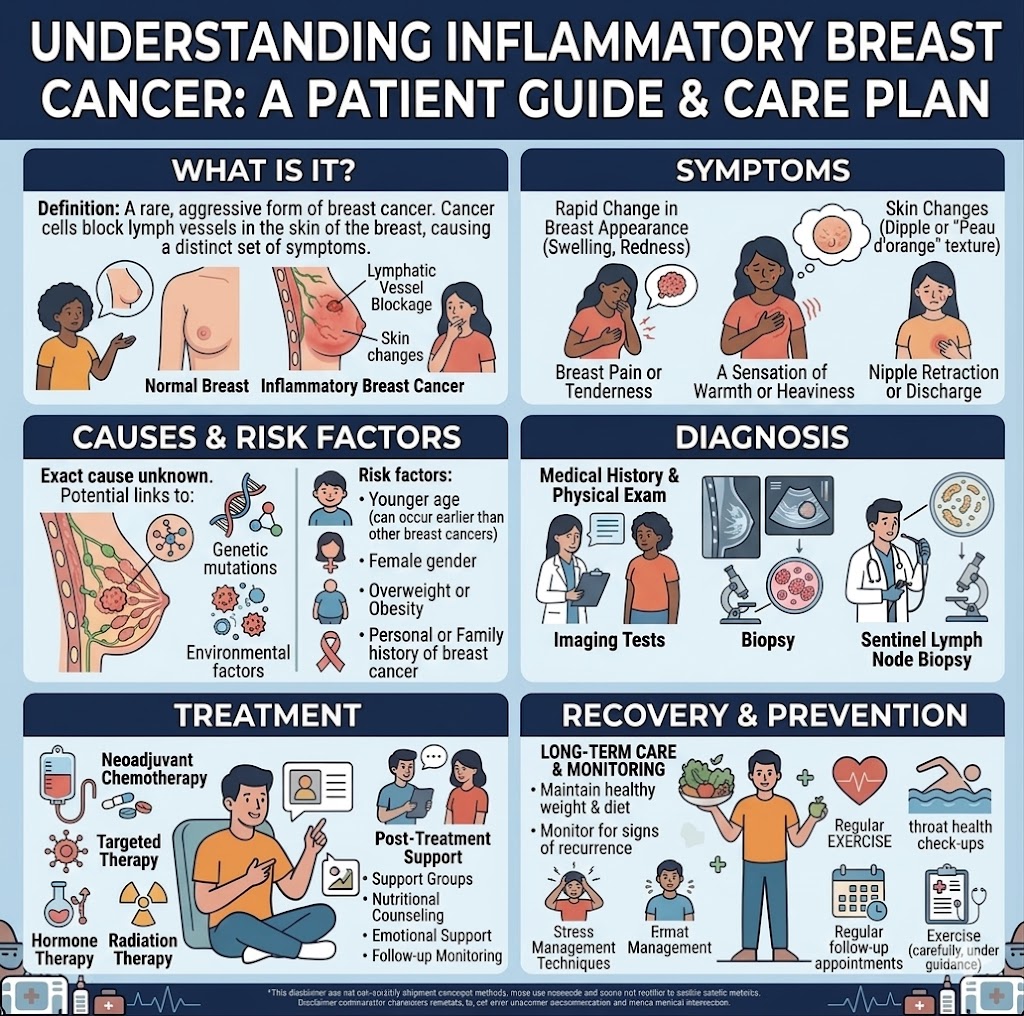
Inflammatory breast cancer (IBC) is a rare but aggressive form of breast cancer that causes the breast to swell and its skin to change. Unlike more common breast cancers, IBC often doesn't form a noticeable lump. Instead, cancer cells grow and spread rapidly, clogging the tiny lymphatic vessels in the breast skin. This blockage leads to the characteristic swollen, red, or purple appearance, which can be mistaken for a common breast infection. IBC is considered 'locally advanced' because it has typically spread to nearby tissues and potentially lymph nodes by the time it's diagnosed.
Understanding the Condition
Inflammatory Breast Cancer: A Guide for Non-Medical Individuals
Understanding the Condition
Common Symptoms
Rapid Change in Appearance: Noticeable and fast changes in one breast's look, typically over several weeks.
Breast Swelling or Heaviness: One breast becoming unusually thick, heavy, or swollen.
Skin Color Changes: The breast skin may appear red, purple, pink, or bruised.
Unusual Warmth: The affected breast feeling unusually warm to the touch.
Dimpled or Ridged Skin: Skin changes resembling an orange peel texture, with dimpling or ridges.
Tenderness, Pain, or Aching: Discomfort, pain, or aching sensation in the breast.
Enlarged Lymph Nodes: Swollen glands felt under the arm, above the collarbone, or below the collarbone.
Nipple Changes: The nipple becoming flattened or turning inward on the affected breast.
Consultation Guide
Which Specialist to Meet
Before your visit, make a list of all your symptoms, including when they started and how they've changed. Be prepared to discuss your medical history, any medications you're taking, and any questions you have. It's also helpful to note if you have a family history of breast cancer.
Book a doctor visit near me
Chemotherapy: Drug treatment using powerful chemicals to kill fast-growing cancer cells throughout the body. For breast cancer, these drugs are typically injected into a vein or taken orally as pills. Chemotherapy may be given before surgery to shrink the tumor (neoadjuvant chemotherapy) or after surgery to destroy any remaining cancer cells and reduce recurrence risk (adjuvant chemotherapy). It can also help manage symptoms and extend life in advanced cases. (Duration: Cycles of treatment over several weeks or months, potentially ongoing for advanced disease.)
Radiation Therapy: Treatment that uses high-energy beams (like X-rays or protons) to kill cancer cells or prevent them from growing. It is often used after surgery to destroy any remaining cancer cells in the breast area and reduce the risk of recurrence. It can also provide symptom relief for cancer that has spread. (Duration: Daily treatments over several weeks, typically 5-7 weeks.)
Discuss Hormone Therapy Risks: If considering combination hormone therapy for menopausal symptoms, talk to your healthcare professional about the benefits and risks, aiming for the lowest dose for the shortest duration possible to reduce breast cancer risk.
Long-Term Monitoring and Survivorship
Symptom Management: Continue to work with your healthcare team to manage any lingering physical or emotional side effects of cancer and its treatment, ensuring ongoing comfort and quality of life.
Consultation Guide
Inflammatory breast cancer (IBC) is a rare but aggressive form of breast cancer that causes the breast to swell and its skin to change. Unlike more common breast cancers, IBC often doesn't form a noticeable lump. Instead, cancer cells grow and spread rapidly, clogging the tiny lymphatic vessels in the breast skin. This blockage leads to the characteristic swollen, red, or purple appearance, which can be mistaken for a common breast infection. IBC is considered 'locally advanced' because it has typically spread to nearby tissues and potentially lymph nodes by the time it's diagnosed.
Diagnostic Procedures
You should consult with your primary care provider immediately if you notice any changes. They can refer you to a breast specialist or an oncologist (cancer specialist) for further evaluation and diagnosis.
Preparations Before Your Visit
A mammogram is an X-ray of the breast tissue used to screen for or investigate breast cancer. It can detect changes in breast tissue that might indicate cancer.
What to Expect
You will stand in front of a specialized X-ray machine. A technician will place one of your breasts on a platform and gently compress it between two firm surfaces to spread out the tissue. This allows for clear images. You may feel some pressure or discomfort during the compression. Black-and-white images are captured and reviewed by a healthcare professional.
An ultrasound uses sound waves to create images of structures inside the body. For breast concerns, it can help differentiate between solid masses and fluid-filled cysts, or provide a clearer view of dense breast tissue.
What to Expect
You will lie down, and a gel will be applied to your breast area. A healthcare professional will then press a small, hand-held device called a transducer against your skin, moving it around the area of concern. The transducer emits sound waves that bounce off internal structures, creating real-time images on a screen. The procedure is generally painless and takes about 15-30 minutes.
Breast MRI (Magnetic Resonance Imaging)
Breast MRI uses powerful magnets and radio waves to create detailed images of the breast. It's often used after a cancer diagnosis to determine the extent of the cancer or to screen high-risk individuals.
What to Expect
You will lie on your stomach on a padded table that slides into a large, tunnel-like MRI machine. Your breasts will rest in a cushioned coil. You will need to remain very still during the scan, which can take 30-60 minutes. You might hear loud banging or buzzing noises from the machine, and earplugs or headphones may be provided. A contrast dye might be injected into a vein to make tissues more visible.
CT Scan (Computed Tomography Scan)
A CT scan uses X-rays and computer processing to create detailed cross-sectional images (slices) of the body. It can help determine if cancer has spread to other parts of the body.
What to Expect
You will lie on a motorized table that slides into a large, donut-shaped machine. The table will move through the scanner as the X-ray tube rotates around you, capturing multiple images. You may be asked to hold your breath briefly at certain times. A contrast dye might be given orally or injected intravenously to enhance image clarity. The scan is typically quick, lasting 10-30 minutes.
A bone scan uses a small amount of radioactive substance to detect changes in bone metabolism. It's used to find the source of bone pain or to see if cancer has spread to the bones.
What to Expect
A radioactive tracer will be injected into a vein, usually in your arm. You will then wait several hours for the tracer to be absorbed by your bones. During this waiting period, you might be encouraged to drink fluids. Afterward, you will lie on a table while a special camera scans your entire body, detecting areas where the tracer has accumulated (called 'hot spots'). The scan itself takes about 30-60 minutes.
Supportive Therapy and Survivorship Services: Services aimed at improving quality of life during and after cancer treatment. This includes managing physical and emotional side effects of treatment, follow-up tests to monitor for recurrence, and help with lingering side effects. (Duration: Throughout and after active treatment, potentially for many years.)
Treatment Options
Surgical Procedures
Mastectomy: Surgery to remove all breast tissue from one or both breasts. For inflammatory breast cancer, this often means removing the entire breast, nipple, areola, and skin (total mastectomy). Some newer techniques may leave certain parts of the breast for improved appearance, depending on the individual case. Breast reconstruction, creating a new breast shape, is an optional procedure that can be done at the same time or later. (Duration: A single operation, but breast reconstruction may involve multiple surgeries over time.)
Lumpectomy (Breast-Conserving Surgery): Removal of the cancer and a small amount of surrounding healthy tissue. This procedure is less common for inflammatory breast cancer, which often requires more extensive removal of tissue due to its diffuse nature. (Duration: A single operation, followed by additional therapies.)
Therapies and Medications
Follow-Up Care: Regular follow-up appointments with your care team are crucial to monitor for any signs of recurrence and manage long-term side effects from treatment.
Prevention & Long-Term Wellbeing
Prevention and Risk Reduction
Regular Screening Discussions: Talk to your doctor about when to begin breast cancer screening, including mammograms, and discuss the benefits and risks to determine the right screening plan for you.
Breast Awareness: Become familiar with the normal look and feel of your breasts by occasionally inspecting them. Report any new changes, lumps, or unusual signs to a healthcare professional immediately.
Limit Alcohol Intake: If you choose to drink alcohol, limit consumption to no more than one drink per day. For breast cancer prevention, avoiding alcohol completely may be considered for those with high risk.
Engage in Regular Physical Activity: Aim for at least 30 minutes of moderate exercise on most days of the week. Consult your doctor before starting a new exercise regimen.
Maintain a Healthy Weight: Work to maintain a healthy weight. If you are overweight or obese, discuss healthy weight loss strategies (fewer calories, increased exercise) with your healthcare provider.
Tags & Topics
Notice an error or need an update?
Help us keep medical information accurate. Report incorrect info or suggest an edit.


