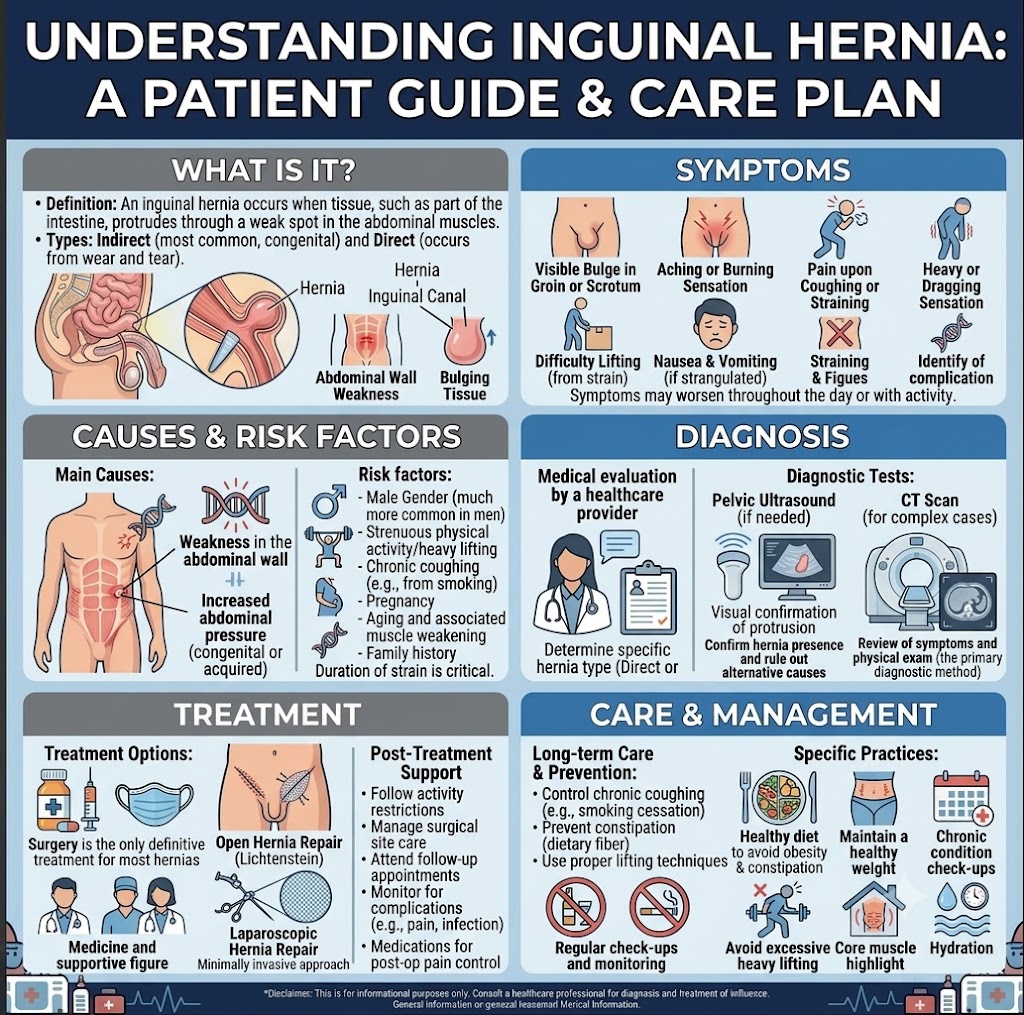
An inguinal hernia occurs when soft tissue, such as part of the intestine, pushes through a weak spot in the lower abdominal muscles. This often forms a noticeable bulge in the groin area, which can be painful, especially when coughing, bending, or lifting. While some hernias cause no pain, they don't heal on their own and can lead to serious complications. Surgery is commonly recommended for hernias causing discomfort or growing in size, as it's a very common and effective repair.
Understanding the Condition
Inguinal Hernia: Understanding and Managing a Common Condition
Understanding the Condition
Common Symptoms
Groin Bulge: A visible or palpable lump in the groin, often more noticeable when standing or straining.
Discomfort/Pain: A burning, aching, or heavy sensation in the groin, worsened by coughing, bending, lifting, or prolonged standing. Pain may extend to the scrotum.
List all symptoms, including onset and aggravating factors. Provide your complete medical history and a list of all current medications. Prepare questions for your doctor. Wear comfortable clothing, as a physical exam will be conducted.
Book a doctor visit near me
Watchful Waiting: For small, non-symptomatic hernias, regular monitoring by a doctor may be recommended instead of immediate surgery. (Duration: Ongoing, with periodic medical review.)
Hernia Truss: An external support device that applies gentle pressure to hold the hernia in place, offering temporary relief from discomfort. Not a cure, use only under medical guidance. (Duration: Worn as needed for symptom relief.)
Over-the-Counter Pain Relievers: Medications available without a prescription to help manage mild pain or discomfort. (Duration: As needed for symptoms.)
Consultation Guide
An inguinal hernia occurs when soft tissue, such as part of the intestine, pushes through a weak spot in the lower abdominal muscles. This often forms a noticeable bulge in the groin area, which can be painful, especially when coughing, bending, or lifting. While some hernias cause no pain, they don't heal on their own and can lead to serious complications. Surgery is commonly recommended for hernias causing discomfort or growing in size, as it's a very common and effective repair.
Painless Hernia: Many hernias, especially small ones, may cause no pain.
Newborns/Children: Bulge seen primarily when crying, coughing, or straining. May cause irritability or reduced appetite. In older children, more noticeable with straining or standing.
Emergency Signs (Seek immediate care): If the bulge cannot be gently pushed back into the abdomen (incarcerated hernia), or if you experience severe, sudden pain, fever, nausea/vomiting, or the bulge turns red, purple, or dark (strangulated hernia). These indicate a cut-off blood supply and are medical emergencies.
Consultation Guide
Which Specialist to Meet
Diagnostic Procedures
Consult your primary care doctor for an initial assessment, who can then refer you to a general surgeon for diagnosis and treatment.
Preparations Before Your Visit
Doctor inspects and gently feels your groin while you stand and lie down, checking for a bulge.
What to Expect
You'll stand while the doctor visually inspects and presses on your groin. You may be asked to cough or strain to make the hernia more evident. For men, a finger may be placed in the scrotum to feel for the hernia. Quick and usually minimally uncomfortable.
Uses sound waves to create real-time images of internal structures, helping visualize the hernia and its contents. Non-invasive.
What to Expect
You'll lie on a table. A gel is applied to your groin, and a handheld device (transducer) is moved over the area, generating images. You might be asked to cough. Painless, 15-30 minutes.
CT Scan (Computed Tomography)
Combines X-rays from multiple angles with computer processing to produce detailed cross-sectional images, offering clarity on tissue relationships.
What to Expect
You'll lie on a table that slides into a large, ring-shaped machine. Contrast dye may be given intravenously. You must remain still for 10-30 minutes; the machine may make noises.
MRI (Magnetic Resonance Imaging)
Utilizes powerful magnets and radio waves to create highly detailed images of soft tissues, often used for complex cases or when other scans are inconclusive.
What to Expect
You'll lie on a table that enters a long, tunnel-like machine. Staying very still is crucial. Expect loud knocking noises, and earplugs or headphones may be offered. The scan can last 30-60 minutes or longer.
Treatment Options
Open Hernia Repair: Involves a single incision in the groin. The protruding tissue is repositioned, and the weak abdominal wall is repaired with stitches or reinforced with a synthetic mesh to prevent recurrence. (Duration: Surgery 1-2 hours. Full recovery for strenuous activities 4-6 weeks.)
Laparoscopic Hernia Repair: A minimally invasive procedure using several small incisions. A camera-equipped tube (laparoscope) and instruments are inserted to push the hernia back and reinforce the area, usually with mesh. (Duration: Surgery 1-2 hours. Quicker recovery (light activity in days to 2 weeks, full activity in 3-4 weeks) than open repair.)
Robotic Hernia Repair: Similar to laparoscopic surgery, but the surgeon uses a console to control robotic instruments, allowing for enhanced precision and dexterity. (Duration: Similar to laparoscopic; surgery 1-2 hours, recovery a few days to a few weeks.)
Manage Persistent Coughs: Seek treatment for chronic coughs to lessen abdominal strain.
Strengthen Core Muscles: Consult a doctor or physical therapist for appropriate core exercises to strengthen the abdominal wall.
Long-Term Wellbeing After Hernia Repair
Follow Post-Operative Instructions: Adhere to wound care, activity restrictions, and pain management for proper healing.
Gradual Return to Activities: Slowly resume physical activities as advised; avoid heavy lifting initially.
Monitor for Recurrence: Report any new bulges or pain in the surgical area to your doctor.
Prevention & Long-Term Wellbeing
Prevention of Hernia
Maintain a Healthy Weight: Reduces strain on abdominal muscles.
Eat Fiber-Rich Foods: Prevents constipation and straining during bowel movements.
Lift Objects Correctly: Bend knees, lift with legs, avoid excessive weight.
Avoid Smoking: Reduces risk of chronic cough, which increases abdominal pressure.
Maintain Healthy Habits: Continue a balanced diet and appropriate exercise to support overall health and potentially prevent new hernias.
Tags & Topics
Notice an error or need an update?
Help us keep medical information accurate. Report incorrect info or suggest an edit.


