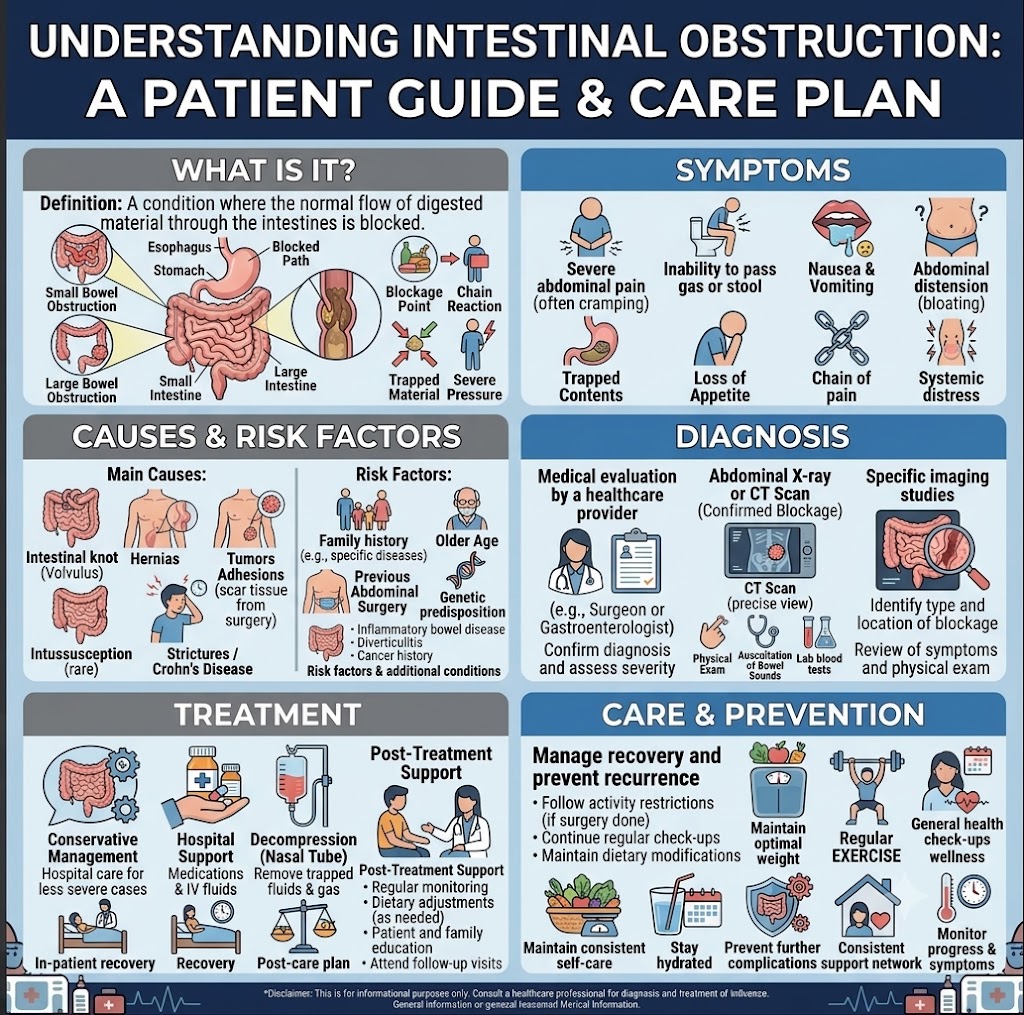
Intestinal obstruction is a blockage that prevents food or liquids from moving through your small or large intestine. This condition can lead to serious health problems if not treated quickly, as the blocked parts of the intestine can be damaged. However, with prompt medical attention, it can often be successfully managed. Common causes include scar tissue from previous surgery, hernias, colon cancer, certain medications, or inflammation from conditions like Crohn's disease or diverticulitis.
Understanding the Condition
Common Symptoms
Severe Abdominal Pain: Intense discomfort or cramping in the belly area.
Vomiting: Expelling stomach contents, often with force.
Nausea: Feeling sick to your stomach, with an urge to vomit.
Diarrhea: Frequent, loose, or watery bowel movements (can occur with partial blockage).
Constipation: Difficulty passing stool, or infrequent bowel movements (common with complete blockage).
Inability to Pass Gas: A complete lack of flatulence.
Swelling of the Abdomen (Abdominal Distension): A visibly swollen or bloated belly.
Consultation Guide
Which Specialist to Meet
Start with your primary care doctor, who may then refer you to a gastroenterologist (a doctor specializing in digestive issues) or a surgeon.
Preparations Before Your Visit
Be prepared to discuss all your symptoms, your complete medical history, any medications you are taking, and details of any recent surgeries.
Book a doctor visit near me
Recognize Warning Signs: Be aware of symptoms like severe abdominal pain, persistent vomiting, or inability to pass gas or stool, and seek immediate medical attention if they occur.
Consultation Guide
Intestinal obstruction is a blockage that prevents food or liquids from moving through your small or large intestine. This condition can lead to serious health problems if not treated quickly, as the blocked parts of the intestine can be damaged. However, with prompt medical attention, it can often be successfully managed. Common causes include scar tissue from previous surgery, hernias, colon cancer, certain medications, or inflammation from conditions like Crohn's disease or diverticulitis.
Diagnostic Procedures
Intestinal Obstruction: Understanding Blockages in Your Digestive System
Understanding the Condition
This imaging test uses high-frequency sound waves to create live pictures of the organs and blood vessels within your abdomen (belly area). It helps doctors visualize the intestines, detect blockages, and check for related issues.
What to Expect
You will lie on an exam table. A gel will be applied to your abdomen, and a handheld device (transducer) will be moved over the skin. You might feel slight pressure, but the procedure is typically painless and takes about 15-30 minutes.
Barium Enema (Colon X-ray)
This is a special X-ray exam used to see the large intestine (colon). A liquid containing a metallic substance (barium) is introduced into the colon, coating its lining and making it visible on X-rays. Air may also be gently pumped in to expand the colon for clearer images.
What to Expect
Before the test, you will need to follow specific instructions to completely empty your colon. During the procedure, you will lie on an X-ray table. A small, soft tube will be gently inserted into your rectum to deliver the barium liquid and possibly air. You may feel a sensation of fullness or mild cramping as the liquid enters. X-ray images are taken as the barium moves through your colon. The test usually lasts about 30-60 minutes.
CT Scan (Computed Tomography Scan)
A CT scan uses multiple X-ray images taken from different angles around your body. A computer then processes these images to create detailed cross-sectional views, or 'slices,' of your bones, blood vessels, and soft tissues, offering more detail than standard X-rays.
What to Expect
You will lie on a motorized table that slides into a large, doughnut-shaped machine. You may be asked to hold your breath for short periods. If a contrast dye is needed, it may be given intravenously or by mouth. The scan is usually quick, lasting from a few minutes to half an hour, and is generally painless, though some people feel warmth from the contrast dye.
An X-ray is a quick and painless imaging test that uses a small amount of radiation to create pictures of the inside of your body, primarily showing bones and dense structures clearly. It can help identify major blockages or other abnormalities.
What to Expect
You will be positioned by a technician, possibly standing, sitting, or lying down. You will need to remain very still for a few seconds while the X-ray machine captures the images. The procedure is very fast and generally takes only a few minutes.
Nasogastric Tube Insertion: A thin tube is inserted through your nose, down your throat, and into your stomach to remove air and fluid, helping to relieve pressure and swelling in the intestine. (Duration: As needed, often until the obstruction clears or surgery is performed.)
Home Enteral Nutrition (Tube Feeding): If you cannot eat or drink enough, liquid nutrition may be delivered directly to your stomach or small intestine through a feeding tube (e.g., nasogastric or nasojejunal tube). This ensures you receive essential nutrients. (Duration: Can be short-term during recovery or long-term for chronic eating difficulties.)
Colectomy (Colon Resection): Surgical removal of a diseased or blocked part of the large intestine (colon). The remaining healthy parts are then reconnected. (Duration: Procedure takes several hours; recovery can be weeks to months.)
Colostomy: A surgical procedure that creates an opening (stoma) in the abdominal wall, bringing a section of the colon to the surface. Stool then passes through this stoma into an external bag (pouching system). This may be temporary or permanent. (Duration: Permanent if the colon cannot be reconnected; temporary for several weeks to months to allow the bowel to heal.)
Ileostomy: Similar to a colostomy, but an opening (stoma) is created from the small intestine (ileum) to the abdominal surface. Stool then exits through this stoma into an external bag. This can also be temporary or permanent. (Duration: Permanent if colon/rectum/anus are removed; temporary for several weeks to months to allow bowel healing.)
Manage Underlying Conditions: Work closely with your doctor to effectively manage conditions like Crohn's disease, diverticulitis, or tumors that can lead to intestinal blockages.
Regular Physical Activity: Engage in regular, moderate exercise to stimulate bowel function and maintain overall digestive health.
Treatment Options
Initial Hospital Care
Hospitalization for Stabilization: If an obstruction is suspected, you will likely be admitted to the hospital. Doctors will provide intravenous fluids to prevent dehydration, manage pain, and relieve nausea. (Duration: Typically a few days, or until the obstruction resolves or is surgically treated.)
Post-Surgical Care and Monitoring: If you've had surgery, diligently follow all post-operative instructions, including dietary guidelines and stoma care (if applicable). Attend all follow-up appointments to monitor for any complications or recurrence.
Prevention & Long-Term Wellbeing
Maintain Hydration and Fiber Intake: Drink plenty of fluids and gradually increase dietary fiber to promote regular bowel movements and prevent constipation, especially if you have a history of partial obstructions or inflammatory bowel disease.
Tags & Topics
Notice an error or need an update?
Help us keep medical information accurate. Report incorrect info or suggest an edit.


