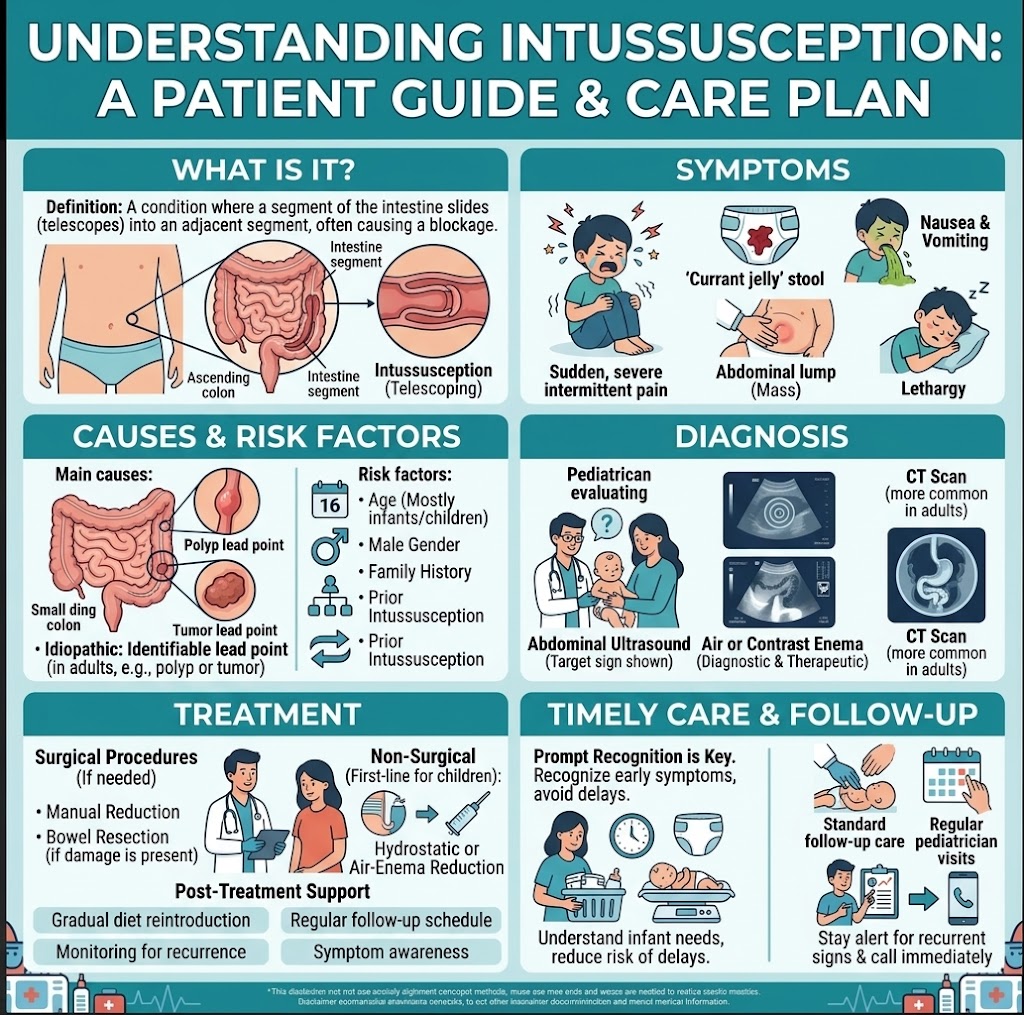
Intussusception (in-tuh-suh-SEP-shun) is a serious medical condition where one part of the intestine slides into an adjacent section, much like the parts of a collapsible telescope. This 'telescoping' action often creates a blockage, preventing food or fluids from passing through. Critically, it also cuts off the blood supply to the affected intestinal segment. If left untreated, this can lead to severe complications such as infection, death of bowel tissue, or a tear in the bowel wall, called perforation.Intussusception is the most common cause of intestinal blockage in children under three years old, though the exact cause is often unknown. While rare in adults, it is usually linked to an underlying medical issue, such as a growth or tumor. In children, a minor procedure can often correct the problem by pushing the intestine back into place, whereas adults typically require surgery.
Understanding the Condition
Common Symptoms
Variable Symptoms: It's important to note that not everyone experiences all these symptoms. Some babies may not show obvious pain, while others may not have bloody stools or a palpable lump. Older children might primarily experience pain without other typical signs. In adults, symptoms are often similar to other digestive issues, making diagnosis more challenging. Adults typically experience intermittent belly pain, nausea, and vomiting, and may have symptoms for weeks before seeking help.**Intussusception is an emergency. If you or your child develops any of these symptoms, seek immediate medical care.**
Consultation Guide
Which Specialist to Meet
For children, you should first consult a pediatrician. For adults, start with your primary care physician. Given the emergency nature of intussusception, you will likely be referred to an emergency room physician, and subsequently to specialists such as a pediatric surgeon, general surgeon, or a gastroenterologist (a doctor specializing in digestive system disorders).
Preparations Before Your Visit
Before your visit, be prepared to provide detailed information. Write down all symptoms, including when they started, how often they occur, and their severity. For a child, note their feeding habits, bowel movements, and energy levels. List any current medications, known allergies, and relevant medical history. Prepare a list of questions you have. Be aware that immediate hospitalization or emergency procedures may be necessary.
Book a doctor visit near me
Prompt Medical Attention: The most crucial prevention strategy for severe complications is early recognition of symptoms and immediate emergency medical care. Swift treatment greatly improves outcomes.
Vaccination Discussion: In very rare instances, the rotavirus vaccine has been associated with a small risk of intussusception. Discuss with your doctor if this vaccine is appropriate for your child, considering the benefits of rotavirus protection versus this rare risk.
Watch for Recurrence: Intussusception can recur, especially in children, even after successful treatment. Parents and caregivers should remain vigilant for the return of symptoms and seek medical advice promptly if they reappear.
Parental Support Groups and Education: Connecting with other parents whose children have experienced intussusception can provide emotional support, practical advice, and a sense of community. Understanding the condition and its potential for recurrence empowers caregivers to recognize symptoms quickly.
Consultation Guide
Intussusception (in-tuh-suh-SEP-shun) is a serious medical condition where one part of the intestine slides into an adjacent section, much like the parts of a collapsible telescope. This 'telescoping' action often creates a blockage, preventing food or fluids from passing through. Critically, it also cuts off the blood supply to the affected intestinal segment. If left untreated, this can lead to severe complications such as infection, death of bowel tissue, or a tear in the bowel wall, called perforation.Intussusception is the most common cause of intestinal blockage in children under three years old, though the exact cause is often unknown. While rare in adults, it is usually linked to an underlying medical issue, such as a growth or tumor. In children, a minor procedure can often correct the problem by pushing the intestine back into place, whereas adults typically require surgery.
Sudden Belly Pain and Crying (Infants): The first noticeable sign in an otherwise healthy baby is often sudden, loud crying caused by severe belly pain. Infants experiencing this pain may instinctively pull their knees up to their chests.
Intermittent Pain: The belly pain associated with intussusception typically comes and goes. Initially, these painful episodes might occur every 15 to 20 minutes. As time passes, the episodes usually become longer and happen more frequently.
Vomiting: This can include vomiting food, or sometimes, bile (a yellow-green fluid).
Bloody, Mucus-like Stool: A classic sign is stool mixed with blood and mucus, often described as looking like 'currant jelly'.
Abdominal Swelling and Tenderness: The belly may appear swollen and feel tender or painful when touched. Sometimes, a lump can be felt in the abdomen.
Lethargy and Weakness: The child may become unusually tired, weak, or unresponsive (lethargic).
Fever: An elevated body temperature can be a sign.
A CT scan uses X-rays and computer processing to create highly detailed, cross-sectional images (like 'slices') of bones, blood vessels, and soft tissues inside the body. It provides more detail than a standard X-ray and can pinpoint the exact location and extent of intussusception, especially in adults, or identify underlying causes like a tumor.
Bowel Resection: If the intussusception has caused significant damage to the intestinal tissue (such as tissue death or a tear) or if it cannot be manually untelescoped, the surgeon will remove the damaged section of the intestine. The healthy ends of the bowel are then reconnected (anastomosis). (Duration: This is a more extensive surgery, requiring a hospital stay of typically 5-7 days or more, with several weeks needed for full recovery at home.)
Diagnostic Procedures
Intussusception: When the Intestine Telescopes
Understanding the Condition
An X-ray is a quick, painless imaging test that uses a small amount of radiation to create pictures of the structures inside your body, especially bones. It can help detect blockages or other issues in the abdomen.
What to Expect
You will lie on a table, and a technician will position you correctly. You might need to change positions for different views. You'll be asked to hold still briefly while the X-ray is taken. The procedure is generally quick and painless. For some X-rays, a special liquid (contrast medium) might be given to highlight specific areas, which you may drink or receive through another route.
Ultrasound (Sonography)
Ultrasound uses high-frequency sound waves to create real-time images of internal body structures. It is a safe procedure that uses low-power sound waves and can often identify intussusception by showing the characteristic 'target sign' or 'pseudokidney sign' in the affected bowel.
What to Expect
You will lie on an examination table. A clear gel is applied to the skin over the area being examined (usually the abdomen). A small, handheld device called a transducer is then gently pressed against your skin and moved around. The sound waves bounce off internal organs, and the transducer sends the echoes to a computer that creates images on a screen. You may feel slight pressure from the transducer, but the procedure is generally painless and takes about 15-30 minutes.
CT Scan (Computed Tomography)
What to Expect
You will lie on a motorized table that slides into a large, donut-shaped machine. The scanner will rotate around you, and you'll need to lie very still. You might hear whirring or clicking sounds during the scan. Sometimes, a contrast dye is given either by injection into a vein, by drinking it, or through the rectum. This dye helps highlight specific areas. If injected, you might feel a warm sensation or a metallic taste. The scan usually takes 10-30 minutes.
Barium Enema (Diagnostic and Therapeutic)
A barium enema is a specialized X-ray examination of the large intestine. Barium sulfate, a liquid contrast material, is gently introduced into the rectum. The barium coats the inside of the intestine, making its shape and any abnormalities visible on X-rays. In some cases, the pressure of the barium or air instilled during the procedure can actually push the telescoped bowel back into its normal position, effectively treating the intussusception.
What to Expect
Prior to the procedure, you will need to follow specific instructions to empty your bowels, which may involve laxatives or a clear liquid diet. During the procedure, you will lie on an X-ray table. A small, lubricated tube will be carefully inserted into your rectum, and the barium fluid will slowly flow in. You might feel fullness, cramping, or a strong urge to have a bowel movement. The radiologist will take X-ray pictures as the barium fills your colon. Air may also be gently pumped in to expand the colon for better views. The procedure can be uncomfortable but is usually brief. After the test, your stools may appear white for a day or two as your body expels the barium.
Enema (Air or Liquid): This is often the first treatment attempt, especially in children, if there are no signs of a torn bowel. Air or a liquid (such as barium or saline) is gently pushed into the rectum. The pressure from the air or liquid often 'un-telescopes' the intestine, pushing the folded section back into its proper place. (Duration: Typically a one-time procedure. If successful, recovery involves careful observation for 24-48 hours in the hospital to ensure no recurrence or complications.)
Manual Reduction: If the enema procedure is unsuccessful, or if it's not a suitable option due to the patient's condition, surgery is performed. A surgeon makes an incision to access the abdomen and gently 'un-telescopes' the intestine by hand, carefully pushing the affected part back into its correct position. (Duration: Hospital stay typically ranges from a few days to a week, depending on the complexity of the surgery and the patient's recovery.)
Treatment Options
Procedures (Non-Surgical)
Intravenous (IV) Fluids and Medications: During hospitalization, patients receive intravenous fluids to prevent dehydration. Pain relievers are administered to manage discomfort. If there's suspicion of infection or tissue damage, antibiotics may also be given to prevent or treat bacterial growth. (Duration: Administered throughout the acute phase of illness and during recovery, typically for the duration of the hospital stay.)
Prevention & Long-Term Wellbeing
Prevention
Follow-up Appointments: Regular follow-up visits with your pediatrician or surgeon are important to monitor recovery, ensure proper healing, and address any long-term concerns related to the digestive system.
Tags & Topics
Notice an error or need an update?
Help us keep medical information accurate. Report incorrect info or suggest an edit.


