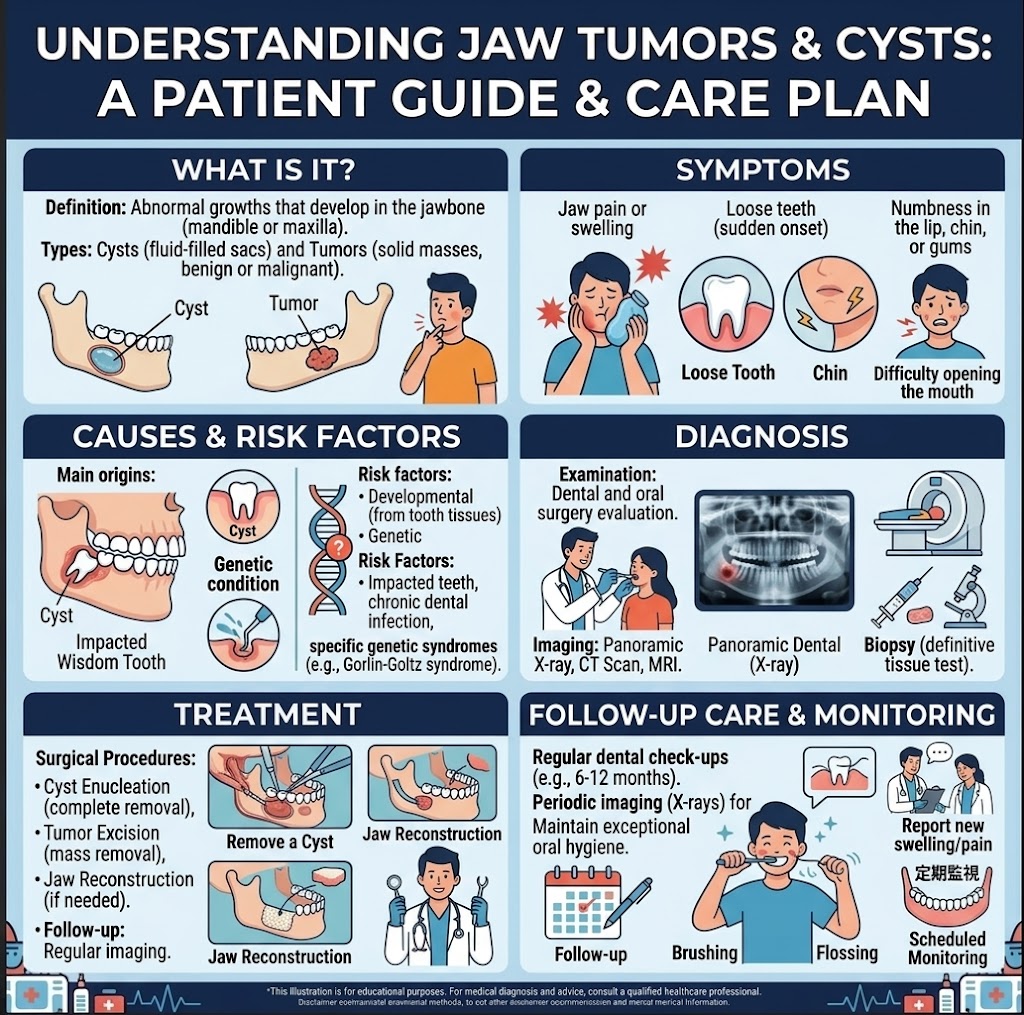
Jaw tumors and cysts are uncommon growths or abnormal pockets of fluid that develop in the jawbone or the soft tissues of the mouth and face. While usually non-cancerous (benign), these growths can sometimes be aggressive, causing damage, displacement, or destruction of surrounding bone, tissues, and teeth. Their origin can be related to tooth development (odontogenic) or other jaw tissues (non-odontogenic). Early detection and appropriate treatment, often surgical, are key to managing these conditions.
Understanding the Condition
Understanding Jaw Tumors and Cysts: A Guide for Non-Medical Persons
Understanding the Condition
Common Symptoms
General Signs: Many jaw tumors and cysts do not cause symptoms initially and are often discovered incidentally during routine dental X-rays. When symptoms do occur, they can include a noticeable swelling or lump in the jaw area, pain, tenderness, numbness, unusual drainage, difficulty moving the jaw, or changes in how teeth fit together.
Central Giant Cell Granuloma: Non-cancerous growths that form from bone cells, frequently in the front part of the lower jaw. Some types grow quickly, causing pain and bone destruction, and may return after surgery. Other types are less aggressive and might not cause symptoms, occasionally even shrinking or disappearing on their own. However, surgical treatment is typically required.
Dentigerous Cyst: The most common type of jaw cyst, forming from the tissue around an unerupted tooth. Most often found around impacted wisdom teeth but can involve other teeth. These cysts can grow and displace teeth or weaken the jawbone.
Odontogenic Keratocyst: Also known as a keratocystic odontogenic tumor due to its tendency to recur after surgical removal. Though usually slow-growing, it can be destructive to the jaw and teeth if not treated over time. It commonly develops in the lower jaw near the back molars and is sometimes linked to a genetic condition called Gorlin-Goltz syndrome.
Odontoma: The most common type of tooth-related tumor, which is non-cancerous. Odontomas often don't cause symptoms but can interfere with normal tooth development or eruption. They are made of dental tissue that grows within the jaw, sometimes appearing as an unusually shaped tooth or a calcified mass. They may be associated with certain genetic conditions.
Other Types: A variety of other cysts and tumors can affect the jaw, including adenomatoid odontogenic tumors, calcifying epithelial odontogenic tumors, glandular odontogenic cysts, and others, each with unique characteristics and potential impacts on the jaw and teeth.
Consultation Guide
Which Specialist to Meet
You should consult with your primary care provider or dentist if you suspect symptoms of a jaw tumor or cyst. They can refer you to a specialist such as an Oral and Maxillofacial Surgeon, who specializes in surgery of the mouth, jaws, and face. Depending on the specific diagnosis, a pathologist (who examines tissue samples) or an oncologist (cancer specialist, if malignancy is a concern) may also be involved.
Preparations Before Your Visit
Before your visit, gather any relevant medical records, including previous dental X-rays or imaging scans. Prepare a list of your symptoms, including when they started, how often they occur, and anything that makes them better or worse. Write down your medical history, including any previous surgeries or existing health conditions, and a list of all medications, supplements, or vitamins you are currently taking. Also, prepare a list of questions you want to ask your doctor.
Book a doctor visit near me
Medication-Based Treatment: In specific cases, particularly for certain types of central giant cell granulomas or as an adjunct to surgery, medications may be used to help shrink the growth or manage symptoms. These therapies are often tailored to the specific type of lesion and individual patient needs. (Duration: Treatment duration varies significantly, ranging from several months to ongoing therapy, depending on the specific medication, the growth's response, and the overall treatment plan.)
Watchful Waiting: For very small, non-symptomatic, and non-aggressive lesions, or in cases where treatment risks outweigh potential benefits, a doctor may recommend monitoring the growth with regular check-ups and imaging studies to observe for any changes. (Duration: Ongoing, with follow-up appointments and imaging scans at regular intervals (e.g., every 6-12 months) for an indefinite period or until a change necessitates intervention.)
Regular Dental Check-ups and X-rays: Routine visits to your dentist, including periodic X-rays, are crucial for early detection. Many jaw tumors and cysts are discovered during these routine screenings before they cause noticeable symptoms or significant damage.
Prompt Evaluation of Oral Changes: Any new lumps, swellings, pain, or unusual changes in your mouth or jaw should be promptly evaluated by a dentist or doctor. Early intervention can significantly improve outcomes.
Genetic Counseling for Syndromes: If there's a family history of conditions like Gorlin-Goltz syndrome (Nevoid Basal Cell Carcinoma Syndrome), which predisposes individuals to multiple odontogenic keratocysts, genetic counseling can provide information and guide screening strategies for affected individuals and their families.
Long-Term Monitoring and Management
Consultation Guide
You will lie on a table that slides into a large, donut-shaped machine. The machine will take multiple images from different angles. You may hear humming or clicking noises. You'll need to remain very still during the scan, which typically takes 10-30 minutes. In some cases, a contrast dye may be injected into a vein to highlight certain areas, which might cause a brief warm sensation.
MRI (Magnetic Resonance Imaging)
An MRI uses powerful magnets and radio waves to generate detailed images of soft tissues, such as muscles, nerves, and blood vessels, which are not as clearly visible on X-rays or CT scans. It's useful for assessing the extent of soft tissue involvement and differentiating between certain types of growths.
Diagnostic Procedures
X-rays (Dental and Panoramic)
These are common imaging tests that use small doses of radiation to create images of the bones and teeth. Dental X-rays focus on specific teeth, while panoramic X-rays provide a broad view of the entire mouth, including the upper and lower jaws, teeth, and surrounding structures.
What to Expect
For dental X-rays, you will sit in a dental chair, and small film sensors will be placed inside your mouth. For a panoramic X-ray, you will stand or sit with your chin on a small support, and a machine will rotate around your head for a short period. Both procedures are quick, painless, and require you to remain still for a few seconds. You may be asked to remove any metal objects like jewelry or glasses.
CT Scan (Computed Tomography)
A CT scan uses specialized X-ray equipment to create detailed cross-sectional images of the jaw and surrounding structures. It provides more detailed information about bone involvement, tumor size, and its relationship to vital structures compared to standard X-rays.
What to Expect
What to Expect
You will lie on a movable table that slides into a large, tube-shaped machine. The MRI machine makes loud banging or knocking noises, so you will be offered earplugs or headphones. It's crucial to remain completely still. The scan can take 30-60 minutes or longer. If you are claustrophobic, discuss this with your doctor beforehand. Similar to CT, a contrast dye might be used.
A biopsy is the most definitive diagnostic procedure, involving the removal of a small tissue sample from the suspicious growth. This sample is then sent to a laboratory for examination under a microscope by a pathologist to determine if the growth is cancerous or non-cancerous and to identify its specific type.
What to Expect
Psychological Support: Dealing with a diagnosis and treatment of a jaw tumor or cyst can be stressful. Seeking support from family, friends, support groups, or mental health professionals can help manage emotional and psychological challenges during and after treatment.
Treatment Options
Jaw tumors and cysts are uncommon growths or abnormal pockets of fluid that develop in the jawbone or the soft tissues of the mouth and face. While usually non-cancerous (benign), these growths can sometimes be aggressive, causing damage, displacement, or destruction of surrounding bone, tissues, and teeth. Their origin can be related to tooth development (odontogenic) or other jaw tissues (non-odontogenic). Early detection and appropriate treatment, often surgical, are key to managing these conditions.
Ameloblastoma: A rare, typically non-cancerous tumor originating from cells that form tooth enamel. It most often develops in the lower jaw near the back teeth (molars). This type can be aggressive, growing large and invading the jawbone. While it can return after treatment, extensive surgical removal helps reduce this risk.
Odontogenic Myxoma: A rare, slow-growing, non-cancerous tumor, most common in the lower jaw. It can become large, aggressively invading the jawbone and surrounding tissues, and displacing teeth. It's known for potentially recurring after surgery, with more extensive surgical approaches reducing this risk.
This procedure is usually performed in an outpatient setting, often under local anesthesia to numb the area, or sometimes under general anesthesia depending on the size and location of the growth. A small incision may be made to access the growth and remove a piece of tissue. You may feel some pressure during the procedure. After the biopsy, you might experience mild discomfort, swelling, or bruising, which can be managed with pain relief medication. Recovery is typically quick, but you'll receive specific aftercare instructions.
Surgical Procedures
More Extensive Surgical Removal (Resection): For larger, more aggressive, or recurrent tumors (like some ameloblastomas or odontogenic myxomas), a wider margin of healthy tissue or a section of the jawbone may need to be removed. In some cases, reconstructive surgery may follow to restore jaw function and appearance. (Duration: A single, more complex surgical procedure, potentially followed by additional reconstructive surgeries. Recovery can range from several weeks to months, often involving physical therapy or rehabilitation.)
Post-Treatment Follow-up: Many types of jaw tumors and cysts, especially aggressive or recurrent types like ameloblastomas or odontogenic keratocysts, require long-term follow-up with your specialist. This includes regular clinical examinations and imaging (X-rays, CT, or MRI) to monitor for any signs of recurrence.
Jaw Function and Oral Rehabilitation: For individuals who undergo extensive surgery, rehabilitation may be necessary to restore jaw function, speech, and chewing ability. This can involve physical therapy, orthodontic treatment, or prosthetic devices to replace lost teeth or jaw structures.
Prevention & Long-Term Wellbeing
Conservative Surgical Removal: This involves carefully removing the tumor or cyst while preserving as much surrounding healthy tissue as possible. This approach is often used for smaller, less aggressive, or more easily accessible growths. (Duration: Typically a single surgical procedure, with recovery varying from several days to a few weeks depending on the extent of removal and individual healing.)
Marsupialization or Enucleation with Curettage: For certain cysts, marsupialization involves creating a small opening in the cyst to allow it to drain and shrink over time. Enucleation involves complete removal of the cyst lining, often followed by curettage (scraping) of the bone to remove any remaining cells. (Duration: Marsupialization may involve a initial procedure and then ongoing care over several weeks to months for drainage. Enucleation is typically a single procedure, with recovery lasting a few weeks.)
Prevention and Early Detection
Lifestyle Support: Maintaining a healthy lifestyle, including a balanced diet and avoiding tobacco and excessive alcohol, supports overall oral health and general wellbeing, which can aid in recovery and potentially reduce risks for other health issues.
Tags & Topics
Notice an error or need an update?
Help us keep medical information accurate. Report incorrect info or suggest an edit.


