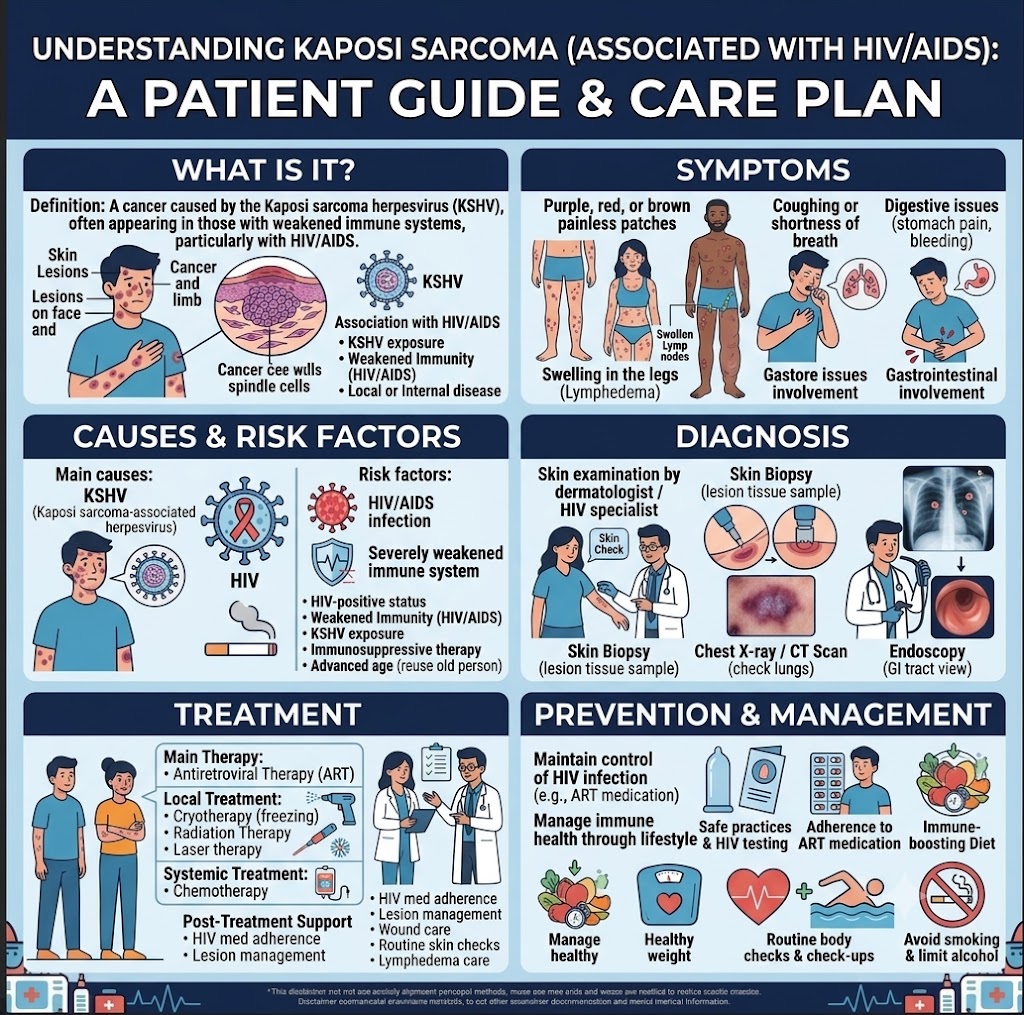
Kaposi sarcoma is a type of cancer that develops from the cells lining blood and lymph vessels. This cancer typically forms colored patches or bumps, known as lesions, on the skin, often appearing on the face, arms, and legs. These lesions can range in color from pink to red, purple, or brown. While most commonly seen on the skin, lesions can also appear inside the mouth, on the genitals, or, in more severe cases, within internal organs like the digestive tract and lungs. The underlying cause of Kaposi sarcoma is an infection with the Human Herpesvirus 8 (HHV-8). In individuals with a healthy immune system, this virus usually remains dormant and causes no problems. However, if the immune system becomes weakened, HHV-8 can become active and lead to the development of Kaposi sarcoma.
Understanding the Condition
Kaposi Sarcoma: A Guide for Non-Medical Persons
Understanding the Condition
Common Symptoms
Internal Symptoms (Digestive Tract): If Kaposi sarcoma affects the digestive tract, symptoms can include stomach pain and unexplained weight loss.
Consultation Guide
Which Specialist to Meet
Before your visit, make a list of all your symptoms, including when they started and how they have progressed. Note down any medications you are currently taking (prescription, over-the-counter, and supplements). Be prepared to discuss your medical history, including any past illnesses or conditions, and any relevant travel history. Write down any questions you have for the doctor.
Book a doctor visit near me
Consultation Guide
Kaposi sarcoma is a type of cancer that develops from the cells lining blood and lymph vessels. This cancer typically forms colored patches or bumps, known as lesions, on the skin, often appearing on the face, arms, and legs. These lesions can range in color from pink to red, purple, or brown. While most commonly seen on the skin, lesions can also appear inside the mouth, on the genitals, or, in more severe cases, within internal organs like the digestive tract and lungs. The underlying cause of Kaposi sarcoma is an infection with the Human Herpesvirus 8 (HHV-8). In individuals with a healthy immune system, this virus usually remains dormant and causes no problems. However, if the immune system becomes weakened, HHV-8 can become active and lead to the development of Kaposi sarcoma.
Skin Growths (Lesions): These are the most common signs, appearing as raised bumps or flat patches on the skin. They can be red, purple, or brown and are frequently found on the face, arms, or legs. Initially, these growths typically do not cause pain or discomfort.
Swelling: Untreated lesions can grow larger and lead to swelling, particularly in the lower legs, due to issues with fluid circulation.
Enlarged Lymph Nodes: The lymph nodes, small glands that are part of the immune system, can become noticeably larger.
Skin Changes: The affected skin may appear red or purple and can become painful or itchy.
You should consult with your primary care provider first, who may then refer you to specialists such as a dermatologist (for skin lesions), an oncologist (a cancer specialist), or an infectious disease specialist (if the cause is related to an underlying infection like HIV).
Preparations Before Your Visit
Diagnostic Procedures
A small sample of the suspicious skin lesion is removed and examined under a microscope by a pathologist to check for cancer cells and confirm the diagnosis of Kaposi sarcoma.
What to Expect
The doctor will clean the area and inject a local anesthetic to numb the skin, so you'll feel little to no pain during the procedure itself. A small piece of the lesion will be removed using a scalpel or a punch tool. You might feel a brief pinch or pressure. The site will then be bandaged. The sample is sent to a lab, and results are typically available within several days to a couple of weeks.
This procedure is used to examine the lining of the digestive tract (esophagus, stomach, duodenum) for Kaposi sarcoma lesions if internal involvement is suspected. A thin, flexible tube with a camera is inserted through the mouth.
What to Expect
You will likely receive a mild sedative to help you relax and make you sleepy during the procedure. The back of your throat may also be numbed. The endoscope is gently guided down your throat. You might feel some pressure but shouldn't experience pain. The doctor will look for lesions and may take small tissue samples (biopsies). After the procedure, you will be monitored until the sedative wears off. You might have a mild sore throat for a day or two.
If Kaposi sarcoma is suspected in the lungs, a bronchoscopy may be performed. A thin, flexible tube with a camera is inserted through the nose or mouth into the airways to visualize and biopsy any lesions.
What to Expect
Similar to an endoscopy, you will likely receive a sedative and local anesthetic for your throat and airways. The bronchoscope is carefully advanced into your lungs. The doctor will examine the airways for lesions and may take biopsies or fluid samples. You will be monitored after the procedure until the sedative wears off. A mild sore throat or cough can be expected.
CT Scan (Computed Tomography)
A CT scan uses specialized X-ray equipment to create detailed cross-sectional images of internal organs and structures. This helps determine if Kaposi sarcoma has spread internally, for example, to lymph nodes, lungs, or other organs.
What to Expect
You will lie on a table that slides into a large, doughnut-shaped scanner. You will need to lie still during the scan. Sometimes, a contrast dye is given orally or injected into a vein to make certain structures clearer. You might feel a warm flush with the injection. The scan itself is painless and usually takes about 15-30 minutes.
Treatment Options
Medications
Antiviral Therapy: For individuals with a weakened immune system due to conditions like HIV/AIDS, specific antiviral medications are used to improve immune function and control the underlying virus. This often helps to control or reverse Kaposi sarcoma. (Duration: Typically ongoing, long-term treatment as directed by a specialist.)
Chemotherapy: These medications kill cancer cells. They can be given systemically (throughout the body, usually intravenously) for widespread disease or as a topical gel directly applied to small skin lesions. (Duration: Systemic chemotherapy is usually given in cycles over several weeks to months. Topical therapy duration varies depending on lesion response, often several weeks.)
Immune-Modulating Drugs: These drugs help adjust or restore the body's immune system to better fight the cancer. For transplant-associated Kaposi sarcoma, reducing or changing immunosuppressant medications can often lead to regression of the disease. (Duration: Duration varies based on the specific drug and response, often adjusted over weeks to months under medical supervision.)
Surgical Procedures
Lesion Excision: Small, bothersome skin lesions can be surgically cut out (excised). This is usually performed for cosmetic reasons or if a lesion is causing pain or bleeding. (Duration: A single procedure, followed by wound healing over several days to weeks.)
Therapies
Radiation Therapy: High-energy X-rays are used to target and destroy cancer cells in specific areas. This is often used for larger or painful lesions, or lesions in sensitive areas. (Duration: Typically given in multiple short sessions over several days to a few weeks.)
Cryotherapy: This involves freezing small skin lesions with liquid nitrogen to destroy the cancer cells. It's often used for individual, superficial lesions. (Duration: A quick, single session per lesion, sometimes repeated after a few weeks if needed.)
Intralesional Injections: Certain medications are injected directly into the Kaposi sarcoma lesions to shrink them. (Duration: Injections may be given periodically, usually every few weeks, until the desired effect is achieved.)
Careful Immunosuppression Management: If you have received an organ transplant, working closely with your doctor to manage immunosuppressive medications is vital. Sometimes, adjusting the dose or type of medication can reduce the risk of Kaposi sarcoma without risking organ rejection.
Safe Practices: While HHV-8 can be transmitted through saliva, practicing safe sexual contact can help reduce the risk of acquiring the virus, especially in populations with higher prevalence.
Long-Term Monitoring and Support
Regular Medical Check-ups: Ongoing follow-up appointments with your healthcare team are essential to monitor for new lesions or signs of disease progression, and to manage any side effects from treatment.
Self-Monitoring for Changes: Regularly check your skin for any new or changing lesions. Report any concerns, including new pain, swelling, or changes in existing lesions, to your doctor promptly.
Nutritional Support: Maintaining good nutrition and a healthy lifestyle can support your overall immune function and general wellbeing, especially during and after cancer treatment.
Psychological Support: Living with Kaposi sarcoma can be challenging. Seeking support from counselors, support groups, or mental health professionals can help manage stress, anxiety, and depression.
Prevention & Long-Term Wellbeing
Prevention
Manage Underlying Conditions: For those with HIV, consistent adherence to antiretroviral therapy (ART) is crucial to maintain a strong immune system, which can prevent HHV-8 from becoming active and causing Kaposi sarcoma.
Tags & Topics
Notice an error or need an update?
Help us keep medical information accurate. Report incorrect info or suggest an edit.


