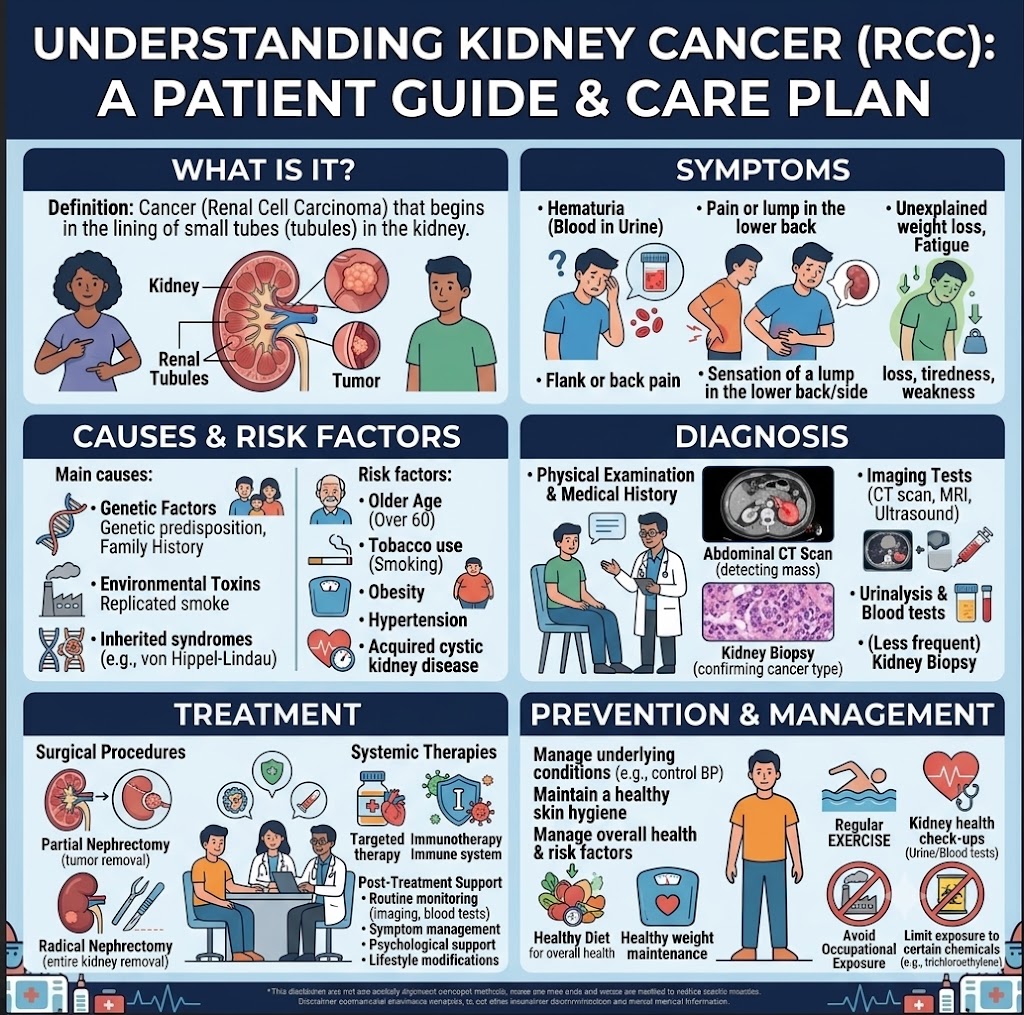
Kidney cancer occurs when cells in the kidneys begin to grow uncontrollably, forming a mass called a tumor. The kidneys are two bean-shaped organs, each roughly the size of a fist, located behind your abdominal organs, one on each side of the spine. The most common type of kidney cancer in adults is renal cell carcinoma. A different type, Wilms tumor, is more common in young children. The number of diagnosed kidney cancers is rising, partly due to increased use of imaging tests like CT scans, which can often find smaller, earlier-stage cancers incidentally.
Understanding the Condition
Understanding Kidney Cancer
Understanding the Condition
Common Symptoms
Blood in Urine: Visible blood in urine, which may appear pink, red, or cola-colored.
Persistent Pain: Ongoing pain in the side or back that doesn't go away.
Unexplained Weight Loss: Losing weight without trying.
Loss of Appetite: Feeling less hungry than usual.
Consultation Guide
Which Specialist to Meet
You should start by consulting your primary care doctor, who may then refer you to specialists such as a urologist (a doctor specializing in urinary tract and male reproductive system issues) or an oncologist (a cancer specialist).
Preparations Before Your Visit
Be prepared to discuss your complete medical history, including any medications you're currently taking, and provide a detailed account of your symptoms—when they started, how they've progressed, and any factors that seem to make them better or worse. Bringing a list of questions you have for the doctor can also be helpful.
Book a doctor visit near me
Consultation Guide
You will lie on a motorized table that slides into a large, doughnut-shaped machine. You might hear humming or clicking noises as the machine operates. For some scans, a contrast dye may be injected into a vein to highlight specific areas, which might cause a warm flush or metallic taste. You may be asked to hold your breath for short periods. The scan is usually quick, lasting only a few minutes.
A specific type of CT scan focused on the entire urinary tract, including the kidneys, ureters (tubes connecting kidneys to bladder), and bladder. A special X-ray dye (contrast material) is injected into a vein to highlight these structures, allowing doctors to assess their function and look for abnormalities like tumors, stones, or blockages.
Similar to a standard CT scan, you will lie on a table. A contrast dye will be injected into a vein in your hand or arm, which may cause a warm sensation or a temporary metallic taste. X-ray pictures are taken at specific intervals as the dye moves through your urinary tract to provide clear, detailed images of your kidneys, ureters, and bladder.
Quit Smoking: Smoking tobacco is a major risk factor for kidney cancer. Quitting smoking can substantially reduce this risk over time. Seek support through nicotine replacement products, medications, or local support groups to help you succeed.
Manage Blood Pressure: High blood pressure (hypertension) is a known risk factor. Regularly monitor your blood pressure and work with your healthcare team to keep it under control through lifestyle changes (such as diet and exercise) and, if necessary, prescribed medication.
Diagnostic Procedures
Kidney cancer occurs when cells in the kidneys begin to grow uncontrollably, forming a mass called a tumor. The kidneys are two bean-shaped organs, each roughly the size of a fist, located behind your abdominal organs, one on each side of the spine. The most common type of kidney cancer in adults is renal cell carcinoma. A different type, Wilms tumor, is more common in young children. The number of diagnosed kidney cancers is rising, partly due to increased use of imaging tests like CT scans, which can often find smaller, earlier-stage cancers incidentally.
A simple laboratory test that checks your urine's appearance, concentration, and content to detect signs of infection, kidney disease, or other conditions. It can reveal substances like blood, protein, or other abnormal cells that shouldn't be present.
What to Expect
You will be asked to provide a urine sample, usually in a private restroom. The sample is then sent to a lab for analysis. There are no special preparations required beyond providing the sample.
An imaging test that uses high-frequency sound waves to create live images of internal organs. It helps visualize the kidneys' structure and identify any unusual growths, cysts, or blockages without using radiation.
What to Expect
You will lie on an exam table. A clear gel is applied to your skin over the kidney area, and a small handheld device called a transducer is moved gently over the gel. You might feel slight pressure from the transducer, but the procedure is generally painless. The sound waves bounce off your organs, creating real-time images on a monitor.
CT Scan (Computed Tomography)
A specialized X-ray technique that creates detailed cross-sectional images, or 'slices,' of bones, blood vessels, and soft tissues inside the body. It provides more detailed information than standard X-rays and is crucial for detecting tumors, evaluating their size and location, and checking for potential spread.
What to Expect
What to Expect
Radiofrequency Ablation (RFA): This minimally invasive procedure uses electrical energy delivered through a thin needle directly into the tumor. The electrical energy creates heat, which then destroys the cancer cells. It is guided by imaging tests like ultrasound or CT and is often used for smaller tumors or for patients who may not be candidates for surgery. (Duration: Typically a single procedure, with a recovery period that is generally shorter than traditional surgery, often ranging from a few days to a few weeks.)
Regular Follow-Up Appointments: After treatment, consistent follow-up appointments with your oncology team are crucial. These visits help monitor for any signs of cancer recurrence or new growths and manage any long-term side effects. This may include periodic imaging scans and blood tests.
Treatment Options
Surgical Procedures
Partial Nephrectomy (Kidney-Sparing Surgery): This procedure involves removing only the cancerous tumor and a small margin of surrounding healthy tissue, preserving as much of the kidney as possible. It can be performed through a single larger incision (open surgery) or smaller incisions using specialized instruments (laparoscopic or robotic-assisted surgery). (Duration: A single procedure, followed by a recovery period that typically ranges from several weeks to a few months, depending on the surgical method and individual patient factors.)
Radical Nephrectomy (Entire Kidney Removal): This surgery removes the entire affected kidney, often along with a surrounding layer of fatty tissue, and sometimes nearby lymph nodes or the adrenal gland if the cancer is extensive or has spread. It can also be performed via open, laparoscopic, or robotic-assisted surgery. (Duration: A single procedure, followed by a recovery period that typically ranges from several weeks to a few months, depending on the surgical method and individual patient factors.)
Targeted and Immunotherapies
Biological Therapy (Immunotherapy): These treatments harness and boost your body's own immune system to fight cancer. They work by helping the immune system recognize and attack cancer cells, or by enhancing its overall ability to combat the disease. There are various types, each with a different mechanism of action. (Duration: Administered in cycles (e.g., intravenously or orally), often over several weeks or months, depending on the specific therapy, the cancer's response, and how well it is tolerated.)
Cryoablation: Similar to RFA, cryoablation is a minimally invasive technique that uses extreme cold to freeze and destroy cancer cells. A specialized needle is inserted into the tumor under imaging guidance to deliver cryo-agents, effectively killing the tumor cells. (Duration: Typically a single procedure, with a recovery period that is generally shorter than traditional surgery, often ranging from a few days to a few weeks.)
Radiation Therapy (Radiotherapy): This treatment uses high-energy beams (such as X-rays or protons) precisely aimed at the cancer to damage and kill cancer cells by destroying their genetic material. It can be delivered from outside the body using a large machine (external beam radiation therapy) or by placing a small radioactive implant inside or near the tumor (brachytherapy). (Duration: Often administered in daily sessions over several weeks, with the exact duration depending on the type and stage of cancer, as well as the specific treatment plan.)
Adherence to Treatment Plans: Strictly follow your prescribed treatment plan, including any ongoing medications or lifestyle recommendations, to optimize outcomes, reduce recurrence risk, and maintain your overall health.
Prevention & Long-Term Wellbeing
Prevention
Maintain a Healthy Weight: Achieving and maintaining a healthy body weight through a balanced diet and regular physical activity can significantly lower your risk of kidney cancer. Consult a healthcare professional for personalized guidance on healthy weight management.
Eat a Healthy Diet: Choose a diet rich in a variety of fruits and vegetables, which provide essential vitamins and nutrients that support overall health. It's generally best to obtain vitamins from food sources rather than taking large doses of supplements, as some can be harmful.
Exercise Regularly: Aim for at least 30 minutes of moderate-intensity exercise on most days of the week. Regular physical activity contributes to overall health and can help reduce cancer risk. If you haven't been active, start slowly and consult your doctor before beginning a new exercise regimen.
Limit Alcohol Intake: If you choose to drink alcohol, do so in moderation. For healthy adults, this generally means up to one standard drink per day for women and up to two standard drinks per day for men.
Long-Term Monitoring
Continued Healthy Lifestyle: Maintain the healthy habits developed during prevention, such as a balanced diet, regular exercise, and avoiding tobacco, to support long-term well-being and reduce the risk of other health issues.
Tags & Topics
Notice an error or need an update?
Help us keep medical information accurate. Report incorrect info or suggest an edit.


