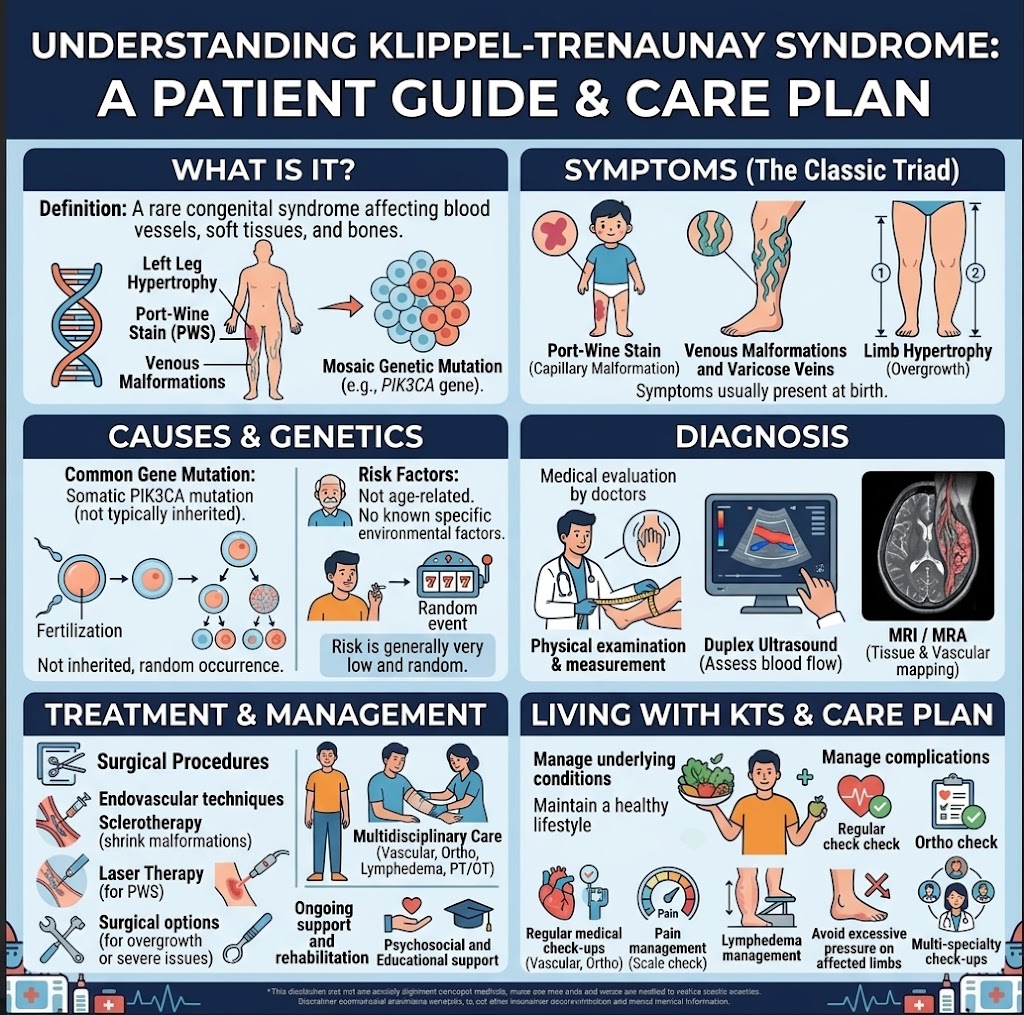
Klippel-Trenaunay (klih-PEL tray-no-NAY) syndrome, often called KTS, is a rare condition present at birth. It involves problems with the development of certain blood vessels, soft tissues like skin and muscles, bones, and sometimes the lymphatic system. The main features of KTS include a red birthmark (port-wine stain), unusual development of veins or lymphatic vessels (malformations), and overgrowth of tissues and bones. These issues most often affect one leg but can appear in an arm or other parts of the body. While there is currently no cure for KTS, treatments aim to manage symptoms and prevent potential complications.
Understanding the Condition
Klippel-Trenaunay Syndrome (KTS): A Guide for Patients and Families
Understanding the Condition
Klippel-Trenaunay (klih-PEL tray-no-NAY) syndrome, often called KTS, is a rare condition present at birth. It involves problems with the development of certain blood vessels, soft tissues like skin and muscles, bones, and sometimes the lymphatic system. The main features of KTS include a red birthmark (port-wine stain), unusual development of veins or lymphatic vessels (malformations), and overgrowth of tissues and bones. These issues most often affect one leg but can appear in an arm or other parts of the body. While there is currently no cure for KTS, treatments aim to manage symptoms and prevent potential complications.
Common Symptoms
Overgrowth of Bones and Soft Tissue: This symptom begins in infancy and usually affects one leg, making it larger and longer than the other. However, it can also affect an arm or, rarely, the body's trunk or face. In rare cases, fingers or toes may be fused together or there may be extra fingers or toes.
Lymphatic System Malformations: The lymphatic system is a vital part of the body's immune system, protecting against infection and disease by transporting a fluid called lymph. In KTS, this system can be malformed, meaning extra lymphatic vessels might be present but don't work correctly. This can lead to fluid leaking into tissues and causing swelling.
Other Conditions: People with KTS may also experience other issues such as clouding of the eye lens (cataracts), increased pressure in the eye (glaucoma), hip dislocation at birth, purple-red skin discoloration when exposed to cold, and problems with blood clotting.
Consultation Guide
Which Specialist to Meet
If KTS is suspected, an initial visit with your primary care doctor or pediatrician is crucial. They can then refer you to specialists who manage KTS, such as a vascular anomalies specialist, dermatologist, vascular surgeon, orthopedic surgeon, lymphedema specialist, geneticist, and physical or occupational therapists.
Preparations Before Your Visit
Before your appointment, gather all medical records, including any previous test results. Make a list of all your symptoms, even mild ones, and note when they started. Be prepared to discuss your family medical history. Write down any questions you have for the doctor. Bringing a family member or friend can also be helpful for support and to help remember details discussed during the visit.
Book a doctor visit near me
During this exam, the doctor will visually inspect and feel the affected areas, take measurements of limbs, and ask detailed questions about your health and symptoms. It is non-invasive and painless.
Vein Surgery (Stripping or Ligation): For severe varicose veins, surgical removal (stripping) or tying off (ligation) of the problematic veins can alleviate symptoms and improve circulation. (Duration: Typically a one-time procedure with a recovery period of several weeks. May be followed by ongoing compression therapy.)
Regular Medical Check-ups: Ongoing follow-up with a team of specialists is essential to monitor symptoms, assess growth, check for new complications, and adjust treatment plans as needed throughout life.
Blood Clot Awareness and Prevention: Understanding the risk factors and symptoms of blood clots (like deep vein thrombosis) is important. If prescribed, consistently take blood-thinning medications and follow activity guidelines.
Consultation Guide
Port-Wine Stain: This is a pink to reddish-purple birthmark caused by an extra number of tiny blood vessels (capillaries) in the top layer of the skin. The birthmark often covers part of one leg but can appear anywhere on the skin. Its color may become darker or lighter over time.
Vein Malformations: These include swollen, twisted veins (varicose veins), typically visible on the surface of the legs. Less visible, deeper malformed veins can also occur in the arms, legs, abdomen, and pelvis. Sometimes, spongy tissue filled with small veins can be felt in or under the skin. These unusual veins may become more noticeable with age.
You will lie on a table that slides into a donut-shaped machine. The scan is quicker than an MRI, typically taking only a few minutes. You may be asked to hold your breath for short periods. Sometimes, a contrast dye is injected into a vein to highlight blood vessels, which might cause a brief warm flush.
MR Venography or CT Venography
These are specialized MRI or CT scans focused on visualizing veins in detail, often used to map the abnormal venous network in KTS.
A small amount of a safe radioactive tracer is injected into the skin, usually between the toes or fingers. Images are then taken over several hours as the tracer moves through the lymphatic system. The procedure is generally comfortable, though the injections might cause a brief sting.
Diagnostic Procedures
A physical examination by a doctor is the first step. They will carefully check for the characteristic port-wine birthmark, signs of limb overgrowth, unusual veins, and any swelling, which helps guide further diagnostic tests.
What to Expect
This imaging test uses sound waves to create pictures of blood vessels and internal organs. It helps identify abnormal veins, assess blood flow, and detect fluid buildup.
What to Expect
You will lie down, and a clear gel will be applied to the skin over the area being examined. A handheld device (transducer) will be gently moved over the gel. You might feel a slight pressure, but the procedure is generally painless and takes about 30-60 minutes.
Magnetic Resonance Imaging (MRI)
An MRI uses strong magnets and radio waves to produce detailed images of soft tissues, bones, blood vessels, and the lymphatic system. It's excellent for evaluating the extent of malformations.
What to Expect
You will lie on a movable table that slides into a large, tube-shaped machine. It's important to remain very still during the scan, which can take 30-90 minutes. You might hear loud banging or buzzing noises, so earplugs or headphones are usually provided. Some people may feel claustrophobic, but communication with the technician is possible throughout.
CT Scan (Computed Tomography)
A CT scan uses X-rays from multiple angles to create detailed cross-sectional images of bones and soft tissues. It's particularly useful for assessing bone structure and complex vascular issues.
What to Expect
What to Expect
Similar to a standard MRI or CT scan, but usually involves the injection of a contrast dye into a vein to make the blood vessels clearly visible on the images. This helps doctors see the structure and flow within your veins more precisely.
This test helps evaluate the lymphatic system by tracking the movement of a radioactive tracer, identifying blockages or abnormal flow in lymphatic vessels.
What to Expect
Since KTS is a genetic disorder, testing can identify changes (mutations), most commonly in the PIK3CA gene, which is involved in cell growth. This can confirm the diagnosis.
What to Expect
A simple blood or saliva sample will be collected. This sample is then sent to a specialized laboratory for analysis. The process of collecting the sample is quick and involves minimal discomfort.
X-rays provide images of bones and can be used to measure limb length discrepancies and assess bone development or any structural issues related to overgrowth.
What to Expect
You will be asked to stand or lie down in a specific position, and a technician will position the X-ray machine. You need to remain still for a few seconds while a brief burst of radiation creates the image. The procedure is quick and painless.
Treatment Options
Supportive Care & Therapies
Compression Garments: Elastic stockings, sleeves, or bandages are used to apply pressure to affected limbs, which helps reduce swelling, improve blood flow, and ease pain. (Duration: Daily, often long-term or lifelong, tailored to individual needs.)
Skin Care: Careful attention to skin hygiene, moisturizing, and protection of the port-wine stain and other affected areas to prevent dryness, cracks, ulcers, and infections. (Duration: Daily, ongoing.)
Elevation: Raising affected limbs above heart level, especially during rest, to help reduce fluid buildup and swelling. (Duration: As needed, particularly when resting or sleeping.)
Pain Management: Over-the-counter pain relievers or prescription medications can help manage chronic pain, which can arise from swelling, bone involvement, or vein issues. (Duration: As needed or on an ongoing basis, as prescribed by a doctor.)
Physical and Occupational Therapy: Therapists help improve movement, strength, flexibility, and overall function in limbs affected by overgrowth or swelling. This can include specialized exercises and techniques. (Duration: Regular sessions initially, followed by a home exercise program, ongoing as needed.)
Lymphedema Therapy: A specialized therapy called Complete Decongestive Therapy (CDT) involves manual lymphatic drainage (a gentle massage technique), multilayer compression bandaging, therapeutic exercises, and meticulous skin care to manage fluid buildup (lymphedema). (Duration: Intensive initial phase (weeks), followed by ongoing self-management and periodic therapist visits.)
Laser Therapy: Pulsed dye laser treatment targets the tiny blood vessels in the port-wine stain, reducing its color and sometimes improving skin texture. (Duration: Multiple sessions (often 5-10 or more) are typically required, spaced several weeks apart, over months to years. Each session is quick.)
Sclerotherapy: A special solution is injected directly into abnormal veins or lymphatic malformations, causing them to scar and close off, redirecting blood flow through healthy vessels. (Duration: Multiple sessions may be needed, usually spaced weeks apart. Treatment may be ongoing for recurrent or new malformations.)
Surgical Procedures
Debulking Surgery: This surgery involves removing excess soft tissue to reduce the size and weight of an overgrown limb, improving comfort and mobility. (Duration: Generally a one-time procedure, but some individuals may require additional surgeries if overgrowth recurs. Recovery can take weeks to months.)
Limb Length Correction Surgery: If one leg is significantly longer than the other, surgery can involve slowing the growth of the longer limb (epiphyseodesis) or lengthening the shorter limb, to improve walking and prevent back and hip problems. (Duration: One-time procedure, sometimes staged, with a recovery and rehabilitation period spanning months to over a year, depending on the method.)
Eye Surgery: Surgical procedures, such as cataract removal or glaucoma surgery, are performed to treat related eye conditions when necessary. (Duration: One-time procedure for each condition, with standard surgical recovery.)
Early Intervention for Complications: Prompt treatment for issues like skin infections (cellulitis), non-healing ulcers, or sudden swelling is crucial to prevent them from worsening.
Meticulous Limb Care: Daily care for affected limbs, including thorough cleaning, moisturizing, and protecting the skin, especially in areas with port-wine stains or lymphedema, to prevent breakdown and infection.
Active Pain Management: Work closely with your healthcare team to develop and maintain an effective pain management strategy, including medications, physical therapy, and other supportive measures, to improve quality of life.
Maintaining Physical Activity: Engage in regular, appropriate physical activity and exercises recommended by therapists to maintain strength, flexibility, and mobility, helping to manage limb size and reduce discomfort.
Psychological Support: Living with a chronic condition can be challenging. Seeking support from counselors, support groups, or mental health professionals can help cope with the emotional aspects, including body image concerns.
Genetic Counseling: If you are considering starting a family, genetic counseling can provide information about the genetic basis of KTS and the very low likelihood of passing it on, as it typically arises from new, random gene changes.
Prevention & Long-Term Wellbeing
Excision of Malformations: Surgical removal of specific, localized venous or lymphatic malformations that are causing significant problems or bleeding. (Duration: One-time procedure for a specific lesion, with typical surgical recovery.)
Long-Term Monitoring and Prevention
Tags & Topics
Notice an error or need an update?
Help us keep medical information accurate. Report incorrect info or suggest an edit.


