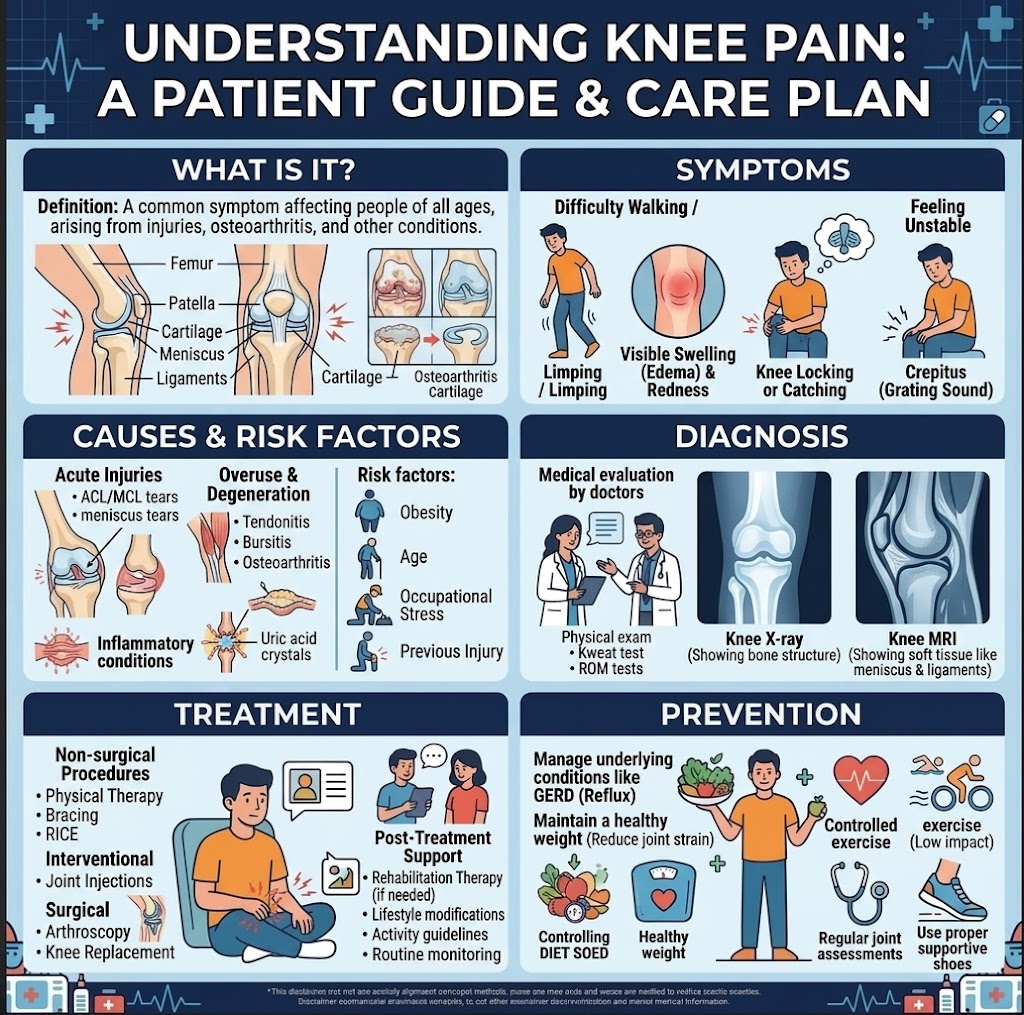
Knee pain is a highly common and treatable issue that affects people of all ages. It can occur suddenly due to acute injuries like ligament tears, or develop over time from mechanical strain or chronic underlying diseases like arthritis. Managing knee pain can range from simple self-care strategies to advanced medical and surgical treatments, depending on the root cause.
Understanding the Condition
Understanding Knee Pain: Symptoms, Diagnostics, and Treatment Options
Understanding the Condition
Common Symptoms
Swelling and Stiffness: Fluid buildup and inflammation around the joint, making it hard to comfortably bend or straighten your leg.
Redness and Warmth: The skin over your knee feels hot to the touch and looks noticeably red, which can indicate active inflammation or infection.
Weakness or Instability: A feeling that your knee is unstable, shaky, or might give out completely when you try to stand or walk.
Popping or Crunching Noises: Hearing or feeling clicking, grinding, or popping sounds within the joint when you move your leg.
Limited Range of Motion: An inability to fully stretch your leg out straight or bend your knee all the way.
Consultation Guide
Which Specialist to Meet
You should consult a Primary Care Physician initially, who may refer you to an Orthopedic Specialist (bone and joint doctor) or a Sports Medicine Specialist for advanced care.
Preparations Before Your Visit
Before your appointment, write down exactly when your pain started, what activities make it worse or better, and any previous injuries you have had. Wear loose, comfortable clothing that easily exposes your knee for the physical exam.
Book a doctor visit near me
Consultation Guide
Knee pain is a highly common and treatable issue that affects people of all ages. It can occur suddenly due to acute injuries like ligament tears, or develop over time from mechanical strain or chronic underlying diseases like arthritis. Managing knee pain can range from simple self-care strategies to advanced medical and surgical treatments, depending on the root cause.
Diagnostic Procedures
A quick, painless imaging test that uses low-dose radiation to create clear pictures of your bones. It is highly effective for detecting bone fractures and identifying signs of joint degeneration, such as bone-on-bone friction.
What to Expect
You will be asked to stand, sit, or lie down in specific positions so the machine can capture different angles of your knee. You must remain completely still for a few seconds while the image is taken. The process is completely painless and takes only a few minutes.
A safe imaging test that utilizes high-frequency sound waves to generate real-time pictures of the soft tissues surrounding your knee, including tendons, ligaments, and fluid pockets.
What to Expect
A technician will apply a warm gel to the skin over your knee and gently glide a hand-held device called a transducer across the area. You will feel mild pressure but no pain. The scan usually takes 15 to 30 minutes, and you can resume normal activities immediately.
An advanced imaging method that combines multiple X-ray angles to create detailed, 3D 'slices' of the bones, blood vessels, and soft tissues inside your knee.
What to Expect
You will lie flat on a motorized table that slowly glides into a large, doughnut-shaped scanner. You will need to lie very still to prevent blurry images. The test is painless and typically takes 10 to 15 minutes.
A minimally invasive surgical procedure where a specialist inserts a tiny, pencil-thin camera through a small incision to directly view and repair damage inside your knee joint.
What to Expect
Treatment Options
Home Care and Medications
The R.I.C.E. Protocol: Resting the joint, applying Ice packs, using a Compression bandage, and Elevating your leg to reduce acute swelling and pain. (Duration: 2 to 3 days immediately following a minor injury.)
Pain Relievers and Anti-inflammatories: Oral medications or topical creams designed to target pain and reduce joint inflammation. (Duration: A few days to several weeks, as directed by your physician.)
Joint Injections: Injections administered directly into the knee joint to target severe inflammation or provide artificial lubrication. (Duration: Provides temporary pain relief lasting 2 to 6 months per injection.)
Therapy and Joint Support
Physical Therapy: Targeted rehabilitation exercises designed to strengthen the thigh and hip muscles, improve joint stability, and restore full range of motion. (Duration: 4 to 12 weeks of structured sessions.)
Knee Bracing and Orthotics: Wearing specialized knee braces or custom shoe inserts to help stabilize the joint and shift painful weight away from damaged areas. (Duration: Used long-term during weight-bearing activities and exercise.)
Surgical Procedures
Partial Knee Replacement: A minimally invasive surgery where only the single damaged section of your knee is replaced with metal and plastic implants, preserving the healthy bone and ligaments. (Duration: Implant is designed to last 15 to 20 years; recovery takes 6 to 12 weeks.)
Prevention & Long-Term Wellbeing
This is performed in an outpatient surgical setting under anesthesia to ensure you feel no pain. The surgeon makes tiny cuts to insert the camera and miniature tools. Afterward, you will have small stitches, and full recovery generally takes a few weeks, sometimes requiring crutches or a brace.
Total Knee Replacement: A comprehensive surgical procedure where the entire worn-out joint surface is reshaped and replaced with a durable metal and high-grade plastic artificial joint. (Duration: Implant lasts 15 to 25 years; recovery and rehabilitation take 3 to 6 months.)
Prevention and Lifestyle Strategies
Maintain a Healthy Weight: Every extra pound of body weight adds extra stress on your knees. Staying at a healthy weight relieves pressure and slows down joint wear-and-tear.
Strengthen Supporting Muscles: Incorporate strength exercises for your quadriceps (front thigh) and hamstrings (back thigh). Strong muscles act as natural shock absorbers for your knee joints.
Switch to Low-Impact Exercises: If you experience knee discomfort, replace high-impact activities like running with gentler options such as swimming, water aerobics, or cycling.
Focus on Proper Technique: Ensure your body alignment and movement patterns during sports or everyday tasks are correct. Working briefly with a trainer can help prevent injury.
Tags & Topics
Notice an error or need an update?
Help us keep medical information accurate. Report incorrect info or suggest an edit.


