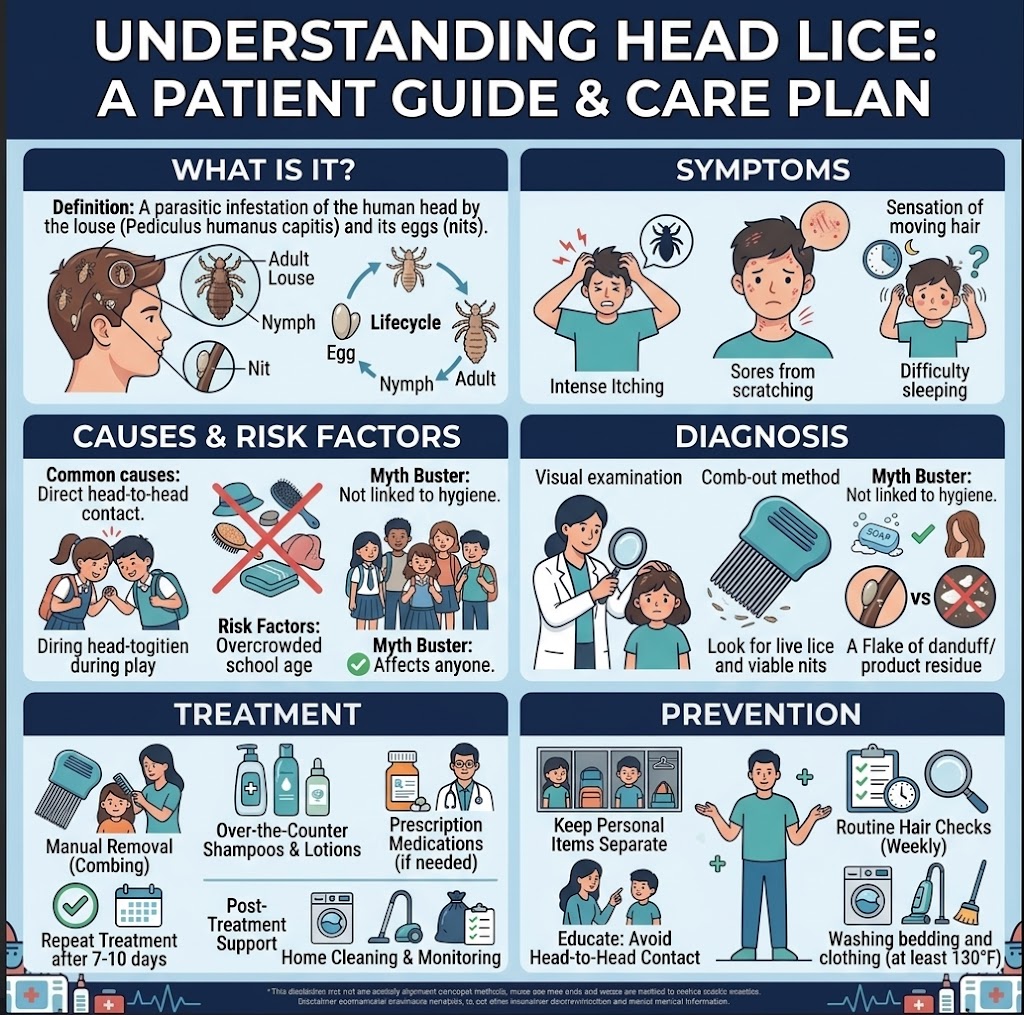
Lice are tiny, wingless insects that feed on human blood. They spread easily from person to person through close contact or by sharing personal items. There are three main types of lice, each infesting different parts of the body: head lice, body lice, and pubic lice (also known as 'crabs'). Understanding which type you may have is important for effective treatment and prevention.
Understanding the Condition
Lice: Understanding and Managing Infestations
Understanding the Condition
Common Symptoms
Itching: This is the most common symptom, caused by an allergic reaction to louse bites. The itching can be intense and persistent, occurring on the scalp, body, or in the genital area, depending on the type of lice.
Visible Lice: You may be able to see the live lice themselves. Adult lice are typically about the size of a sesame seed or slightly larger. They can be found crawling on the scalp, body, in clothing seams, or in pubic or other coarse body hair. They are often fast-moving and can be hard to spot.
Lice Eggs (Nits): Lice lay tiny eggs called nits, which are firmly glued to hair shafts close to the scalp. They are very small, teardrop-shaped, and can be difficult to see. Nits often appear white or yellowish and can be mistaken for dandruff, but unlike dandruff, they cannot be easily brushed or flicked off the hair. They are commonly found around the ears and at the back of the neck for head lice.
Sores and Bumps: Constant scratching can break the skin, leading to small red bumps or sores on the scalp, neck, shoulders, or other affected areas. These sores can become infected with bacteria, leading to tenderness, redness, and pus, which may require medical attention.
Bite Marks: In some cases, small red spots or areas of crusted blood from bites may be visible on the skin, particularly around the waist, groin, upper thighs, and pubic area, commonly associated with body or pubic lice.
Swollen Lymph Nodes: Children with head lice sometimes develop swollen lymph nodes (small, bean-shaped glands that are part of the immune system) in the neck, particularly behind the ears or at the back of the head. This indicates the body's immune response to the infestation.
Consultation Guide
Which Specialist to Meet
Before your visit, it's helpful to make a list of your symptoms, when they started, and any potential exposures (e.g., close contact with someone known to have lice, shared items). Avoid using any treatments or home remedies directly before your appointment, as this might make it harder for the doctor to confirm the diagnosis. Do not cut your hair before the appointment, as nits are easier to spot on longer strands.
Book a doctor visit near me
Educate and Check Family Members: If someone in your household has lice, regularly check all other family members for lice and nits, even if they don't show symptoms. Prompt treatment of all infested individuals prevents re-infestation.
Long-Term Monitoring and Support
Diagnostic Procedures
Most cases of lice can be managed by a general practitioner or a pediatrician (for children). If the diagnosis is unclear, treatment is ineffective, or if you suspect body lice or pubic lice with potential complications, you might be referred to a dermatologist, an infectious disease specialist, or a urologist/gynecologist (for sexually transmitted infection checks related to pubic lice).
Preparations Before Your Visit
Visual Inspection for Lice and Nits
The primary way to diagnose lice is by carefully examining the hair, scalp, skin, or clothing for the presence of live lice or nits (eggs). This usually involves a thorough visual check, often aided by a magnifying glass and a fine-toothed comb.
What to Expect
During the examination, the healthcare professional will part your hair section by section, starting from the scalp, or carefully examine the affected skin areas. For head lice, they will look closely at the base of hair shafts, especially behind the ears and at the nape of the neck, for nits and adult lice. A bright light and a magnifying glass may be used to improve visibility. For body lice, they will check clothing seams and bedding in addition to the skin. For pubic lice, the pubic hair and other coarse body hairs will be inspected. This procedure is quick, non-invasive, and painless.
Follow-up for Pubic Lice: If diagnosed with pubic lice, it is important to discuss with your healthcare provider whether testing for other sexually transmitted infections (STIs) is recommended, as pubic lice can sometimes coexist with other STIs.
Treatment Options
Lice are tiny, wingless insects that feed on human blood. They spread easily from person to person through close contact or by sharing personal items. There are three main types of lice, each infesting different parts of the body: head lice, body lice, and pubic lice (also known as 'crabs'). Understanding which type you may have is important for effective treatment and prevention.
Home Remedies and Environmental Cleaning
Wet-Combing: For head lice, thoroughly wet the hair and apply a regular conditioner to help untangle it. Use a fine-toothed nit comb (often metal) to systematically comb through the hair from scalp to tip, wiping the comb on a tissue after each stroke to remove lice and nits. Repeat this process every 3-4 days for at least two weeks after seeing the last louse. (Duration: At least 2 weeks, typically 2-3 weeks, performed every 3-4 days.)
Cleaning Personal Items and Environment: Wash all clothing, bedding, towels, and stuffed animals that have been in contact with the infested person in hot water (at least 130°F or 54°C) and dry them on a hot cycle. Items that cannot be washed can be dry-cleaned or sealed in an airtight bag for two weeks. Vacuum furniture and car interiors thoroughly. Soaking combs and brushes in hot water for 5-10 minutes can also help. (Duration: Ongoing during treatment and for several weeks after.)
Medications (Topical and Oral)
Over-the-Counter Topical Treatments: These typically contain ingredients that kill lice and nits. They are available as shampoos, lotions, or rinses. Follow the product instructions carefully regarding application time and rinsing. A second application is often recommended 7-10 days after the first to kill newly hatched lice. (Duration: Typically two applications, 7-10 days apart.)
Prescription Topical Treatments: For cases where over-the-counter options are ineffective or not suitable, a healthcare provider may prescribe stronger topical solutions. These treatments also involve applying the product to the affected area for a specified duration before rinsing. They often target the nervous system of lice or suffocate them. (Duration: Varies by product, often 1-2 applications, 7-10 days apart.)
Prescription Oral Medications: In some challenging cases, particularly for body lice or head lice that are resistant to topical treatments, an oral medication may be prescribed. This type of medication works systemically to kill lice. For pubic lice, if other treatments fail, oral options may also be considered, sometimes in conjunction with topical agents. (Duration: Varies; can be a single dose or a short course, as directed by a doctor.)
Post-Treatment Checks: Continue to check the hair or affected body areas regularly for several weeks after treatment to ensure that all lice and nits have been eradicated and to catch any new infestations early. Pay attention to any return of itching.
Inform Close Contacts: If you or a family member has lice, it's important to inform close contacts, such as schools, daycare centers, or close family and friends, so they can check themselves and take preventive measures. This helps to break the cycle of transmission.
Prevention & Long-Term Wellbeing
Prevention of Lice Spread
Avoid Head-to-Head Contact: The most common way head lice spread is through direct contact. Encourage children to avoid sharing helmets, hats, scarves, and close playtime that involves head contact. For adults, be mindful in crowded spaces or during activities involving close physical proximity.
Do Not Share Personal Items: Refrain from sharing combs, brushes, hair accessories, towels, hats, scarves, headphones, blankets, pillows, or clothing with others. This applies to all types of lice to minimize transmission.
Regular Hygiene for Body Lice: For body lice prevention, maintain good personal hygiene, including regular bathing and frequent changing into clean clothes (at least once a week). Ensure access to clean bedding and a clean living environment, especially in crowded settings.
Safe Sexual Practices: To prevent pubic lice, avoid sexual contact and sharing bedding or clothing with anyone known to have an infestation. If you are being treated for pubic lice, all current sexual partners should also be treated simultaneously.
Address Underlying Conditions (Body Lice): For body lice, addressing any underlying conditions that contribute to crowded or unsanitary living situations is crucial for long-term prevention. This includes access to clean water, laundry facilities, and stable housing.
Tags & Topics
Notice an error or need an update?
Help us keep medical information accurate. Report incorrect info or suggest an edit.


