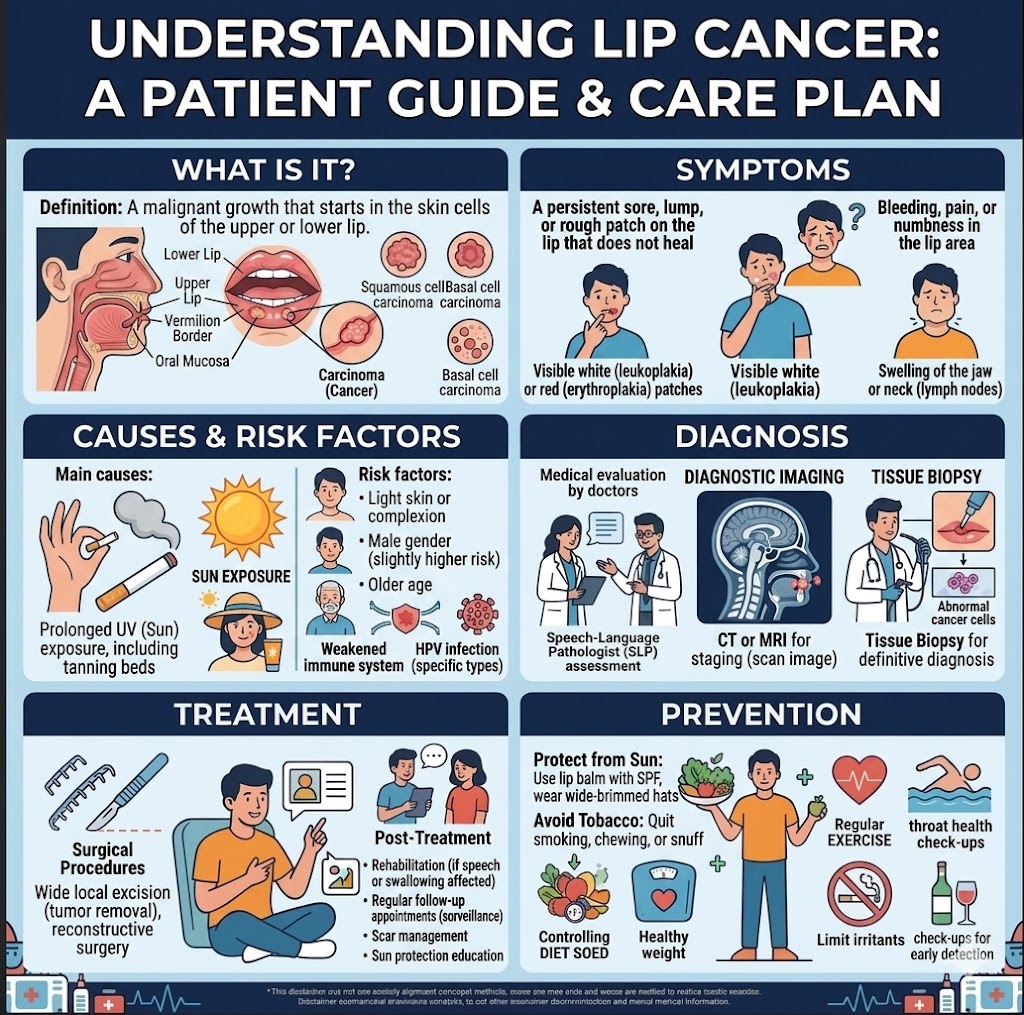
Lip cancer develops on the skin of the lips, most frequently on the lower lip. It is a type of oral (mouth) cancer, often starting in the flat cells on the skin's surface, known as squamous cell carcinoma. Significant risk factors include excessive sun exposure and tobacco use. Treatment usually involves surgical removal of the cancer, which can range from a minor procedure to more extensive surgery requiring reconstruction. If the ability to eat normally is affected by the cancer or its treatment, home enteral nutrition (tube feeding) may be necessary to ensure adequate nutrient intake.
Understanding the Condition
Understanding Lip Cancer and Supportive Care
Understanding the Condition
Common Symptoms
Changes in Lip Appearance: A flat or slightly raised area on the lip that appears whitish.
Non-Healing Sore: A persistent sore or ulcer on your lip that does not heal.
Unusual Sensations: Tingling, pain, or numbness of the lips or the skin around the mouth.
Consultation Guide
Which Specialist to Meet
If you experience persistent symptoms, first consult your primary care doctor. They may refer you to a dermatologist (skin specialist), an oral surgeon, or an oncologist (cancer specialist) for further evaluation and treatment. A plastic surgeon may be involved for reconstruction, and a registered dietitian or gastroenterologist might be consulted if nutritional support like tube feeding is considered.
Preparations Before Your Visit
Before your appointment, prepare to discuss your symptoms in detail, including when they started and how they've progressed. Provide your complete medical history, including any tobacco use, sun exposure habits, and current medications. Write down any questions you have.
Book a doctor visit near me
Consultation Guide
Lip cancer develops on the skin of the lips, most frequently on the lower lip. It is a type of oral (mouth) cancer, often starting in the flat cells on the skin's surface, known as squamous cell carcinoma. Significant risk factors include excessive sun exposure and tobacco use. Treatment usually involves surgical removal of the cancer, which can range from a minor procedure to more extensive surgery requiring reconstruction. If the ability to eat normally is affected by the cancer or its treatment, home enteral nutrition (tube feeding) may be necessary to ensure adequate nutrient intake.
Diagnostic Procedures
Your doctor will thoroughly examine your lips, inside your mouth, and your neck to check for any lumps, sores, or abnormal areas that could indicate cancer.
What to Expect
The doctor will visually inspect and gently feel your lips and surrounding areas. This is typically a quick and painless part of your visit.
A small tissue sample is taken from the suspicious area on your lip. This sample is then sent to a laboratory for examination under a microscope by a pathologist to definitively diagnose cancer.
What to Expect
The area will be numbed with a local anesthetic injection. Your doctor will then remove a small piece of tissue using a specialized tool. You might feel a brief sting from the anesthetic, but the procedure itself should be painless. A few stitches might be needed, and you may experience minor soreness or bleeding afterward.
Imaging Tests (e.g., CT scan, MRI scan)
If lip cancer is diagnosed, imaging tests may be used to determine the tumor's size and whether it has spread to nearby lymph nodes or other parts of the body.
What to Expect
You will lie on a table that moves into a large scanning machine. For a CT scan, the machine rotates around you, taking X-ray images. For an MRI, it uses strong magnets and radio waves. You might receive an injection of a special dye (contrast material) to enhance image clarity. These tests are generally painless but require you to remain very still for a period and can be noisy (especially an MRI).
Enteral Nutrition (Tube Feeding): A method of delivering liquid nutrition directly to the stomach or small intestine through a flexible tube, used when a person cannot eat or drink enough due to cancer or its treatment. Tubes can be placed through the nose (nasogastric or nasojejunal) for short-term use, or directly into the stomach (gastrostomy) or small intestine (jejunostomy) for longer-term needs. (Duration: Can be short-term (weeks to months) or long-term (months to years), depending on individual needs and expected duration of use.)
Treatment Options
Surgical Procedures
Surgical Excision: The most common treatment involves surgically removing the cancerous tumor along with a small margin of healthy tissue around it to ensure all cancer cells are eliminated. (Duration: A single procedure, with recovery typically taking several weeks.)
Mohs Micrographic Surgery: For smaller lip cancers, this precise technique involves removing cancer layer by layer, with each layer immediately examined under a microscope. This continues until no cancer cells are seen, preserving as much healthy tissue as possible. (Duration: Can take several hours in a single session, with recovery lasting several weeks.)
Reconstructive Surgery: Following extensive cancer removal, reconstructive surgery uses tissue from other body parts to restore the lip's appearance and function (such as eating and speaking). (Duration: Can involve one or more procedures over several months, with extended recovery.)
External Beam Radiation: High-energy beams, similar to X-rays, are directed at the tumor to kill cancer cells or shrink tumors. (Duration: Typically given daily over several weeks.)
Systemic Chemotherapy: Medications are administered, usually intravenously, to kill fast-growing cancer cells throughout the body. (Duration: Given in cycles over several months, depending on the specific regimen.)
Targeted Drug Therapy: Medications that specifically attack certain vulnerabilities or characteristics of cancer cells, often with fewer side effects than traditional chemotherapy. (Duration: Can be taken over several months or years, depending on the response and type of drug.)
Supportive Procedures
Regular Follow-up Appointments: After treatment, consistent check-ups with your medical team are crucial to monitor for any signs of recurrence or new cancers and to manage lingering side effects.
Self-Examination: Regularly examine your lips and mouth for any new or changing sores, lumps, or discolorations. Report anything unusual to your doctor promptly.
Prevention & Long-Term Wellbeing
Lymph Node Dissection: If there's a risk the cancer has spread to nearby lymph nodes in the neck, these nodes may be surgically removed and examined. (Duration: A single procedure, with recovery taking several weeks.)
Prevention
Quit or Avoid Tobacco: All forms of tobacco expose lip cells to dangerous cancer-causing chemicals. Quitting or never starting significantly reduces risk.
Limit Sun Exposure: Avoid prolonged sun exposure, especially between 10 a.m. and 4 p.m. when UV rays are strongest, even on cloudy days or in winter.
Use Sun Protection: Apply a broad-spectrum sunscreen with an SPF of at least 30 to your lips and face regularly, reapplying every two hours or more often if swimming or sweating. Wear a wide-brimmed hat to shade your face.
Avoid Tanning Beds: Tanning beds emit harmful UV rays that increase the risk of lip cancer.
Long-Term Monitoring
Healthy Lifestyle: Maintain a balanced diet, stay physically active as advised by your doctor, and continue to avoid tobacco and excessive sun exposure to support overall health and reduce cancer risk.
Tags & Topics
Notice an error or need an update?
Help us keep medical information accurate. Report incorrect info or suggest an edit.


