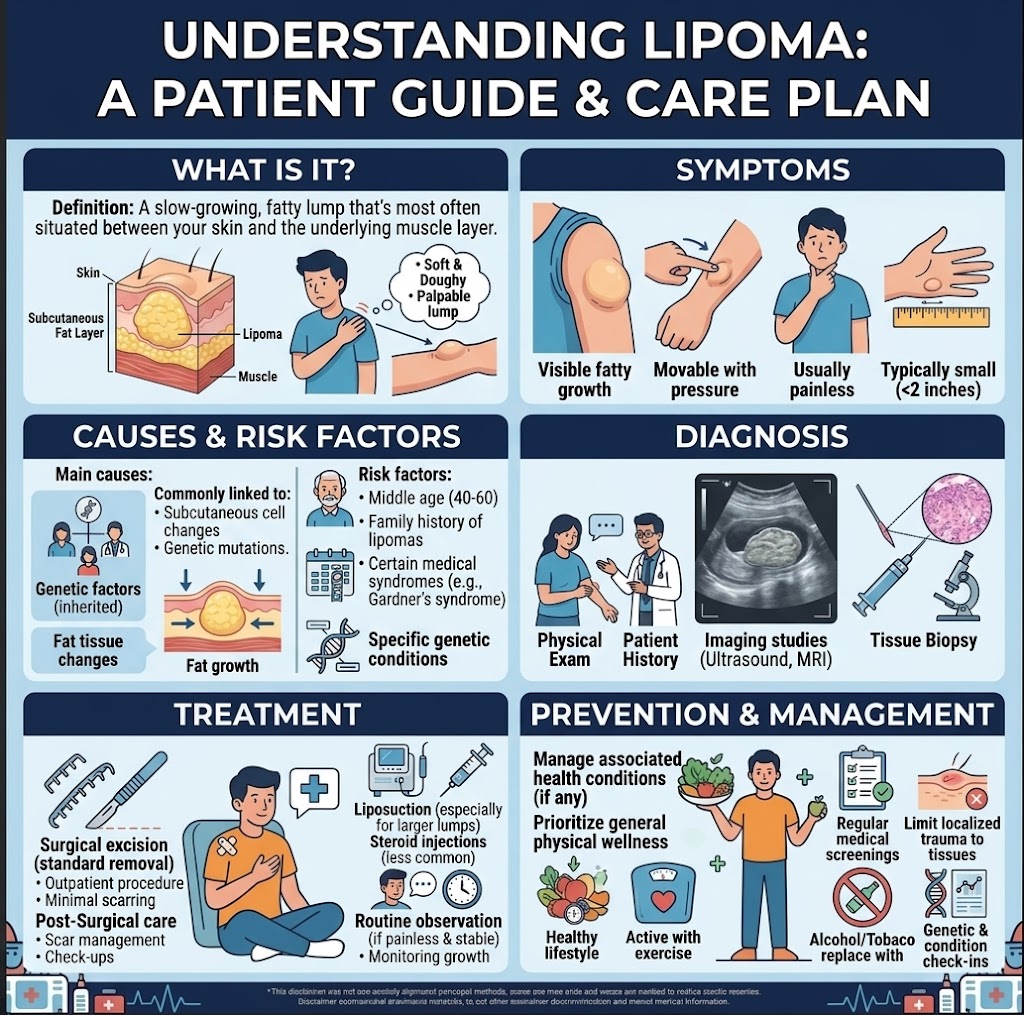
A lipoma is a common, non-cancerous growth of fatty tissue that forms slowly beneath the skin. It often feels soft, rubbery, and moves slightly when touched. While they can appear anywhere on the body, they are frequently found between the skin and muscle layers. Lipomas are generally harmless and typically don't require treatment unless they become bothersome, painful, or grow larger.
Understanding the Condition
Lipoma: Understanding Common Fatty Lumps
Understanding the Condition
Common Symptoms
Fatty Lump: A visible or palpable mass composed of fat cells, usually just below the skin.
Soft and Rubbery Feel: The lump typically feels soft to the touch and has a somewhat rubbery texture.
Movable Under Skin: It can be gently moved with slight finger pressure, suggesting it's not firmly attached to the surrounding skin or deep tissues.
Often Not Tender: Most lipomas are not painful or sensitive when pressed, though some can become tender if they press on nerves or have blood vessels.
Consultation Guide
Which Specialist to Meet
Start by consulting a general practitioner or family doctor. If further evaluation or removal is needed, they may refer you to a dermatologist (skin specialist) or a surgeon.
Preparations Before Your Visit
Be ready to discuss when you first noticed the lump, if it has changed in size or feel, and any associated symptoms like pain. You may also want to prepare a list of questions for your doctor.
Book a doctor visit near me
Watchful Waiting: For lipomas that are small, asymptomatic, and not growing, immediate treatment may not be needed. Regular self-monitoring for any changes in size, tenderness, or appearance is recommended. (Duration: Ongoing, unless symptoms develop or changes are observed.)
Consultation Guide
Genetic Predisposition & Risk Awareness: The exact cause of lipomas isn't fully understood, but they tend to run in families, suggesting a genetic link. Certain rare genetic conditions can also increase the risk. As direct prevention isn't generally possible, understanding your family history and being aware of these conditions is important.
Self-Monitoring & Regular Check-ups: Regularly examine your body for any new lumps or changes in existing ones. While most lipomas are harmless, any new or growing lump, especially if it becomes painful, firm, or changes significantly, should be checked by a healthcare professional to rule out other conditions.
Diagnostic Procedures
An ultrasound uses safe sound waves to create live images of internal body structures, helping to distinguish different types of lumps and assess their characteristics, such as whether they are solid or fluid-filled.
What to Expect
A clear gel is applied to your skin over the area to be examined. A small, handheld device (transducer) is then gently moved across the skin, creating images on a monitor. The procedure is typically painless. For certain abdominal or pelvic ultrasounds, specific preparation like fasting or drinking water might be required. You might be asked to wear loose clothing and remove jewelry.
CT (Computed Tomography) Scan
A CT scan combines X-rays and computer processing to create detailed cross-sectional images, or 'slices,' of bones, blood vessels, and soft tissues inside the body. It offers more detailed views than standard X-rays to precisely locate and characterize a lump, especially if it's deeper or larger.
What to Expect
You will lie on a motorized table that slides into a large, ring-shaped machine. You must remain still during the scan, and you might hear buzzing or clicking sounds. Depending on the body part being scanned, you might receive a special dye (contrast material) intravenously or by mouth to enhance image clarity, which may require fasting for a few hours beforehand.
A skin biopsy involves taking a small sample of skin tissue from the lump for examination under a microscope in a laboratory. This procedure is crucial to confirm the diagnosis and rule out other conditions.
What to Expect
The area around the lump will be numbed with a local anesthetic injection. The method of biopsy depends on the lump's characteristics:* **Shave Biopsy**: The top layer of the lump is carefully scraped off with a sterile razor blade or scalpel. Stitches are usually not needed.* **Punch Biopsy**: A small, circular, cookie-cutter-like tool is rotated into the skin to remove a deeper core of tissue. Stitches may be required to close the small hole.* **Excisional Biopsy**: The entire lump along with a small margin of surrounding healthy tissue is cut out with a scalpel. This typically requires stitches to close the wound.After any type of biopsy, the area will be bandaged, and you'll receive instructions on wound care.
Treatment Options
A lipoma is a common, non-cancerous growth of fatty tissue that forms slowly beneath the skin. It often feels soft, rubbery, and moves slightly when touched. While they can appear anywhere on the body, they are frequently found between the skin and muscle layers. Lipomas are generally harmless and typically don't require treatment unless they become bothersome, painful, or grow larger.
Home Remedies / Watchful Waiting
Surgical Removal (Excision): This is the most common and effective treatment. A surgeon makes a small incision over the lipoma and removes it completely. This is often performed under local anesthetic in an outpatient setting. (Duration: A one-time procedure. Recovery typically involves a few days to weeks for the incision to heal, with full recovery within a month.)
Prevention & Long-Term Wellbeing
Liposuction: Less common for typical lipomas, but may be used for larger or softer lipomas, or those in areas where a minimal scar is desired. A thin tube (cannula) is inserted through a small incision, and the fatty tissue is suctioned out. It is a method of fat removal and body contouring, not a weight-loss solution. (Duration: A one-time procedure. Recovery typically takes several weeks, with swelling and bruising gradually resolving.)
Prevention
Tags & Topics
Notice an error or need an update?
Help us keep medical information accurate. Report incorrect info or suggest an edit.


