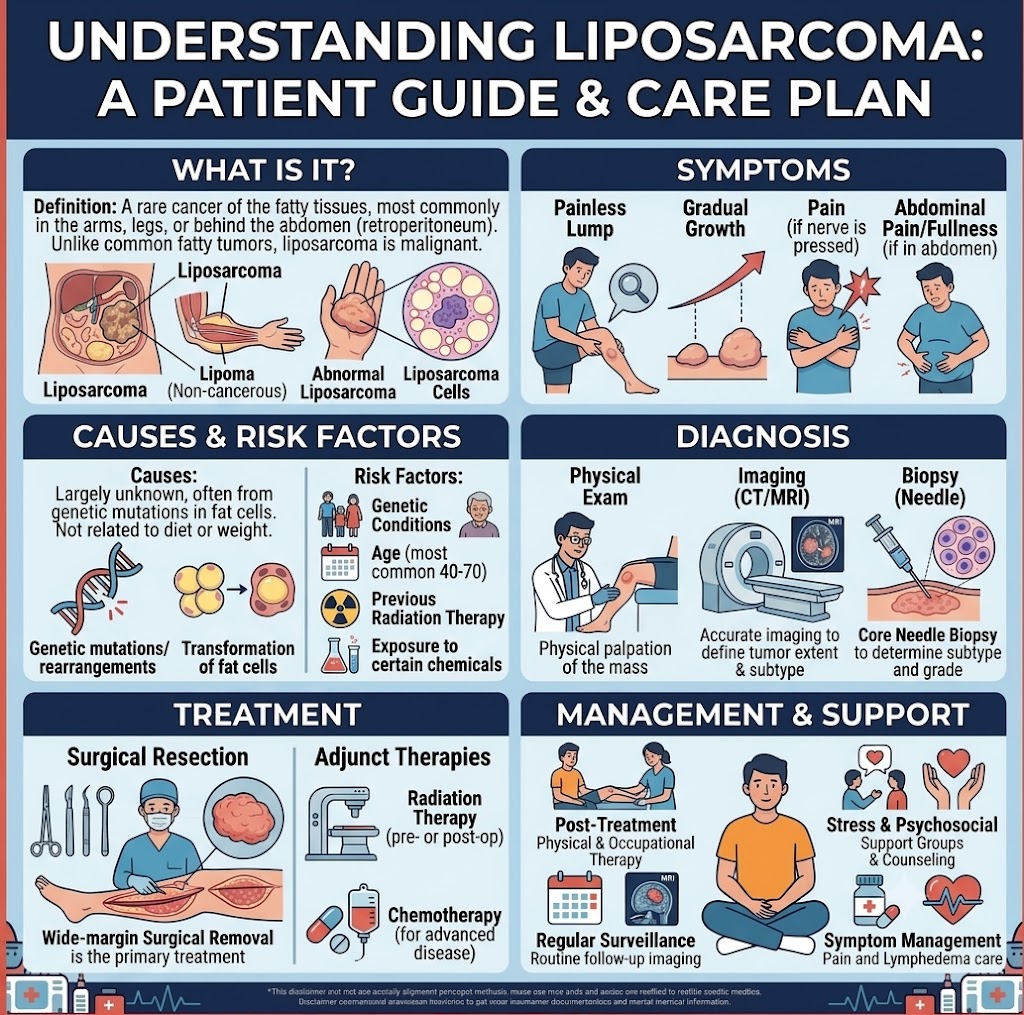
Liposarcoma is a rare type of cancer that begins in the fat cells of the body. While it can develop anywhere fat cells are found, it most commonly appears as a growth in the deep tissues of the arms, legs, or inside the belly. This condition typically affects older adults, but it can occur at any age. It is classified as a soft tissue sarcoma, a group of cancers that form in the body's connective tissues. Liposarcoma arises when fat cells undergo changes in their DNA, causing them to grow quickly, produce excess cells, and survive beyond their natural lifespan, forming a tumor. Treatment usually involves surgical removal of the tumor, often combined with other therapies like radiation.
Understanding the Condition
Liposarcoma: Understanding a Rare Cancer of Fat Cells
Understanding the Condition
Common Symptoms
Arms and Legs: Symptoms when liposarcoma develops in the limbs can include a noticeable, often painless, lump or swelling under the skin that may increase in size over time. You might also experience a feeling of weakness or difficulty moving the affected arm or leg, which can result from the tumor pressing on nearby nerves or muscles.
Belly (Abdomen): If liposarcoma forms in the abdomen, symptoms may include discomfort or pain in the stomach area, noticeable enlargement or swelling of the belly, and feeling full very quickly after starting to eat, even small amounts of food. Other digestive issues like constipation and, in some cases, blood in the stool, can also occur. Blood in stool requires immediate medical attention.
Consultation Guide
Which Specialist to Meet
When symptoms suggest liposarcoma, you will likely need to consult several specialists. This team may include an Oncologist (a cancer specialist), an Orthopedic Oncologist (a surgeon specializing in bone and soft tissue tumors, especially for limb tumors), a Surgical Oncologist (a surgeon who removes cancer), and potentially a Radiation Oncologist (a doctor specializing in using radiation to treat cancer). A pathologist will also play a crucial role in diagnosing the tissue samples.
Preparations Before Your Visit
To make the most of your appointment, prepare by bringing a detailed list of all your symptoms, including when they started and how they have changed. Compile your complete medical history, including past illnesses, surgeries, and any medications or supplements you are currently taking. Write down any questions you have for the doctor. Consider bringing a family member or friend to help take notes and remember information.
Book a doctor visit near me
The doctor will gently feel the symptomatic area and may check nearby lymph nodes. This is a quick and generally painless part of your initial visit.
Magnetic Resonance Imaging (MRI)
Uses magnets and radio waves for detailed images of soft tissues, precisely showing tumor size, location, and characteristics, and helping differentiate from other growths.
Diagnostic Procedures
Your doctor examines the affected area for lumps, swelling, or tenderness, and assesses your general health.
What to Expect
What to Expect
You'll lie still on a table inside a noisy, tunnel-like machine for 30-60 minutes. Earplugs are often provided. A contrast dye might be injected to improve image clarity.
Computed Tomography (CT) Scan
Uses X-rays for cross-sectional images, confirming tumor size and location, and checking for spread to other organs or bones.
What to Expect
You'll lie on a table that slides through a donut-shaped scanner for 10-30 minutes. A contrast dye may be administered.
Uses sound waves to create real-time images, helping to determine if a lump is solid or fluid-filled and providing an initial assessment.
What to Expect
Gel is applied to the skin, and a handheld device (transducer) is moved over the area. It's painless and takes 15-30 minutes.
Positron Emission Tomography (PET) Scan
Utilizes a radioactive sugar tracer to identify areas of increased metabolic activity, useful for detecting cancer spread throughout the body.
What to Expect
After an injection of the tracer, you'll wait about an hour before lying on a table for a 30-minute scan.
Biopsy (Core Needle or Incisional)
The definitive diagnostic procedure, involving removal of a tissue sample for microscopic examination to confirm cancer, its type, and grade.
What to Expect
Performed under local anesthesia, either by guiding a needle into the tumor (core needle biopsy, often with imaging) or through a small surgical incision (incisional biopsy). You may feel some pressure or minor discomfort, followed by soreness.
Treatment Options
Liposarcoma is a rare type of cancer that begins in the fat cells of the body. While it can develop anywhere fat cells are found, it most commonly appears as a growth in the deep tissues of the arms, legs, or inside the belly. This condition typically affects older adults, but it can occur at any age. It is classified as a soft tissue sarcoma, a group of cancers that form in the body's connective tissues. Liposarcoma arises when fat cells undergo changes in their DNA, causing them to grow quickly, produce excess cells, and survive beyond their natural lifespan, forming a tumor. Treatment usually involves surgical removal of the tumor, often combined with other therapies like radiation.
Surgical Procedures
Tumor Removal (Wide Local Excision): The primary treatment involves surgically removing the tumor along with a margin of surrounding healthy tissue to ensure complete removal of cancer cells while preserving function. (Duration: Surgery lasts several hours. Recovery ranges from weeks to several months depending on tumor size and location.)
External Beam Radiation Therapy: High-energy X-rays target cancer cells, used before surgery to shrink tumors or after surgery to destroy remaining cells and reduce recurrence risk. (Duration: Typically given five days a week for 5-7 weeks; each session is short.)
Brachytherapy (Internal Radiation): Radioactive sources are temporarily placed directly within or near the tumor during surgery for highly localized radiation delivery. (Duration: Sources remain in place for a few days before removal.)
Medications
Chemotherapy: Anti-cancer drugs administered intravenously to kill cancer cells throughout the body, used if cancer has spread or if other treatments are insufficient. (Duration: Administered in cycles over several months, depending on the regimen and patient response.)
Targeted Therapy: Drugs that specifically attack vulnerabilities in cancer cells, inhibiting their growth and spread with less harm to healthy cells. Often customized to the tumor's genetic profile. (Duration: Can continue for months or years if effective and well-tolerated.)
Supportive Care and Rehabilitation
Physical and Occupational Therapy: Helps patients regain strength, mobility, and function after treatment, aiding in recovery and daily living adjustments. (Duration: Starts post-treatment, continuing for weeks to many months as needed for recovery.)
Pain Management: Strategies to alleviate discomfort during and after treatment, involving medications and non-pharmacological approaches. (Duration: Ongoing as required throughout the treatment and recovery process.)
Post-Treatment Care & Support
Consistent Follow-up Care: Adhere to all scheduled follow-up appointments, including physical exams and imaging, to monitor for any recurrence or new developments.
Engage in Rehabilitation: Participate in recommended physical or occupational therapy to regain strength, mobility, and improve daily function after treatment.
Seek Emotional Support: Connect with support groups, counselors, or therapists to manage the emotional and psychological impact of cancer and its treatment.
Prevention & Long-Term Wellbeing
Risk Awareness & Early Detection
Monitor Body for Lumps: Regularly examine your body for any new, growing, or suspicious lumps, particularly in areas like arms, legs, and abdomen. Report such findings to a doctor promptly.
Embrace a Healthy Lifestyle: While specific prevention is unclear, maintaining a balanced diet, engaging in regular exercise, and avoiding tobacco can contribute to overall health and potentially reduce general cancer risk.
Tags & Topics
Notice an error or need an update?
Help us keep medical information accurate. Report incorrect info or suggest an edit.


