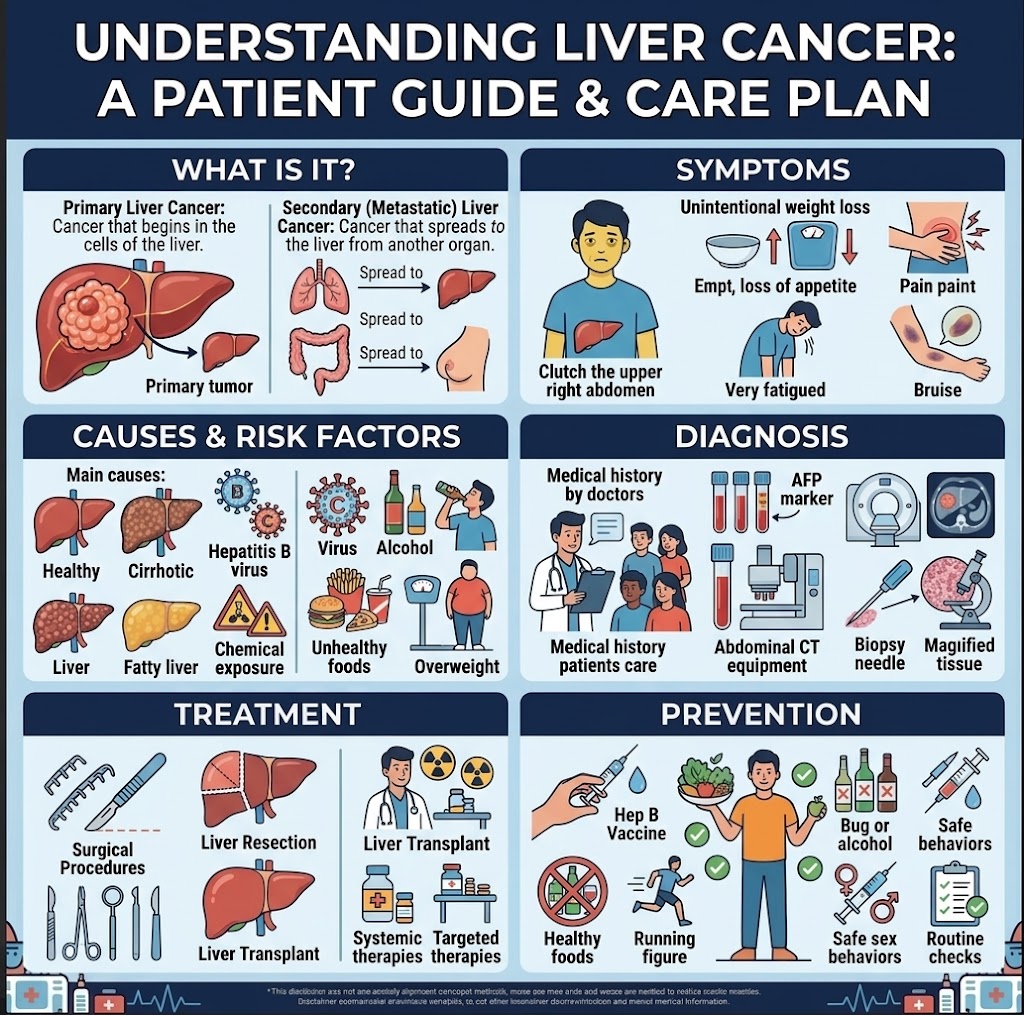
Liver cancer is a disease where abnormal cells begin to grow out of control in your liver, a football-sized organ located in the upper right part of your belly, just under your ribs. While several types can form, the most common is hepatocellular carcinoma, which starts in the main liver cells. It's important to know that cancer starting elsewhere in the body (like the colon or lung) and spreading to the liver is called metastatic cancer, not primary liver cancer, and is named for its original location.
Understanding the Condition
Liver Cancer: Understanding, Symptoms, and Care
Understanding the Condition
Liver cancer is a disease where abnormal cells begin to grow out of control in your liver, a football-sized organ located in the upper right part of your belly, just under your ribs. While several types can form, the most common is hepatocellular carcinoma, which starts in the main liver cells. It's important to know that cancer starting elsewhere in the body (like the colon or lung) and spreading to the liver is called metastatic cancer, not primary liver cancer, and is named for its original location.
Common Symptoms
Unexplained Weight Loss: Losing weight without trying to.
Loss of Appetite: Feeling full quickly or not wanting to eat.
Upper Belly Pain: Discomfort or pain in the upper right side of the abdomen.
Nausea and Vomiting: Feeling sick to your stomach and throwing up.
General Weakness and Fatigue: Feeling unusually tired or lacking energy.
Abdominal Swelling: A noticeable increase in the size of your belly.
Jaundice: Yellowing of your skin and the whites of your eyes.
Pale Stools: Stools that are white or chalky in color.
Consultation Guide
Which Specialist to Meet
If you experience concerning symptoms, your first step should be to see your primary care physician. They may then refer you to specialists such as a gastroenterologist (a doctor specializing in digestive organs), a hepatologist (a liver specialist), an oncologist (a cancer specialist), or a surgeon.
Preparations Before Your Visit
Before your visit, make a list of your symptoms, including when they started and how often they occur. Be prepared to discuss your medical history, any underlying health conditions, and current medications. It can also be helpful to write down any questions you have for the doctor.
Book a doctor visit near me
Palliative Care: Specialized medical care focused on providing relief from pain and other symptoms of a serious illness, and improving quality of life for both the patient and their family. It can be provided alongside other treatments. (Duration: Ongoing, as needed, throughout the course of the illness.)
Consultation Guide
A small amount of blood will be drawn from a vein in your arm. The process is quick and causes minimal discomfort.
Maintain a Healthy Weight: Achieve and maintain a healthy weight through a balanced diet and regular exercise. This helps prevent nonalcoholic fatty liver disease, a risk factor for liver cancer.
Get Vaccinated Against Hepatitis B: The hepatitis B vaccine is highly effective in preventing chronic infection, a major risk factor for liver cancer. It is recommended for almost everyone, including infants and adults.
Prevent Hepatitis C Infection: There is no vaccine for hepatitis C. Reduce your risk by practicing safe sex, avoiding intravenous drug use (or using sterile needles and not sharing), and ensuring any piercings or tattoos are done in clean, reputable shops with sterile equipment.
Regular Medical Check-ups: Especially for individuals with known risk factors (e.g., cirrhosis, chronic hepatitis), regular monitoring with your doctor can help detect liver cancer early.
Diagnostic Procedures
Alanine Aminotransferase (ALT) Blood Test
This is a blood test that measures the level of an enzyme called ALT, mainly found in the liver. High levels can indicate liver cell irritation or damage.
What to Expect
A small amount of blood will be drawn from a vein in your arm, similar to any routine blood test. You might feel a brief pinch or sting.
Alkaline Phosphatase (ALP) Blood Test
This blood test measures ALP, an enzyme found mostly in the liver and bones. Elevated levels can suggest liver or bone problems.
What to Expect
A nuclear imaging test that uses a small amount of a radioactive substance (tracer) to detect bone diseases or cancer that has spread to the bones.
What to Expect
You'll receive an injection of a radioactive tracer into a vein. After a waiting period (a few hours) for the tracer to absorb, you'll lie still on a table while a special camera scans your body. The scan itself is painless.
An imaging test that uses radiation to create pictures of your heart, lungs, blood vessels, airways, and chest bones, helping to detect problems in these areas.
What to Expect
You will stand or sit against a flat plate while a machine sends a brief burst of X-rays. You'll be asked to hold your breath for a few seconds. The procedure is quick and painless.
CT Scan (Computerized Tomography)
A CT scan uses multiple X-ray images taken from different angles to create detailed cross-sectional pictures (slices) of bones, blood vessels, and soft tissues inside the body.
What to Expect
You'll lie on a motorized table that slides into a large, donut-shaped machine. You may hear humming or clicking noises. Sometimes, a contrast dye is given by injection or swallowed to highlight certain areas. You'll need to remain still during the scan.
A procedure to remove a small sample of liver tissue for microscopic examination in a lab, helping to diagnose damage or disease and guide treatment decisions.
What to Expect
You'll typically receive a local anesthetic to numb the area. A thin needle is then inserted through the skin into the liver to collect a tissue sample. You might feel pressure or a brief, sharp pain. Other methods, like transjugular (through a neck vein) or laparoscopic (small incision), may also be used depending on your specific situation. You'll need to rest afterwards.
An imaging technique that uses high-frequency sound waves to create live images of internal body structures, like the liver.
What to Expect
A gel is applied to your skin over the area to be examined. A handheld device (transducer) is then moved across the skin, sending sound waves and receiving echoes to create images. It is generally painless and quick.
Discussion of Screening Options: For those at high risk of liver cancer, discuss with your doctor whether regular screening tests, such as imaging or blood tests, are appropriate for you.
Treatment Options
Procedures and Therapies
Ablation Therapy: A minimally invasive procedure that uses extreme heat (radiofrequency ablation) or cold (cryoablation), lasers, or chemicals to destroy abnormal or cancerous liver tissue. (Duration: A single session or multiple sessions, depending on the tumor. Recovery is often shorter than traditional surgery.)
Chemotherapy: Medication treatment using powerful chemicals to kill fast-growing cancer cells throughout the body. It can be given intravenously or orally. (Duration: Administered in cycles, typically over several weeks to months, with rest periods in between.)
Hepatic Artery Infusion Pump (HAIP) Chemotherapy: A surgically implanted pump under the skin delivers high doses of chemotherapy directly to the liver through its main artery, minimizing side effects on the rest of the body. (Duration: Requires an initial surgical procedure to implant the pump, followed by ongoing medication refills as determined by your care team.)
Radiation Therapy: Uses high-energy beams to kill cancer cells or shrink tumors. This can involve external beams aimed at the liver or small radioactive implants placed near the tumor (brachytherapy). Proton therapy, a newer form, uses positively charged particles. (Duration: Typically given in multiple daily sessions over several weeks.)
Surgical Procedures
Liver Transplant: A major surgery to remove a diseased liver and replace it with a healthy liver from a deceased donor or a portion of a healthy liver from a living donor. This is an option for certain cases of liver cancer. (Duration: The surgery itself takes several hours, followed by a hospital stay and a long recovery period involving lifelong anti-rejection medications.)
Manage Chronic Hepatitis Infections: If you have chronic hepatitis B or C, work with your doctor to manage the infection, as treatment can significantly reduce the risk of liver cancer.
Address Underlying Liver Conditions: If you have inherited liver diseases like hemochromatosis or Wilson's disease, or conditions like cirrhosis or diabetes, follow your doctor's recommendations for management to lower your risk.
Avoid Aflatoxin Exposure: Minimize consumption of foods that may be contaminated with aflatoxins, poisons produced by molds that can grow on poorly stored grains and nuts.
Long-Term Monitoring and Support
Prevention & Long-Term Wellbeing
Prevention of Liver Cancer
Limit Alcohol Consumption: Drinking alcohol in moderation, if at all, can reduce your risk of liver damage and cirrhosis. For women, this generally means no more than one drink per day; for men, no more than two.
Tags & Topics
Notice an error or need an update?
Help us keep medical information accurate. Report incorrect info or suggest an edit.


