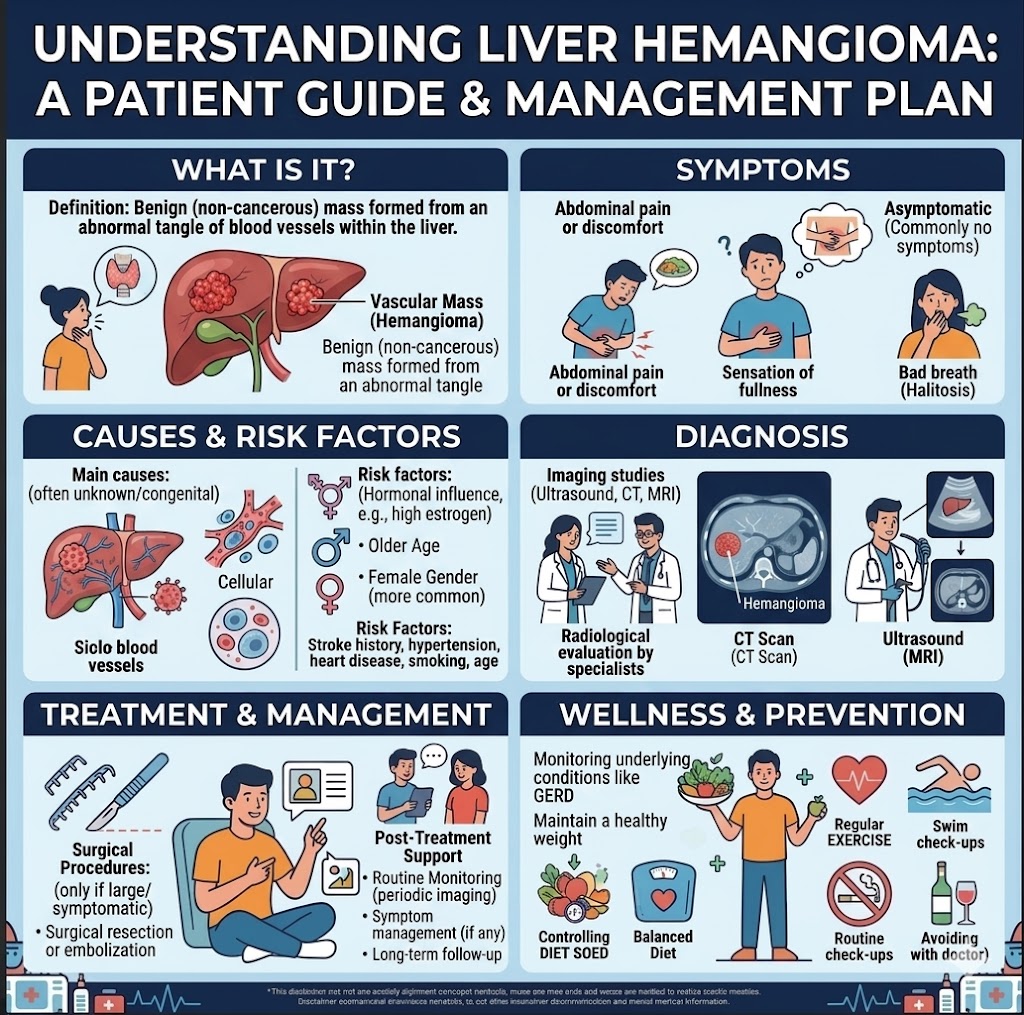
A liver hemangioma (pronounced: heh-man-jee-OH-muh) is a common, non-cancerous growth found in the liver. It's essentially a tangled cluster of blood vessels. Often called a "hepatic hemangioma," these masses are usually discovered by chance during medical tests for other health concerns. They are very common, affecting up to 20% of people. Most individuals with a liver hemangioma experience no symptoms and typically do not require any treatment. While finding a mass in your liver can be concerning, there is no evidence that an untreated liver hemangioma will turn into liver cancer. The liver is your largest internal organ, about the size of a football, located mainly in the upper right part of your belly, beneath the diaphragm.
Understanding the Condition
Liver Hemangioma: A Simple Guide to a Common Liver Mass
Understanding the Condition
A liver hemangioma (pronounced: heh-man-jee-OH-muh) is a common, non-cancerous growth found in the liver. It's essentially a tangled cluster of blood vessels. Often called a "hepatic hemangioma," these masses are usually discovered by chance during medical tests for other health concerns. They are very common, affecting up to 20% of people. Most individuals with a liver hemangioma experience no symptoms and typically do not require any treatment. While finding a mass in your liver can be concerning, there is no evidence that an untreated liver hemangioma will turn into liver cancer. The liver is your largest internal organ, about the size of a football, located mainly in the upper right part of your belly, beneath the diaphragm.
Common Symptoms
No Symptoms: In the vast majority of cases, a liver hemangioma does not cause any noticeable symptoms.
Rare Symptoms: When symptoms do occur, which is very rare and typically only with larger hemangiomas, they may include: Pain in the upper right abdomen; Feeling full after eating only a small amount (early satiety); Nausea and vomiting. Important Note: These symptoms are often caused by other conditions. If you experience any persistent or worrying symptoms, it's important to consult a healthcare professional.
Consultation Guide
Which Specialist to Meet
You should initially consult your primary care doctor or a gastroenterologist (a doctor specializing in digestive system and liver conditions). If the hemangioma is large or causing very rare symptoms, they might refer you to a hepatologist (a liver specialist) or a surgeon.
Preparations Before Your Visit
Before your visit, make a list of any symptoms you're experiencing, including when they started and how severe they are. Note down any medications, supplements, or vitamins you're currently taking. Be prepared to discuss your medical history, including any previous diagnoses or family medical conditions. It’s helpful to bring copies of any prior imaging reports or blood test results if you have them.
Book a doctor visit near me
Watchful Waiting / Observation: For most asymptomatic liver hemangiomas, the primary approach is no treatment. Instead, your doctor may recommend periodic monitoring with imaging tests (like ultrasound or MRI) to check if the hemangioma is growing. This is a common and safe strategy. (Duration: Ongoing, typically with follow-up imaging every 6-12 months initially, then less frequently if stable.)
Surgical Removal (Resection/Enucleation): If a hemangioma is large, causing significant symptoms, or if there's uncertainty about the diagnosis, surgeons may remove the tumor (enucleation) or the affected part of the liver (resection). This is a major surgery. (Duration: One-time surgery, followed by a hospital stay (days to a week) and a recovery of several weeks to months.)
Radiation Therapy: Radiation therapy uses high-energy beams to shrink the hemangioma. It's rarely used for liver hemangiomas, typically only when surgery is not an option and symptoms are severe. It carries potential risks to healthy liver tissue. (Duration: Usually delivered over several weeks in multiple daily sessions.)
Symptom Awareness: While rare, be aware of any new or worsening symptoms like persistent abdominal pain, unexplained fullness, nausea, or vomiting. Report these to your doctor promptly, even if they are likely due to other causes, to ensure thorough evaluation.
Consultation Guide
Liver Transplant: In extremely rare and severe situations, such as when a massive hemangioma damages the entire liver or causes life-threatening complications, a liver transplant might be considered. This involves replacing the diseased liver with a healthy liver from a donor. (Duration: A one-time, complex surgical procedure, followed by a significant hospital stay (weeks) and a lifelong need for anti-rejection medications.)
Maintain a Healthy Weight: Obesity is a risk factor for various liver conditions. Regular exercise and a healthy diet can help maintain a healthy weight, supporting overall liver function.
Diagnostic Procedures
Ultrasound, or sonography, uses sound waves to create live images of internal organs like the liver. It's a common, safe test that helps visualize the size and structure of a hemangioma.
What to Expect
You'll lie on a table while a technician applies a gel to your abdomen. A small handheld device (transducer) is moved over the skin, sending sound waves and capturing echoes to create images. You might feel slight pressure. The procedure takes about 15-30 minutes. You may need to fast or have a full bladder depending on the area scanned.
CT Scan (Computerized Tomography Scan)
A CT scan uses specialized X-rays and computer processing to create detailed cross-sectional images ("slices") of your internal organs, including the liver. This offers a more precise view of a hemangioma's characteristics and helps distinguish it from other masses.
What to Expect
You'll lie still on a motorized table that slides into a large, donut-shaped machine. You might be asked to hold your breath. A contrast dye may be injected to enhance images, causing a warm sensation or metallic taste. The scan is noisy and takes 10-30 minutes.
SPECT Scan (Single-Photon Emission Computed Tomography Scan)
A SPECT scan is a nuclear imaging test that uses a small amount of a radioactive tracer and a special camera to produce 3D images showing how organs function, particularly blood flow. It can help confirm the nature of a liver hemangioma by revealing its unique blood flow patterns.
What to Expect
A small amount of radioactive tracer is injected into a vein. After a waiting period for the tracer to distribute, you'll lie still on a table while a camera rotates around your body to detect the tracer's emissions. This scan typically takes 20-40 minutes.
Regular Follow-up Imaging: For diagnosed liver hemangiomas that are not being actively treated, regular check-ups with your doctor and follow-up imaging (e.g., ultrasound or MRI) are crucial to monitor the size and characteristics of the hemangioma. This helps ensure it remains stable and non-problematic.
Treatment Options
Artery Ligation: In some rare cases where a hemangioma is very large and cannot be safely removed, the main artery supplying blood to the hemangioma can be tied off. This cuts off the blood supply, causing the hemangioma to shrink. The rest of the liver receives blood from other vessels. (Duration: A one-time surgical procedure, with recovery similar to other abdominal surgeries.)
Avoid Unnecessary Medications/Supplements: Be cautious with over-the-counter medications, herbal remedies, and supplements. Always inform your doctor about anything you are taking, as some can impact liver function.
Prevention & Long-Term Wellbeing
Lifestyle Adjustments for General Liver Health
Healthy Diet: Maintain a balanced diet rich in fruits, vegetables, and whole grains. Limit processed foods, excessive sugars, and saturated fats, which can contribute to overall liver strain.
Moderate Alcohol Consumption: Avoid excessive alcohol intake, as it can be harmful to liver health. Follow recommended guidelines for moderate drinking or abstain if advised by your doctor.
Tags & Topics
Notice an error or need an update?
Help us keep medical information accurate. Report incorrect info or suggest an edit.


