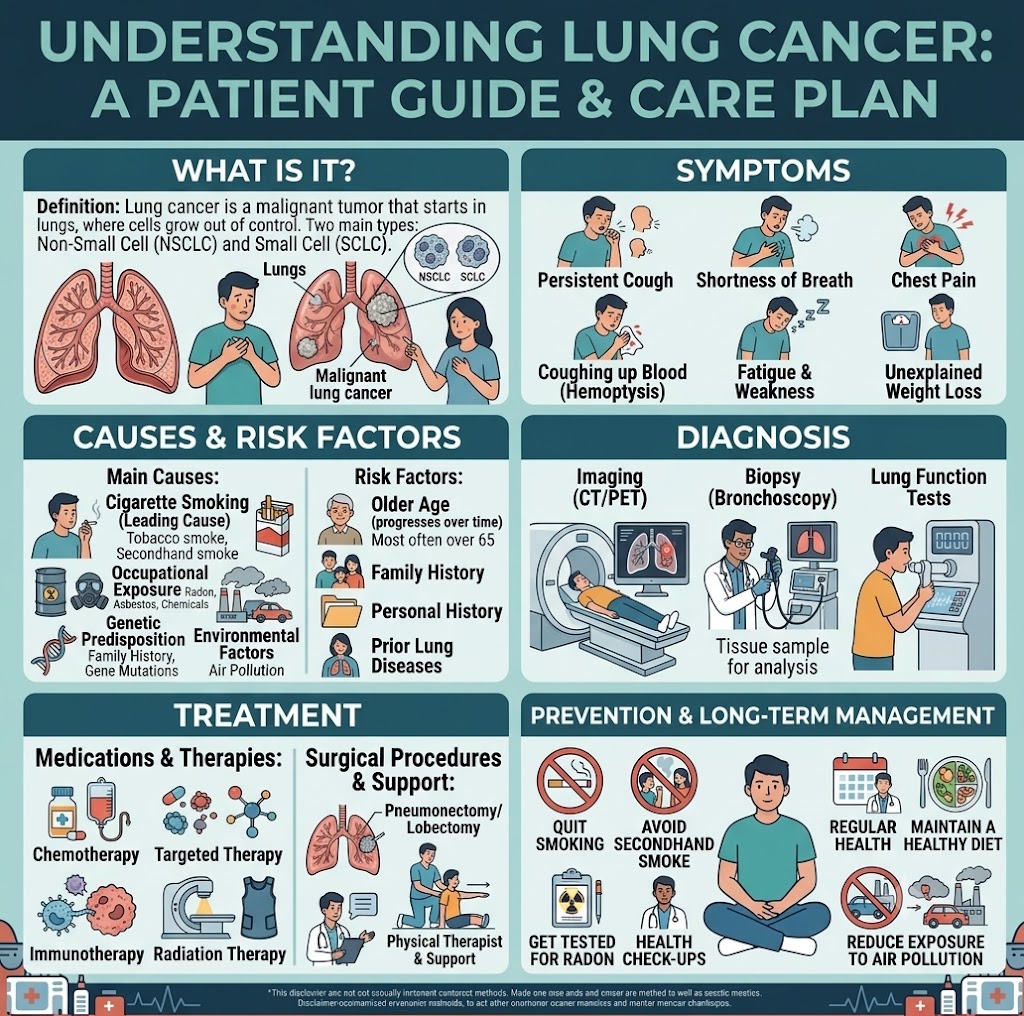
Lung cancer begins with an uncontrolled growth of cells in the lungs, the two spongy organs in your chest responsible for breathing. It is a leading cause of cancer deaths worldwide. While smoking is the most significant risk factor, increasing with the duration and amount smoked, lung cancer can also occur in individuals who have never smoked. Quitting smoking, even after many years, greatly reduces your risk.
Understanding the Condition
Lung Cancer: Understanding the Condition
Understanding the Condition
Common Symptoms
Early Symptoms (Often Absent): Lung cancer typically doesn't cause noticeable symptoms in its early stages. Symptoms usually appear when the disease has advanced.
Symptoms Near the Lungs: These may include a new cough that doesn't go away, persistent chest pain, coughing up blood (even a small amount), hoarseness, and shortness of breath.
Symptoms from Cancer Spread: If lung cancer spreads to other parts of the body, symptoms can include unexplained weight loss, loss of appetite, and swelling in the face or neck.
Consultation Guide
Which Specialist to Meet
Initially, you might see your primary care physician (PCP) for persistent symptoms. They may then refer you to a lung specialist (pulmonologist) or a cancer specialist (oncologist) for further evaluation and treatment.
Preparations Before Your Visit
Before your visit, list all your symptoms, including when they started and how severe they are. Bring a list of your current medications, any relevant medical history, and prepare questions to ask your doctor.
Book a doctor visit near me
This specialized CT scan uses a lower dose of radiation than a standard CT and is recommended for certain high-risk individuals (e.g., current or former heavy smokers) who don't have symptoms, to detect lung cancer at its earliest, most treatable stage.
Symptom Awareness: Be vigilant about new or worsening symptoms and report them to your doctor immediately. This allows for early detection and management of potential issues.
Consultation Guide
Lung cancer begins with an uncontrolled growth of cells in the lungs, the two spongy organs in your chest responsible for breathing. It is a leading cause of cancer deaths worldwide. While smoking is the most significant risk factor, increasing with the duration and amount smoked, lung cancer can also occur in individuals who have never smoked. Quitting smoking, even after many years, greatly reduces your risk.
Diagnostic Procedures
A quick and painless imaging test that uses radiation to create pictures of the structures inside your chest, including your lungs, heart, and bones. It can reveal abnormalities like masses or fluid.
What to Expect
You will stand or sit in front of an X-ray machine, holding your breath for a few seconds while the images are taken. It's a very brief procedure.
CT Scan (Computed Tomography)
This advanced imaging technique uses a series of X-rays taken from different angles to create detailed cross-sectional images (slices) of your bones, blood vessels, and soft tissues, offering more detail than a standard X-ray.
What to Expect
You will lie on a narrow table that slides into a large, donut-shaped machine. You might receive a contrast dye injected into a vein to highlight certain areas. You'll need to stay still during the scan, which usually takes 10-30 minutes.
PET Scan (Positron Emission Tomography)
A PET scan is an imaging test that helps reveal the metabolic activity of your body's tissues and organs. It uses a radioactive sugar-like substance (tracer) that cancer cells absorb more readily, making them appear brighter on the scan. Often combined with a CT scan (PET-CT).
What to Expect
A small amount of radioactive tracer will be injected into your arm. After about an hour for the tracer to circulate, you will lie on a table that slides into the PET scanner. The scan itself takes about 30 minutes.
A procedure that allows a doctor to look inside your lungs and air passages. A thin, flexible tube (bronchoscope) with a camera is passed through your nose or mouth, down your throat, and into your lungs to visualize the airways, take tissue or fluid samples, or remove blockages.
What to Expect
The definitive way to diagnose cancer involves taking a small piece of tissue or fluid from the suspicious area to be examined under a microscope by a pathologist. This can be done during a bronchoscopy, with a needle guided by imaging, or surgically.
What to Expect
What to Expect
A nuclear imaging test that helps diagnose and track bone diseases, including cancer that has spread to the bones. It uses a radioactive tracer that is absorbed more by areas of increased bone activity, which can indicate cancer or injury.
What to Expect
A small amount of radioactive tracer is injected into your vein. After a waiting period (often 2-3 hours) for the tracer to be absorbed, you will lie on a table while a special camera scans your entire body. The scan itself takes about 30 minutes to an hour.
Lung Cancer Screening (Low-Dose CT)
What to Expect
Similar to a regular CT scan, you will lie on a table that slides into the scanner. It is a quick and non-invasive procedure designed to be efficient.
Test Your Home for Radon: Radon is a naturally occurring radioactive gas that can accumulate in homes. Test your home's radon levels, especially if you live in a known problem area, and take steps to reduce levels if they are high.
Protect Yourself at Work: If your job involves exposure to cancer-causing chemicals (carcinogens) like asbestos, arsenic, or nickel, follow all safety precautions, including wearing protective gear like masks.
Treatment Options
You'll likely receive medication to help you relax and numb your throat. The bronchoscope is gently inserted, and you may feel some pressure or coughing. The procedure usually takes 30-60 minutes, and you'll be monitored afterward until the sedative wears off.
Biopsy (Tissue Sample)
Surgical Procedures
Wedge Resection: Removal of a small, wedge-shaped piece of the lung that contains the tumor and a margin of healthy tissue. (Duration: Typically 1-2 hours for the surgery itself, followed by hospital stay and recovery time.)
Segmental Resection: Removal of a larger section or 'segment' of the lung containing the tumor. (Duration: Usually 2-3 hours for the surgery itself, followed by hospital stay and recovery time.)
Lobectomy: Removal of an entire lobe (section) of the lung. Lungs have multiple lobes (three on the right, two on the left). (Duration: Generally 2-4 hours for the surgery itself, followed by hospital stay and recovery time.)
Pneumonectomy: Removal of an entire lung. This is performed when the cancer is widespread within one lung. (Duration: Typically 3-5 hours for the surgery itself, followed by hospital stay and recovery time.)
Therapies
Radiation Therapy (External Beam): Uses high-energy beams, often X-rays, directed from outside the body to precisely target and kill cancer cells while minimizing damage to healthy tissue. (Duration: Usually administered daily for several weeks, with each session lasting a few minutes.)
Brachytherapy (Internal Radiation): Involves placing radioactive material directly inside or very close to the tumor, delivering a high dose of radiation to the cancer with less impact on surrounding healthy tissue. (Duration: Can be a single treatment or several short sessions over days or weeks, depending on the cancer.)
Proton Therapy: A newer type of radiation therapy that uses positively charged particles (protons) to deliver a highly targeted dose of radiation to the tumor, potentially reducing side effects. (Duration: Administered daily for several weeks, similar to external beam radiation, with each session lasting a few minutes.)
Chemotherapy: Uses powerful medications, given orally or intravenously, to kill fast-growing cancer cells throughout the body. It may be used alone or in combination with other treatments. (Duration: Typically administered in cycles over several months, with breaks between treatments to allow the body to recover.)
Targeted Therapy: Medications that specifically target certain abnormalities within cancer cells. These treatments are often more precise than chemotherapy and can have different side effects. (Duration: Can be taken daily for months or even years, depending on the specific drug and cancer response.)
Immunotherapy: Treatments that help your body's own immune system recognize and fight cancer cells. These are often given intravenously. (Duration: Typically given in cycles, usually every few weeks, and can continue for months or years.)
Ablation Therapy: A minimally invasive procedure that destroys abnormal tissue, like tumors, using various methods such as heat (radiofrequency ablation), extreme cold (cryoablation), lasers, or chemicals. Probes are inserted through the skin, guided by imaging. (Duration: Often a single session or a few sessions, with recovery generally faster than open surgery.)
Avoid Smoking and Tobacco: If you don't smoke, don't start. If you do, quitting is the single most effective way to reduce your risk, even after many years. Seek professional help for quitting, including counseling, nicotine replacement, and medications.
Avoid Secondhand Smoke: Stay away from areas where people smoke. Ask household members to smoke outside. Breathing in smoke from others increases your risk.
Regular Medical Check-ups: Even after successful treatment, regular follow-up appointments with your healthcare team are crucial to monitor for any recurrence or new health concerns.
Periodic Imaging Scans: Your doctor may recommend periodic CT scans or other imaging to watch for any changes in your lungs or other parts of your body.
Prevention & Long-Term Wellbeing
Prevention
Maintain a Healthy Lifestyle: Eat a balanced diet rich in fruits and vegetables. Regular physical activity also contributes to overall health. Be cautious with high-dose vitamin supplements, as some have been linked to increased cancer risk in smokers.
Long-Term Monitoring
Tags & Topics
Notice an error or need an update?
Help us keep medical information accurate. Report incorrect info or suggest an edit.


