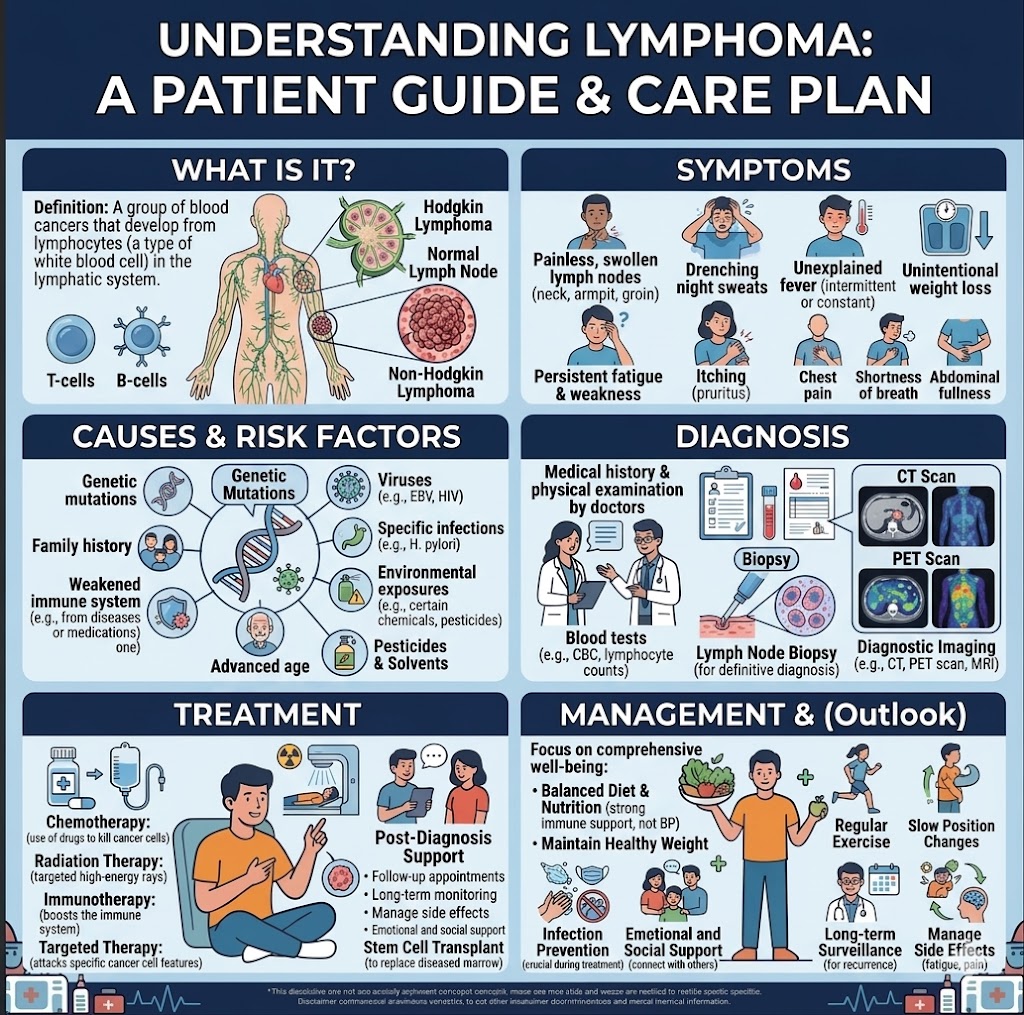
Lymphoma is a type of cancer that begins in the lymphatic system, a vital part of your body's immune system responsible for fighting infections. The lymphatic system includes organs, glands, vessels, and clusters of immune cells called lymph nodes. Lymphoma starts in germ-fighting white blood cells known as lymphocytes. These cancer cells can accumulate in lymph nodes, blood, bone marrow, spleen, and other body tissues like the gut, brain, bones, or skin.There are many types of lymphoma, with two main categories:* **Hodgkin lymphoma:** This type is characterized by specific large, abnormal cells called Reed-Sternberg cells, often having more than one nucleus. Hodgkin lymphoma is frequently curable.* **Non-Hodgkin lymphoma:** This category includes all lymphomas that do not have Reed-Sternberg cells. Non-Hodgkin lymphoma is more common, and its appearance under a microscope varies greatly. The possibility of a cure depends on the specific type.Cancer generally occurs when cells develop changes in their DNA, which contains instructions for cell growth, multiplication, and death. In lymphoma, these DNA changes cause lymphocytes to grow and multiply uncontrollably, failing to die when healthy cells would. While the exact cause isn't fully understood, certain risk factors can increase the likelihood of developing lymphoma.
Understanding the Condition
Lymphoma: A Guide for Non-Medical Persons
Understanding the Condition
Common Symptoms
Swollen Lymph Nodes: Often felt as a lump under the skin, commonly in the neck, armpit, or groin. These are usually painless.
Drenching Night Sweats: Excessive sweating at night that often soaks through clothing or bedding.
Unexplained Weight Loss: Losing weight without intentionally trying to.
Pain: Can occur in the chest, abdomen, or bones, depending on where the lymphoma is located.
Itchy Skin: Generalized itching of the skin.
Skin Symptoms (Cutaneous Lymphoma): If lymphoma affects the skin, symptoms may include a rash, patch, or raised plaque; changes in skin color (red, purple, or brown); peeling and painful skin; or a skin mass (tumor).
Consultation Guide
Which Specialist to Meet
If you experience symptoms suggesting lymphoma, you should consult with a general practitioner who can refer you to a hematologist (a specialist in blood disorders) or an oncologist (a cancer specialist). These specialists are best equipped to diagnose and manage lymphoma.
Preparations Before Your Visit
Before your appointment, gather your medical history, including any past illnesses, treatments, and current medications. Make a list of all your symptoms, noting when they started and how they have progressed. Prepare a list of questions for your doctor to ensure all your concerns are addressed. Bringing a friend or family member for support and to help take notes can also be beneficial.
Book a doctor visit near me
The doctor will check areas like your neck, armpits, and groin for swollen lymph nodes. They will ask detailed questions about your symptoms, general health, and family medical history. This is a non-invasive part of the diagnostic process.
Watch and Wait (Active Surveillance): For some slow-growing lymphomas, doctors may recommend closely monitoring the condition without immediate treatment, especially if symptoms are mild or absent. (Duration: Ongoing, with regular check-ups and tests until treatment is deemed necessary.)
Consultation Guide
Lymphoma is a type of cancer that begins in the lymphatic system, a vital part of your body's immune system responsible for fighting infections. The lymphatic system includes organs, glands, vessels, and clusters of immune cells called lymph nodes. Lymphoma starts in germ-fighting white blood cells known as lymphocytes. These cancer cells can accumulate in lymph nodes, blood, bone marrow, spleen, and other body tissues like the gut, brain, bones, or skin.There are many types of lymphoma, with two main categories:* **Hodgkin lymphoma:** This type is characterized by specific large, abnormal cells called Reed-Sternberg cells, often having more than one nucleus. Hodgkin lymphoma is frequently curable.* **Non-Hodgkin lymphoma:** This category includes all lymphomas that do not have Reed-Sternberg cells. Non-Hodgkin lymphoma is more common, and its appearance under a microscope varies greatly. The possibility of a cure depends on the specific type.Cancer generally occurs when cells develop changes in their DNA, which contains instructions for cell growth, multiplication, and death. In lymphoma, these DNA changes cause lymphocytes to grow and multiply uncontrollably, failing to die when healthy cells would. While the exact cause isn't fully understood, certain risk factors can increase the likelihood of developing lymphoma.
Understanding Risk Factors: While there's no known way to prevent lymphoma entirely, understanding risk factors like weakened immune systems (e.g., from autoimmune conditions or organ transplants) or certain infections (like HIV, Epstein-Barr virus) can help you discuss any concerns with your doctor.
Immune System Health: Maintaining a healthy immune system through general wellbeing practices, and managing any underlying autoimmune conditions, may contribute to overall health.
Long-Term Monitoring and Support
Diagnostic Procedures
Physical Exam and Medical History
Your doctor will examine you for swollen lymph nodes and other signs of lymphoma, and review your overall health and medical background.
What to Expect
Blood tests can help assess your overall health, organ function, and detect abnormalities in blood cell counts that might indicate lymphoma.
What to Expect
A healthcare professional will draw a small sample of blood, usually from a vein in your arm. This is a quick procedure, typically causing only a brief pinch or sting. The blood is then sent to a lab for analysis.
Biopsy (Lymph Node or Other Tissue)
A biopsy is the most definitive way to diagnose lymphoma. A small sample of suspicious tissue, typically a swollen lymph node, is removed and examined under a microscope to identify cancer cells, including Reed-Sternberg cells for Hodgkin lymphoma.
What to Expect
For a lymph node biopsy, a local anesthetic is usually given to numb the area. A small incision may be made to remove part or all of a lymph node (excisional biopsy), or a needle may be used to extract a small tissue sample (core needle biopsy). You might feel some pressure or mild discomfort. The procedure typically takes 15-60 minutes, and the tissue sample is then sent to a pathologist for examination. Results may take several days.
Bone Marrow Biopsy and Aspiration
If lymphoma is suspected to have spread to the bone marrow, samples of bone marrow (the spongy tissue inside bones that produces blood cells) are taken to check for cancer cells.
What to Expect
You will lie on your stomach or side. After numbing the skin and bone, a thin needle is inserted into the hip bone to draw out a liquid sample (aspiration). Then, a slightly larger needle is used to take a small core of bone marrow tissue (biopsy). You might feel a brief, sharp pain or pressure during the aspiration. The procedure takes about 15-30 minutes, and samples are sent for lab analysis.
Computed Tomography (CT) Scan
A CT scan uses X-rays and computer processing to create detailed cross-sectional images (slices) of bones, blood vessels, and soft tissues, helping to pinpoint the location and spread of lymphoma.
What to Expect
You will lie on a narrow table that slides into a large, donut-shaped machine. You may be asked to hold your breath for short periods. Sometimes, a contrast dye is injected into a vein or given orally to highlight certain areas. The scan itself is painless and typically takes 15-30 minutes. You may hear humming or clicking noises from the machine.
Positron Emission Tomography (PET) Scan
What to Expect
A small amount of radioactive tracer is injected into a vein, usually in your arm. You will then wait for about 30-60 minutes for the tracer to distribute throughout your body. Afterward, you lie on a narrow table that slides into a large scanner. The scan takes about 30 minutes. It is generally painless, though lying still for the duration is important. You will be exposed to a small amount of radiation from the tracer.
Clinical Trials: Participation in research studies testing new treatments for lymphoma. These may offer access to cutting-edge therapies not yet widely available. (Duration: Varies significantly based on the trial protocol, often spanning months or years with regular follow-ups.)
Post-Treatment Monitoring for Relapse: After successful treatment, lymphoma can sometimes return, even years later. Regular follow-up appointments, physical exams, and imaging tests are crucial to detect any signs of recurrence early.
Treatment Options
A PET scan uses a radioactive tracer to reveal the metabolic activity of tissues and organs. Cancer cells often show higher metabolic activity and light up brightly on the scan, helping to detect disease, assess its extent, and monitor treatment effectiveness. PET scans are often combined with CT scans (PET-CT) for clearer images.
Therapies and Procedures
Chemotherapy: This drug treatment uses powerful chemicals to kill fast-growing cancer cells throughout the body. (Duration: Typically administered in cycles over several weeks to months, depending on the specific regimen and type of lymphoma.)
Immunotherapy: This treatment harnesses your body's own immune system to identify and attack cancer cells. (Duration: Varies depending on the specific type of immunotherapy, often given over several weeks or months, and sometimes ongoing for maintenance.)
CAR-T Cell Therapy (Chimeric Antigen Receptor T-cell Therapy): Your own T-cells (a type of white blood cell) are collected, genetically modified in a lab to better target cancer cells, multiplied, and then infused back into your body. (Duration: Cell collection and modification take several weeks. The prepared cells are then given as a single infusion, with potential for lasting anti-cancer effects.)
Radiation Therapy: This treatment uses high-energy beams, such as X-rays or protons, precisely aimed at cancer cells to destroy their genetic material and prevent them from growing. (Duration: Typically given in daily sessions over several weeks, depending on the size and location of the tumor.)
Targeted Therapy: These drugs are designed to target specific weaknesses or characteristics unique to cancer cells, minimizing harm to healthy cells. (Duration: Varies widely, from several months to years, often ongoing as long as the treatment is effective and tolerable.)
Radiopharmaceuticals: These are medicines containing a small amount of a radioactive substance that can be used to treat cancer. They travel to the cancer cells and deliver radiation directly. (Duration: Can be a single dose or multiple doses over a period, depending on the specific radiopharmaceutical and treatment plan.)
Treatments for Cutaneous Lymphomas: Specific therapies for lymphoma affecting the skin may include topical creams, light therapy (phototherapy), or skin-directed radiation, in addition to systemic treatments. (Duration: Can range from weeks to months for topical or light therapies, or several weeks for radiation, often with ongoing maintenance.)
Monitoring for Transformation: Some slow-growing types of lymphoma can transform into more aggressive forms. Ongoing monitoring helps identify these changes, which may require stronger treatments.
Healthy Lifestyle: Adopting a healthy lifestyle, including a balanced diet, regular exercise, and adequate sleep, can support your overall health and well-being during and after lymphoma treatment.
Emotional and Psychological Support: Living with and beyond lymphoma can be challenging. Seeking support from family, friends, support groups, or mental health professionals can help manage stress and anxiety.
Prevention & Long-Term Wellbeing
Bone Marrow Transplant (Stem Cell Transplant): This procedure replaces diseased bone marrow with healthy blood-forming stem cells. It's often used after high doses of chemotherapy or radiation to rescue the bone marrow. (Duration: The intensive preparation and transplant procedure can take several weeks, followed by months of recovery and close monitoring for complications.)
Prevention and Risk Management
Tags & Topics
Notice an error or need an update?
Help us keep medical information accurate. Report incorrect info or suggest an edit.


