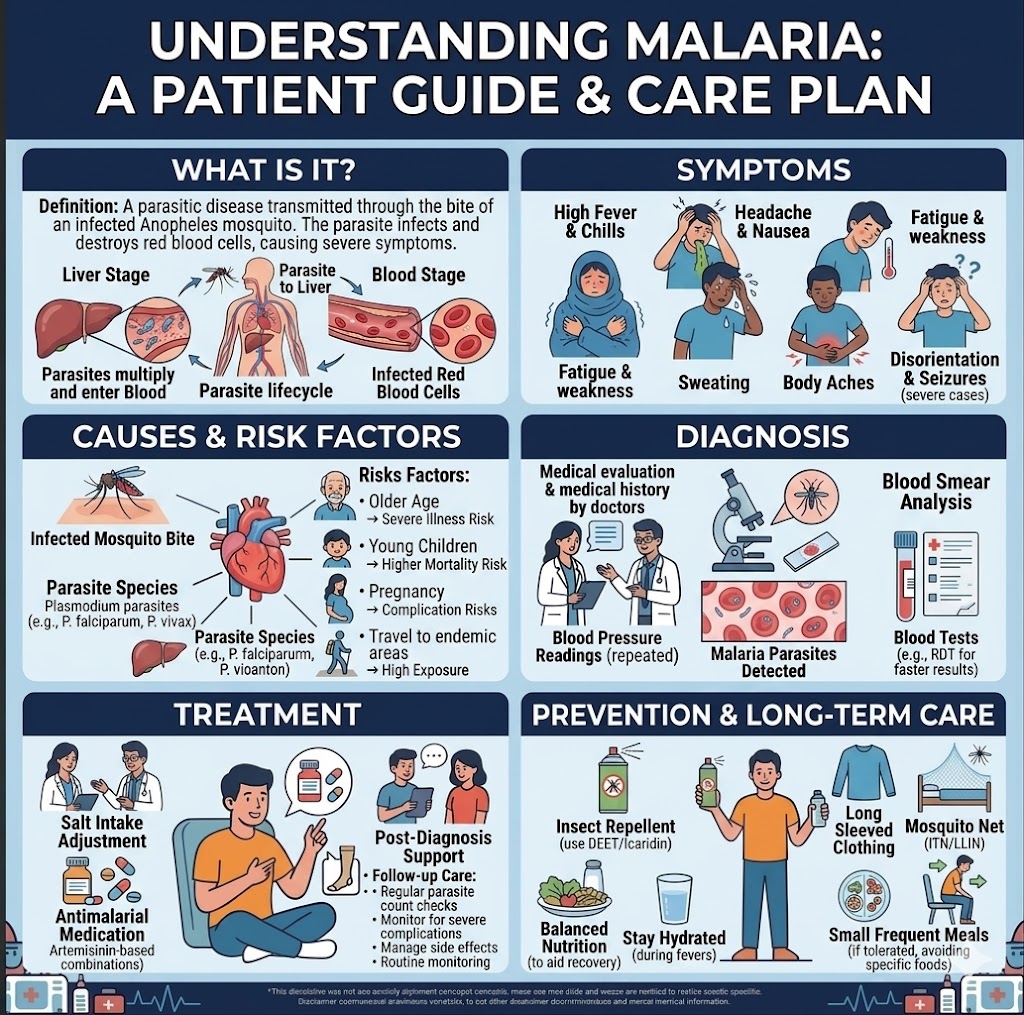
Malaria is a serious and sometimes life-threatening disease caused by a microscopic parasite. It is primarily transmitted to humans through the bites of infected female mosquitoes. When the parasite enters the human bloodstream, it travels to the liver to mature and multiply, eventually invading and destroying healthy red blood cells. While malaria is rare in temperate climates, it remains highly prevalent in tropical and subtropical regions of the world.
Understanding the Condition
Understanding Malaria: Causes, Symptoms, and Protection
Understanding the Condition
Common Symptoms
Cyclic Attacks: A distinct pattern of illness that begins with sudden, uncontrollable shivering and chills, followed by a high fever, and ends with intense sweating as the body temperature returns to normal.
High Fever: A rapid spike in body temperature, often reaching 101°F (38.3°C) or higher, which can occur continuously or in cycles.
Severe Shaking Chills: An intense, uncontrollable feeling of cold and shivering that usually precedes the fever stage.
Profuse Sweating: Heavy, drenching sweating that typically occurs as the fever begins to break.
Flu-like Symptoms: Generalized body discomfort, including severe headaches, muscle aches, extreme fatigue, nausea, vomiting, and diarrhea.
Consultation Guide
Which Specialist to Meet
You should consult an Infectious Disease Specialist or a Travel Medicine Specialist. If you are experiencing severe symptoms such as difficulty breathing, confusion, or seizures, seek immediate emergency medical attention.
Preparations Before Your Visit
Before your appointment, write down all your symptoms, when they started, and create a highly detailed list of all international travel over the past 12 months, including specific countries, regions, and dates. Note whether you took any preventive malaria medications during your travels, and bring a list of all current medications, vitamins, and supplements you are taking.
Book a doctor visit near me
Post-Travel Health Monitoring: Stay highly vigilant for any flu-like symptoms or fevers for up to one year after returning from a malaria-endemic region. Inform any medical professional you see of your travel history immediately.
Vaccination: For children living in moderate-to-high transmission regions, ensure they receive the recommended malaria vaccine schedule as advised by local public health guidelines.
Consultation Guide
Malaria is a serious and sometimes life-threatening disease caused by a microscopic parasite. It is primarily transmitted to humans through the bites of infected female mosquitoes. When the parasite enters the human bloodstream, it travels to the liver to mature and multiply, eventually invading and destroying healthy red blood cells. While malaria is rare in temperate climates, it remains highly prevalent in tropical and subtropical regions of the world.
A healthcare provider will draw a small sample of blood from a vein in your arm or perform a simple finger prick. You will feel a brief pinch or sting. The blood is then processed in a laboratory. Because parasite levels in the blood can fluctuate, this test may need to be repeated every 12 to 24 hours over a couple of days.
Diagnostic Procedures
Blood Smear (Microscopy)
This is the gold standard diagnostic test for malaria. A drop of blood is spread onto a glass slide, stained with special dyes, and examined under a microscope to visually identify the malaria parasites and determine which specific species is causing the infection.
What to Expect
Rapid Diagnostic Test (RDT)
A quick test that detects specific proteins (antigens) produced by the malaria parasite in a person's blood. It provides rapid results when laboratory microscopy is not immediately available.
What to Expect
A healthcare worker will clean your fingertip with an alcohol wipe and prick it with a small, sterile needle (lancet) to collect a few drops of blood. The blood is placed on a test strip, and results are typically ready in 15 to 20 minutes.
Polymerase Chain Reaction (PCR) Test
A highly sensitive molecular test used to detect the genetic material (DNA) of the malaria parasite. It is exceptionally useful when parasite levels in the blood are too low to be seen under a microscope, or to confirm the specific strain of malaria.
What to Expect
A standard blood sample will be drawn from a vein in your arm. You will feel a quick prick. The sample is sent to a specialized laboratory for analysis, and results may take a few days to return.
Treatment Options
Prescription Medications
Active Bloodstream Clearance Therapy: Oral prescription medications designed to target, attack, and kill the malaria parasites active inside your red blood cells. (Duration: Typically taken daily for 3 consecutive days, depending on the severity of the infection and the specific strain of malaria.)
Liver-Stage Clearance Therapy: Specific oral prescription medications designed to target dormant malaria parasites resting in the liver to prevent future relapses. (Duration: Usually taken daily for 14 consecutive days, often prescribed alongside or immediately following the bloodstream clearance therapy.)
Intravenous (IV) Therapy: For severe or complicated malaria cases, powerful malaria medications are delivered directly into the bloodstream in a hospital setting to ensure rapid absorption. (Duration: Administered continuously or in scheduled doses for at least 24 hours, or until the patient is stable enough to transition to oral medications.)
Intravenous Fluids: Medical fluids delivered directly into a vein to treat or prevent dehydration, stabilize blood pressure, and support kidney function. (Duration: Administered continuously in a hospital setting until the patient can comfortably consume and retain oral fluids.)
Fever-Reducing Medications: Over-the-counter medications used to manage high body temperatures and relieve associated body aches. (Duration: Taken as needed every 4 to 6 hours during the acute fever stage of the illness, under the direction of a healthcare provider.)
Preventive (Prophylactic) Medications: Consult a travel medicine specialist before your trip to obtain prescription medications that prevent malaria infection. It is critical to take these medications exactly as prescribed before entering, during your stay in, and for several weeks after leaving the high-risk area.
Insecticide-Treated Bed Nets: Sleep under bed nets treated with long-lasting insecticides, especially if your sleeping area is not air-conditioned or well-screened. Ensure the net is tucked securely under the mattress.
Insect Repellent: Regularly apply EPA-registered insect repellent containing active ingredients like DEET, picaridin, or oil of lemon eucalyptus to exposed skin and clothing.
Protective Clothing: Wear long-sleeved shirts, long pants, socks, and closed-toe shoes, particularly from dusk to dawn when the mosquitoes that transmit malaria are most active.
Long-Term Monitoring and Public Health
Prevention & Long-Term Wellbeing
Prevention Strategies Before and During Travel
Tags & Topics
Notice an error or need an update?
Help us keep medical information accurate. Report incorrect info or suggest an edit.


