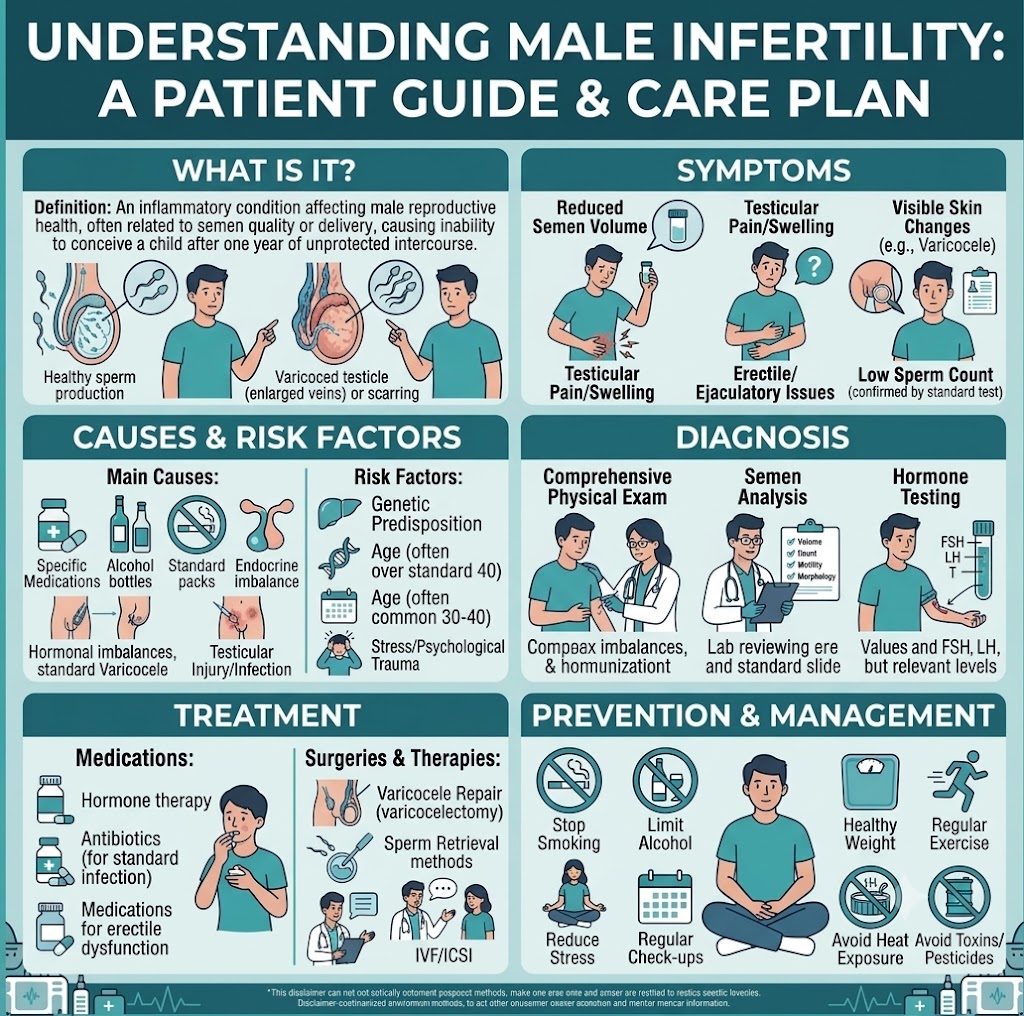
Male infertility occurs when a man has a reduced chance of making his female partner pregnant. It affects approximately 1 in 7 couples trying to conceive, with male factor issues playing a role in up to half of these cases. Infertility is typically defined as the inability to conceive after one year of regular, unprotected sexual intercourse. It can result from low sperm production, structural blockages that prevent sperm delivery, abnormal sperm function, or underlying medical conditions.
Understanding the Condition
Common Symptoms
Inability to Conceive: The primary indicator of male infertility is the inability to achieve pregnancy with a partner after one year of regular, unprotected sex.
Sexual Function Challenges: Difficulty with ejaculation, low volumes of ejaculated fluid, reduced sexual drive, or trouble maintaining an erection (erectile dysfunction).
Consultation Guide
Understanding Male Infertility: Causes, Diagnosis, and Treatments
Understanding the Condition
Male infertility occurs when a man has a reduced chance of making his female partner pregnant. It affects approximately 1 in 7 couples trying to conceive, with male factor issues playing a role in up to half of these cases. Infertility is typically defined as the inability to conceive after one year of regular, unprotected sexual intercourse. It can result from low sperm production, structural blockages that prevent sperm delivery, abnormal sperm function, or underlying medical conditions.
Recurrent Respiratory Infections: Frequent chest or sinus infections, which can sometimes be linked to inherited conditions that also cause infertility.
Consultation Guide
Which Specialist to Meet
You should consult a Urologist specializing in male reproductive medicine (an Andrologist), or a Reproductive Endocrinologist.
Preparations Before Your Visit
Blood tests to identify chromosomal abnormalities or genetic mutations (such as those associated with cystic fibrosis or Klinefelter's syndrome) that can cause severe infertility.
Avoid Toxic Substances: Eliminate exposure to heavy metals, pesticides, tobacco smoke, recreational drugs, and excessive alcohol, which cause DNA damage to sperm.
Regular Reproductive Health Screenings: Some underlying causes of male infertility, such as varicoceles or genetic conditions, warrant long-term monitoring as they can be linked to other health concerns like bone loss or cardiovascular changes.
Psychological and Emotional Counseling: Infertility can cause high levels of stress, anxiety, and relationship strain. Seeking support groups or couples counseling is highly beneficial for mental wellbeing.
Diagnostic Procedures
Testicular Discomfort or Swelling: Pain, swelling, or a physical lump in or around the testicle and scrotum area.
Hormonal or Genetic Changes: Decreased facial or body hair, abnormal breast growth (gynecomastia), or a reduced sense of smell.
A lab test that evaluates the volume of semen, along with the total count, shape (morphology), and movement (motility) of the sperm.
What to Expect
You will be asked to provide a semen sample, typically by masturbating into a sterile cup in a private room at the doctor's clinic. This test is often performed twice over a few weeks to ensure accurate results.
An imaging test that uses high-frequency sound waves to search for structural abnormalities, testicular tumors, or dilated veins (varicoceles) in the scrotum.
What to Expect
You will lie on your back while a technician applies a warm gel to your scrotum and gently moves a handheld wand (transducer) over the area. It is painless and takes about 15 to 20 minutes.
A blood test designed to measure the levels of testosterone, follicle-stimulating hormone (FSH), and other hormones that regulate sperm production.
What to Expect
A nurse will insert a small needle into a vein in your arm to draw a blood sample. This is usually scheduled in the morning when testosterone levels are naturally at their highest.
Post-Ejaculation Urinalysis
A urine test to detect the presence of sperm, which helps diagnose retrograde ejaculation (sperm traveling backward into the bladder).
What to Expect
You will be asked to masturbate and ejaculate, and immediately afterward, provide a urine sample in a sterile cup for laboratory analysis.
What to Expect
A routine blood sample will be drawn from your arm and sent to a specialized genetic laboratory. Results may take several weeks.
Varicoxele Repair (Varicocelectomy): A minor outpatient surgery to tie off swollen veins in the scrotum, improving blood flow and testicle temperature. (Duration: The surgery takes 1 to 2 hours. Full recovery takes 1 to 2 weeks, and improvements in sperm quality are usually observed 3 to 6 months later.)
Surgical Sperm Retrieval: A procedure where sperm is harvested directly from the testicle or epididymis using a fine needle or a small incision when no sperm is present in the semen. (Duration: The procedure takes 30 to 60 minutes under local or general anesthesia. It is performed in tandem with a partner's egg retrieval cycle.)
Hormone Replacement Therapy: Hormone injections or oral medications prescribed to correct imbalances in the hypothalamus, pituitary, or testicles. (Duration: Typically requires 3 to 6 months of continuous use to significantly improve sperm production.)
Treatment Options
Before your visit, abstain from ejaculation for 2 to 5 days to prepare for a possible semen analysis. Write down all medications, supplements, past surgeries, and lifestyle habits (such as tobacco or alcohol use), and compile a family medical history.
Book a doctor visit near me
Surgical Procedures
Medications and Therapies
Antibiotic Therapy: Targeted medication to treat infections of the reproductive tract, which can clear up inflammation and restore sperm passage. (Duration: A standard course of treatment lasts 10 to 14 days, though chronic cases may require longer therapy.)
Assisted Reproductive Technology (ART)
Intracytoplasmic Sperm Injection (ICSI): An advanced laboratory procedure performed during in vitro fertilization (IVF) where a single, high-quality sperm is injected directly into a harvested egg. (Duration: The laboratory fertilization process takes place over 1 to 5 days, followed by the embryo transfer into the partner's uterus.)
Prevention & Long-Term Wellbeing
Vasectomy Reversal: A microscopic surgical procedure to reconnect the tubes (vas deferens) that were cut during a vasectomy, allowing sperm to enter the semen again. (Duration: The procedure takes 2 to 4 hours. Recovery takes 2 to 3 weeks, and sperm may appear in the ejaculate within 3 to 12 months.)
Prevention and Lifestyle Adjustments
Maintain a Cool Scrotal Temperature: Avoid frequent use of hot tubs, saunas, tight-fitting underwear, and resting laptop computers directly on your lap, as excessive heat impairs sperm production.
Manage Weight and Diet: Adopt an antioxidant-rich diet and maintain a healthy body mass index (BMI). Obesity alters male hormones, decreasing sperm concentration and quality.
Long-Term Monitoring and Support
Tags & Topics
Notice an error or need an update?
Help us keep medical information accurate. Report incorrect info or suggest an edit.


