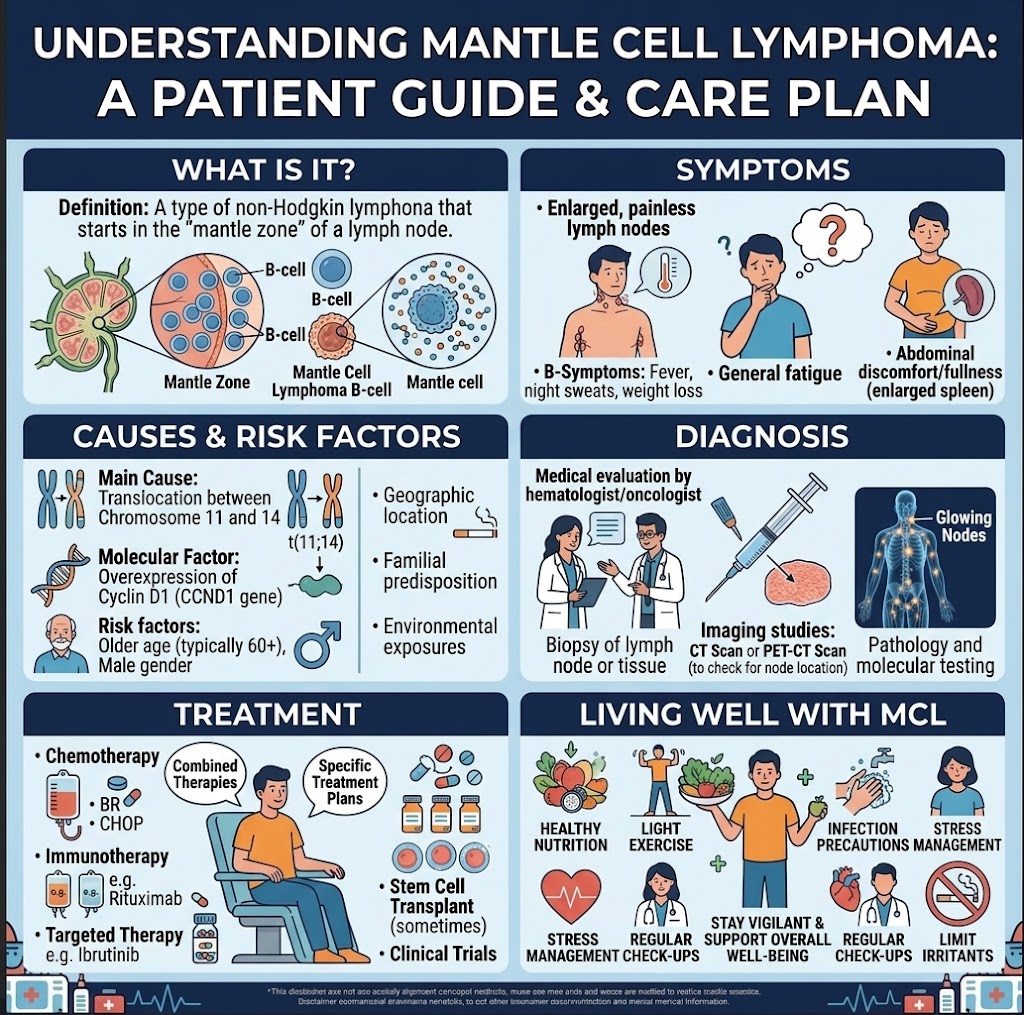
Mantle cell lymphoma (MCL) is a rare and often aggressive type of cancer that affects the body's lymphatic system. The lymphatic system is a vital part of your immune system, composed of organs, glands, vessels, and cell clusters called lymph nodes, all working to fight off infections. MCL typically begins in the lymph nodes but can also spread to the blood, bone marrow, and other tissues throughout the body.Lymphoma is broadly categorized into Hodgkin lymphoma and non-Hodgkin lymphoma, with MCL being a type of non-Hodgkin lymphoma. The name 'Mantle cell' comes from the fact that this cancer starts in the 'mantle zone' of a lymph node, an area rich in germ-fighting white blood cells called B lymphocytes. In MCL, genetic changes cause these B lymphocytes to transform into cancer cells, which then multiply and accumulate in the lymph nodes and other parts of the body.While MCL is often challenging to cure, available treatments aim to reduce the cancer's size, control its spread, and extend periods when the cancer is inactive (remission), thereby prolonging life. There are different types of MCL, including the most common 'Classic' type found in lymph nodes, and a slower-growing 'Leukemic nonnodal' type mainly affecting the blood and spleen. A very early, non-aggressive form called 'In situ mantle cell neoplasia' may also be identified, often requiring only monitoring. Rarer, more aggressive 'blastoid' and 'pleomorphic' variants can also occur.
Understanding the Condition
Mantle Cell Lymphoma: An Overview for Non-Medical Persons
Understanding the Condition
Common Symptoms
Painless Swelling: Noticeable, non-tender lumps in the neck, armpit, or groin due to enlarged lymph nodes.
Decreased Appetite and Weight Loss: Unexplained loss of appetite leading to significant weight loss without trying.
Digestive Issues: If the cancer affects the digestive system, symptoms can include changes in bowel habits (such as diarrhea or constipation) and blood in the stool.
General Discomfort: MCL may not cause any symptoms in its early stages.
Consultation Guide
Which Specialist to Meet
If you experience any concerning symptoms, it's advisable to consult your primary care doctor first. They may then refer you to a hematologist-oncologist, a doctor specializing in blood disorders and cancer, for further evaluation and management.
Preparations Before Your Visit
Before your appointment, make a list of all your symptoms, including those that seem unrelated to your main concern. Document any personal medical information, including past health conditions, treatments, and family medical history. Prepare a list of questions you want to ask your doctor. Consider bringing a trusted family member or friend to help you remember information and provide support.
Book a doctor visit near me
Addressing Complications: Be aware of potential complications from advanced cancer, such as swollen lymph nodes pressing on organs (causing difficulty swallowing/breathing) or fluid buildup. Promptly report any new or worsening symptoms.
Consultation Guide
Mantle cell lymphoma (MCL) is a rare and often aggressive type of cancer that affects the body's lymphatic system. The lymphatic system is a vital part of your immune system, composed of organs, glands, vessels, and cell clusters called lymph nodes, all working to fight off infections. MCL typically begins in the lymph nodes but can also spread to the blood, bone marrow, and other tissues throughout the body.Lymphoma is broadly categorized into Hodgkin lymphoma and non-Hodgkin lymphoma, with MCL being a type of non-Hodgkin lymphoma. The name 'Mantle cell' comes from the fact that this cancer starts in the 'mantle zone' of a lymph node, an area rich in germ-fighting white blood cells called B lymphocytes. In MCL, genetic changes cause these B lymphocytes to transform into cancer cells, which then multiply and accumulate in the lymph nodes and other parts of the body.While MCL is often challenging to cure, available treatments aim to reduce the cancer's size, control its spread, and extend periods when the cancer is inactive (remission), thereby prolonging life. There are different types of MCL, including the most common 'Classic' type found in lymph nodes, and a slower-growing 'Leukemic nonnodal' type mainly affecting the blood and spleen. A very early, non-aggressive form called 'In situ mantle cell neoplasia' may also be identified, often requiring only monitoring. Rarer, more aggressive 'blastoid' and 'pleomorphic' variants can also occur.
You will lie on a motorized table that slides into a large, doughnut-shaped machine. You may be asked to hold your breath briefly at certain times. The scan is painless, but the machine can be noisy. Some scans may require an injection of a contrast dye to highlight certain areas, which might cause a warm sensation or metallic taste.
PET Scan (Positron Emission Tomography Scan)
Diagnostic Procedures
A procedure where a small sample of tissue is removed from an enlarged lymph node for laboratory examination. This is crucial for diagnosing lymphoma and identifying its specific type.
What to Expect
The procedure is usually done under local anesthesia, sometimes with sedation. A small incision may be made, or a needle used, to remove a portion or the entire lymph node. You might feel some pressure or minor discomfort. The sample is then sent to a pathologist for analysis.
Bone Marrow Biopsy and Aspiration
These are two procedures often performed together to collect and examine samples of bone marrow, the spongy tissue inside your bones where blood cells are produced. Aspiration collects liquid marrow, while biopsy collects a small piece of solid marrow tissue.
What to Expect
You will typically lie on your stomach or side. After numbing the area (usually the back of the hip bone) with a local anesthetic, a thin needle is inserted into the bone. You may feel pressure and a brief, sharp pain or pulling sensation as the liquid marrow is aspirated. For the biopsy, a slightly larger needle removes a core of solid tissue. The procedure usually takes about 15-30 minutes, and you may experience some soreness afterward.
CT Scan (Computed Tomography Scan)
A type of imaging that uses X-ray technology and computer processing to create detailed cross-sectional images (slices) of your bones, blood vessels, and soft tissues. It provides more detail than standard X-rays.
What to Expect
An imaging test that reveals the metabolic activity of tissues and organs. It uses a small amount of a radioactive drug (tracer) to highlight areas of high metabolic activity, which can indicate the presence of cancer, often before it's visible on other scans. PET scans are frequently combined with CT scans (PET-CT) for better image interpretation.
What to Expect
A radioactive tracer is injected into a vein, usually in your arm. You will then wait for about an hour for the tracer to distribute throughout your body. Afterward, you will lie still on a narrow table that slides into the PET scanner. The scan typically takes around 30 minutes, during which you must remain very still. The scanner itself is quiet.
Regular Follow-Up: Due to the high risk of relapse, ongoing monitoring with regular doctor visits, blood tests, and imaging scans is crucial, often for life, even after successful treatment.
Treatment Options
Therapies and Medications
Chemotherapy: Uses powerful medications, often given intravenously (through a vein), to kill fast-growing cancer cells throughout the body. These drugs can be used alone or in combination. (Duration: Administered in cycles, typically lasting several months, with breaks between treatments to allow the body to recover.)
Targeted Therapy: Medications that specifically target certain vulnerabilities or changes in cancer cells, often leading to fewer side effects compared to traditional chemotherapy by sparing healthy cells. (Duration: Can be taken orally or intravenously, often for an extended period, potentially for years, depending on the response and specific medication.)
Immunotherapy: Treatments that harness your body's own immune system to recognize and fight cancer cells. This category includes biological therapies that enhance the immune response. (Duration: Given in cycles, usually intravenously, over several months, with ongoing monitoring of response.)
Radiation Therapy: Uses high-energy beams (like X-rays or protons) to precisely target and destroy cancer cells in a specific area of the body while minimizing damage to surrounding healthy tissue. (Duration: Typically given in daily sessions over several weeks, depending on the area being treated and the type of radiation.)
Managing Treatment Side Effects: Work closely with your healthcare team to manage common side effects like nausea, vomiting, fatigue, fever, rash, and diarrhea. Medications and supportive care can help mitigate these effects.
Monitoring for Viral Reactivation: Some treatments can reactivate dormant viral infections (e.g., Hepatitis B/C). Your doctor will monitor for this and take preventive measures or treat if reactivation occurs.
Risk Management for Tumor Lysis Syndrome: This serious condition can occur when many cancer cells die rapidly after treatment, releasing harmful substances. Medications may be given to prevent or treat this, particularly during initial treatment phases.
Healthy Lifestyle and Support: Maintaining a balanced diet, light exercise (as tolerated), adequate rest, and seeking emotional support from family, friends, or support groups can significantly contribute to overall well-being during and after treatment.
Prevention & Long-Term Wellbeing
CAR-T Cell Therapy (Chimeric Antigen Receptor T-cell Therapy): A specialized immunotherapy where your own immune T-cells are collected, genetically modified in a lab to better recognize and attack cancer cells, multiplied, and then reinfused into your body. (Duration: A multi-stage process involving cell collection, lab modification (several weeks), and a single infusion, followed by intensive monitoring and recovery for weeks to months in the hospital and outpatient setting.)
Bone Marrow Transplant (Stem Cell Transplant): A procedure to replace diseased bone marrow with healthy blood-forming stem cells. This often involves high-dose chemotherapy to eliminate the existing bone marrow before the new stem cells are infused. Cells can come from your own body (autologous) or a donor (allogeneic). (Duration: Requires an intensive preparation period with chemotherapy, followed by the transplant and a prolonged hospital stay (several weeks). Full recovery and immune system restoration can take months to over a year.)
Prevention
No Known Prevention: Currently, there is no known way to prevent mantle cell lymphoma. Focus is on early detection and effective management.
Long-Term Monitoring and Management
Tags & Topics
Notice an error or need an update?
Help us keep medical information accurate. Report incorrect info or suggest an edit.


