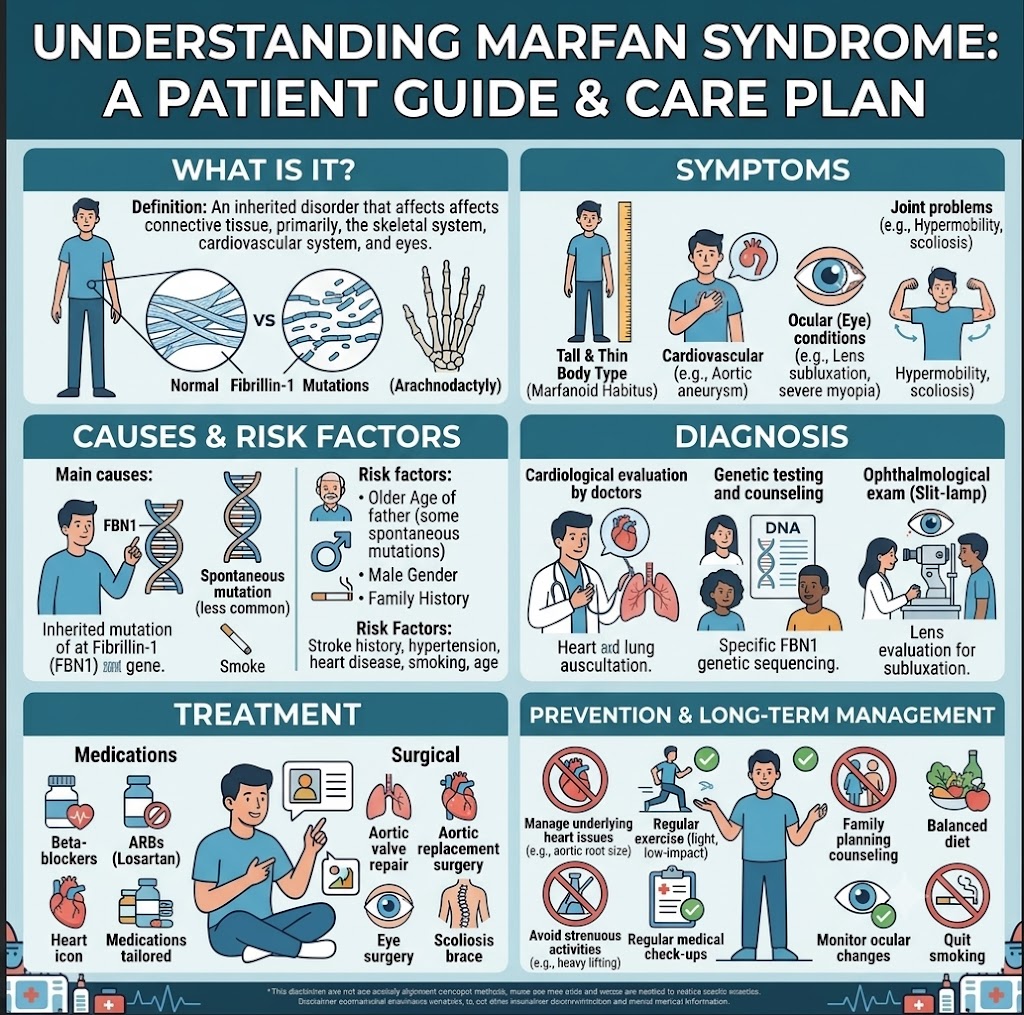
Marfan syndrome is a genetic condition that affects the body's connective tissue. Connective tissue acts like the "glue" and "scaffolding" that supports and holds together organs, blood vessels, bones, and other structures. In Marfan syndrome, this tissue is weaker or less elastic than it should be due to a faulty gene. This gene is responsible for making a protein called fibrillin-1, which is crucial for strong, flexible connective tissue. Most people inherit this faulty gene from an affected parent, with each child having a 50% chance of inheriting it. In about 1 in 4 cases, the genetic change happens spontaneously and is not inherited from a parent. This condition can impact many parts of the body, most notably the heart and blood vessels, eyes, and skeleton. The effects can range from mild to severe, but serious complications, especially those involving the main artery from the heart (the aorta), can be life-threatening.
Understanding the Condition
Marfan Syndrome: Understanding a Genetic Connective Tissue Disorder
Understanding the Condition
Marfan syndrome is a genetic condition that affects the body's connective tissue. Connective tissue acts like the "glue" and "scaffolding" that supports and holds together organs, blood vessels, bones, and other structures. In Marfan syndrome, this tissue is weaker or less elastic than it should be due to a faulty gene. This gene is responsible for making a protein called fibrillin-1, which is crucial for strong, flexible connective tissue. Most people inherit this faulty gene from an affected parent, with each child having a 50% chance of inheriting it. In about 1 in 4 cases, the genetic change happens spontaneously and is not inherited from a parent. This condition can impact many parts of the body, most notably the heart and blood vessels, eyes, and skeleton. The effects can range from mild to severe, but serious complications, especially those involving the main artery from the heart (the aorta), can be life-threatening.
Common Symptoms
Tall and Slender Build: Individuals often have an unusually tall and thin body shape.
Disproportionately Long Limbs and Digits: Arms, legs, fingers, and toes may appear unusually long compared to the rest of the body.
Chest Bone Abnormalities: The breastbone (sternum) may either stick out (protrude) or appear sunken inward.
High, Arched Palate and Crowded Teeth: The roof of the mouth might be higher and more arched than usual, leading to dental crowding.
Heart Murmurs: Unusual sounds detected during a heartbeat, indicating potential heart valve issues.
Severe Nearsightedness (Myopia): Difficulty seeing distant objects clearly.
Abnormally Curved Spine: Conditions like scoliosis (a sideways curve of the spine) are common.
Foot Pain and Low Back Pain: Chronic discomfort in these areas due to skeletal issues.
Consultation Guide
Which Specialist to Meet
You should start by speaking with your primary care doctor or pediatrician. If they suspect Marfan syndrome, they will likely refer you to specialists such as a medical geneticist (a doctor specializing in genetic disorders), a cardiologist (heart specialist), an ophthalmologist (eye specialist), and possibly an orthopedic specialist (bone and joint specialist).
Preparations Before Your Visit
Before your visit, gather as much family medical history as possible, especially regarding any relatives with similar physical traits or known connective tissue disorders. Make a list of all your symptoms, even those that seem minor, and be prepared to discuss your health history thoroughly. Also, write down any questions you have for the doctor.
Book a doctor visit near me
Measurements of height and arm span, examination of spine, chest, and feet. Detailed questions about symptoms and family health.
Uses sound waves to create pictures of the heart and aorta, checking for size, function, and any weakness.
Diagnostic Procedures
Physical Examination and Medical History
A doctor assesses physical features (e.g., tall stature, long limbs, chest shape) and gathers personal and family medical history, noting any similar traits or conditions.
What to Expect
What to Expect
A technician applies gel to your chest and moves a transducer (small device) to create images. It's painless and takes 30-60 minutes.
Analyzes DNA to identify specific mutations in the FBN1 gene, confirming diagnosis or carrier status.
What to Expect
A small blood, saliva, or cheek swab sample is collected and sent to a lab. Results may take several weeks. Minimal discomfort.
An ophthalmologist checks for lens dislocation, retinal issues, glaucoma, and cataracts.
What to Expect
Eye drops dilate pupils for a clearer view. Specialized instruments are used to examine the retina, lens, and measure eye pressure. Painless, but vision may be blurry temporarily.
Provides highly detailed images of the aorta, blood vessels, and skeletal structures, especially for surgical planning or when an echocardiogram suggests issues.
What to Expect
For CT, you lie on a table that slides into a donut-shaped machine for X-ray images. For MRI, you enter a tube-shaped machine using magnets and radio waves. Contrast dye may be used. You must remain still. CT takes minutes, MRI 30-60 minutes.
Treatment Options
Medications
Blood Pressure-Lowering Medications: Reduces strain on the aorta, slowing enlargement and decreasing tear risk. (Duration: Lifelong)
Surgical Procedures
Aortic Root Repair or Replacement: Repairs or replaces a weakened aortic section with a synthetic graft to prevent rupture. (Duration: One-time surgery, followed by lifelong monitoring)
Heart Valve Repair or Replacement: Fixes faulty heart valves to improve function and prevent heart failure. (Duration: One-time surgery, followed by lifelong monitoring)
Cataract Surgery: Removes cloudy lens and replaces it with a clear artificial lens to restore vision. (Duration: One-time outpatient procedure per eye)
Spinal Surgery (e.g., for Scoliosis): Corrects severe spinal curves causing pain or organ issues. (Duration: One-time surgery, followed by recovery and physical therapy)
Therapies and Devices
Vision Correction: Eyeglasses or contact lenses correct refractive errors; specialized lenses or surgery for lens dislocation. (Duration: Ongoing, as needed)
Orthopedic Bracing or Physical Therapy: Braces manage mild spinal curvature; physical therapy improves posture, strength, and pain. (Duration: Varies (months to years for bracing; ongoing for PT))
Prevention & Long-Term Wellbeing
Long-Term Monitoring
Regular Heart and Blood Vessel Check-ups: Echocardiograms, CT/MRI scans to monitor aorta and heart valves, crucial for early detection.
Routine Eye Exams: Essential ophthalmologist visits to monitor for lens dislocation, retinal issues, glaucoma, and cataracts.
Skeletal Assessments: Regular evaluations by an orthopedic specialist for spinal curvature, chest wall, and joint issues.
Lifestyle Modifications
Avoid Strenuous Physical Activities: Avoid high-impact sports, heavy lifting, or activities causing significant strain to protect the aorta.
Maintain a Healthy Lifestyle: Balanced diet and healthy weight support overall cardiovascular health.
Family Planning and Counseling: Provides information on inheritance risks and helps families make informed decisions.
Patient Support Groups: Connects individuals with Marfan syndrome for emotional support and practical advice.
Tags & Topics
Notice an error or need an update?
Help us keep medical information accurate. Report incorrect info or suggest an edit.


