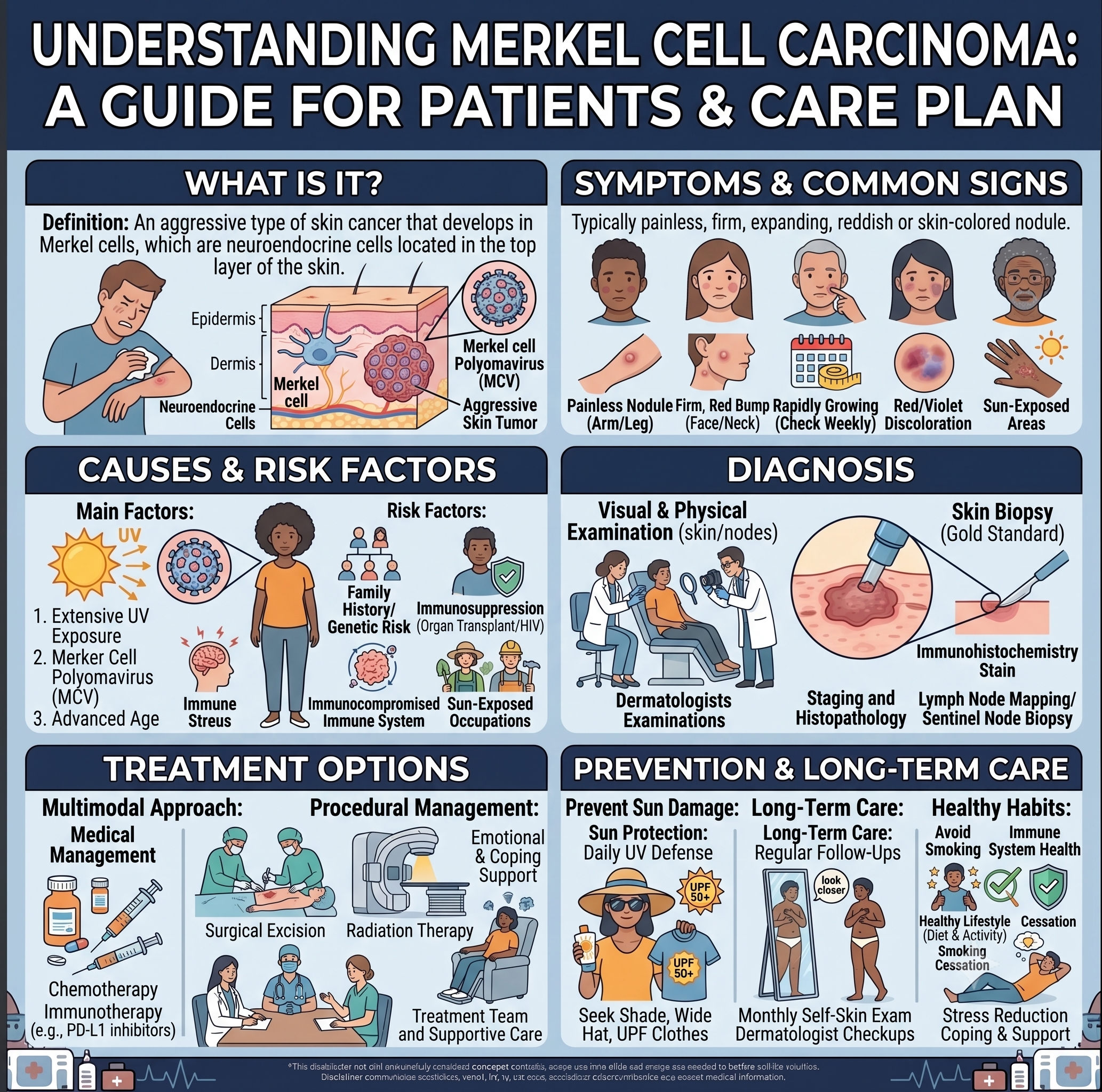
Merkel cell carcinoma is a rare, aggressive type of skin cancer that often appears as a fast-growing, painless bump on sun-exposed areas like the face, head, or neck. It is more common in people over 50, those with significant sun exposure, or a weakened immune system. This cancer is named for Merkel cells, which are involved in touch, though experts now believe the cancer originates from a different, as-yet-unknown type of skin cell, often linked to a common virus called Merkel cell polyomavirus. This cancer tends to grow and spread quickly to other body parts.
Understanding the Condition
Merkel Cell Carcinoma
Understanding the Condition
Merkel cell carcinoma is a rare, aggressive type of skin cancer that often appears as a fast-growing, painless bump on sun-exposed areas like the face, head, or neck. It is more common in people over 50, those with significant sun exposure, or a weakened immune system. This cancer is named for Merkel cells, which are involved in touch, though experts now believe the cancer originates from a different, as-yet-unknown type of skin cell, often linked to a common virus called Merkel cell polyomavirus. This cancer tends to grow and spread quickly to other body parts.
Common Symptoms
Skin Growth: The primary symptom is a new or changing growth on the skin. While it can occur anywhere, it most commonly appears on sun-exposed areas like the head or neck. In people with lighter skin, it's often on the head or neck, while in people with darker skin, it may be more frequent on the legs.
Characteristics of the Bump: The growth typically presents as a firm bump that is often painless but grows rapidly. It may appear pink, purple, red-brown, or the same color as the surrounding skin. It often has uneven sides and an irregular border.
Consultation Guide
Which Specialist to Meet
Before your appointment, prepare a list of your symptoms, including when they started and any changes you've noticed. Gather information about your medical history, any medications you are taking, and a list of questions you have for the doctor. Observing your skin regularly and noting any suspicious changes can aid in diagnosis.
Book a doctor visit near me
Consultation Guide
Schedule Professional Skin Checks: If you notice any suspicious skin changes, especially a rapidly growing, painless bump, promptly make an appointment with a healthcare professional. Regular follow-up appointments are crucial for early detection and management, particularly for individuals with a history of skin cancer or increased risk factors.
Diagnostic Procedures
You should initially consult a general practitioner or a dermatologist (skin specialist). If Merkel cell carcinoma is suspected or diagnosed, you may then be referred to an oncologist (cancer specialist) or a surgical oncologist.
Preparations Before Your Visit
A skin biopsy involves removing a small sample of the suspicious skin growth for examination under a microscope by a pathologist (a doctor who specializes in analyzing tissue samples). This is the definitive test to diagnose Merkel cell carcinoma.
What to Expect
The doctor will numb the area with a local anesthetic. Depending on the size and location of the growth, different types of biopsies may be performed: a shave biopsy scrapes off the surface, a punch biopsy removes a small, round, deeper sample, or an excisional biopsy removes the entire growth along with some surrounding healthy skin. Stitches may be needed after some biopsy types.
This procedure helps determine if cancer cells have spread from the original tumor to the nearest lymph nodes. Sentinel nodes are the first few lymph nodes to which cancer cells are most likely to spread.
What to Expect
A harmless dye and/or a small amount of radioactive solution are injected near the tumor. These tracers travel to the sentinel lymph nodes. During a surgical procedure, the surgeon locates and removes these specific nodes, which are then tested in a lab for cancer cells. This is typically performed under local or general anesthesia.
A chest X-ray uses a small amount of radiation to create images of your heart, lungs, blood vessels, and bones in your chest. It can help detect if the cancer has spread to the lungs or other chest structures.
What to Expect
You will be asked to stand or sit in front of an X-ray plate. You will need to hold your breath for a few seconds while the image is taken. The procedure is quick, painless, and does not require any special preparation.
CT Scan (Computed Tomography Scan)
A CT scan uses specialized X-ray equipment and a computer to create detailed cross-sectional images, or 'slices,' of bones, blood vessels, and soft tissues inside your body. It helps identify if the cancer has spread to other organs.
What to Expect
You will lie on a motorized table that slides into a large, donut-shaped machine. You may receive a contrast dye (either by drinking it or through an intravenous injection) to make certain structures more visible. You will need to lie still during the scan, which is painless and takes about 10-30 minutes.
PET Scan (Positron Emission Tomography Scan)
A PET scan is an imaging test that uses a radioactive tracer to detect areas of high metabolic activity in tissues and organs. Cancer cells often have higher metabolic activity and will 'light up' on the scan, indicating where cancer may have spread. PET scans are often combined with CT scans (PET-CT).
What to Expect
A small amount of radioactive tracer is injected into a vein, usually in your arm. You will then wait for about an hour for the tracer to circulate throughout your body. After this, you will lie on a narrow table that slides into a large, doughnut-shaped scanner. You must remain very still during the scan, which typically lasts about 30 minutes. The procedure is painless.
Treatment Options
Surgical Procedures
Surgical Removal (Wide Local Excision or Mohs Surgery): The primary treatment for Merkel cell carcinoma involves surgically removing the tumor. This may include a 'wide local excision,' where the tumor and a margin of healthy tissue around it are removed. For certain cases, 'Mohs surgery' may be used, a precise technique where thin layers of cancerous skin are progressively removed and examined under a microscope until no cancer cells remain. This method aims to remove all cancer while preserving as much healthy tissue as possible. (Duration: A single surgical session may take several hours, or multiple sessions might be required, depending on the cancer's extent.)
Radiation Therapy: This treatment uses high-energy beams, such as X-rays or protons, to kill cancer cells or shrink tumors. It can be used after surgery to destroy any remaining cancer cells, or as a primary treatment if surgery is not feasible. It may also be used to treat cancer that has spread to lymph nodes or other areas. (Duration: Typically administered in short daily sessions, five days a week, over several weeks.)
Chemotherapy: Chemotherapy uses powerful medications, often given through a vein or orally, to kill rapidly growing cancer cells throughout the body. It is generally used for advanced Merkel cell carcinoma that has spread beyond the skin and nearby lymph nodes. (Duration: Administered in cycles, which involve periods of treatment followed by periods of rest, over several months.)
Prevention & Long-Term Wellbeing
Prevention
Limit UV Light Exposure: Minimize time outdoors during peak sun hours (typically 10 a.m. to 3 p.m.), even on cloudy days. Seek shade whenever possible. Avoid tanning beds and sunlamps, as they significantly increase skin cancer risk.
Wear Protective Clothing: When outdoors, cover exposed skin with dark, tightly woven clothing. Opt for long-sleeved shirts, long pants, and a wide-brimmed hat that shades your face, ears, and neck. Don't forget sunglasses that block both UVA and UVB rays.
Use Sunscreen Regularly: Apply a broad-spectrum sunscreen with an SPF of at least 30 to all exposed skin. Reapply generously every two hours, or more often if swimming or sweating.
Long-Term Monitoring
Perform Regular Skin Self-Exams: Become familiar with your skin and check it regularly for any new growths, or changes in existing moles, freckles, bumps, or birthmarks. Use mirrors to examine all areas of your body, including your scalp, ears, between your toes, and genital area.
Tags & Topics
Notice an error or need an update?
Help us keep medical information accurate. Report incorrect info or suggest an edit.


