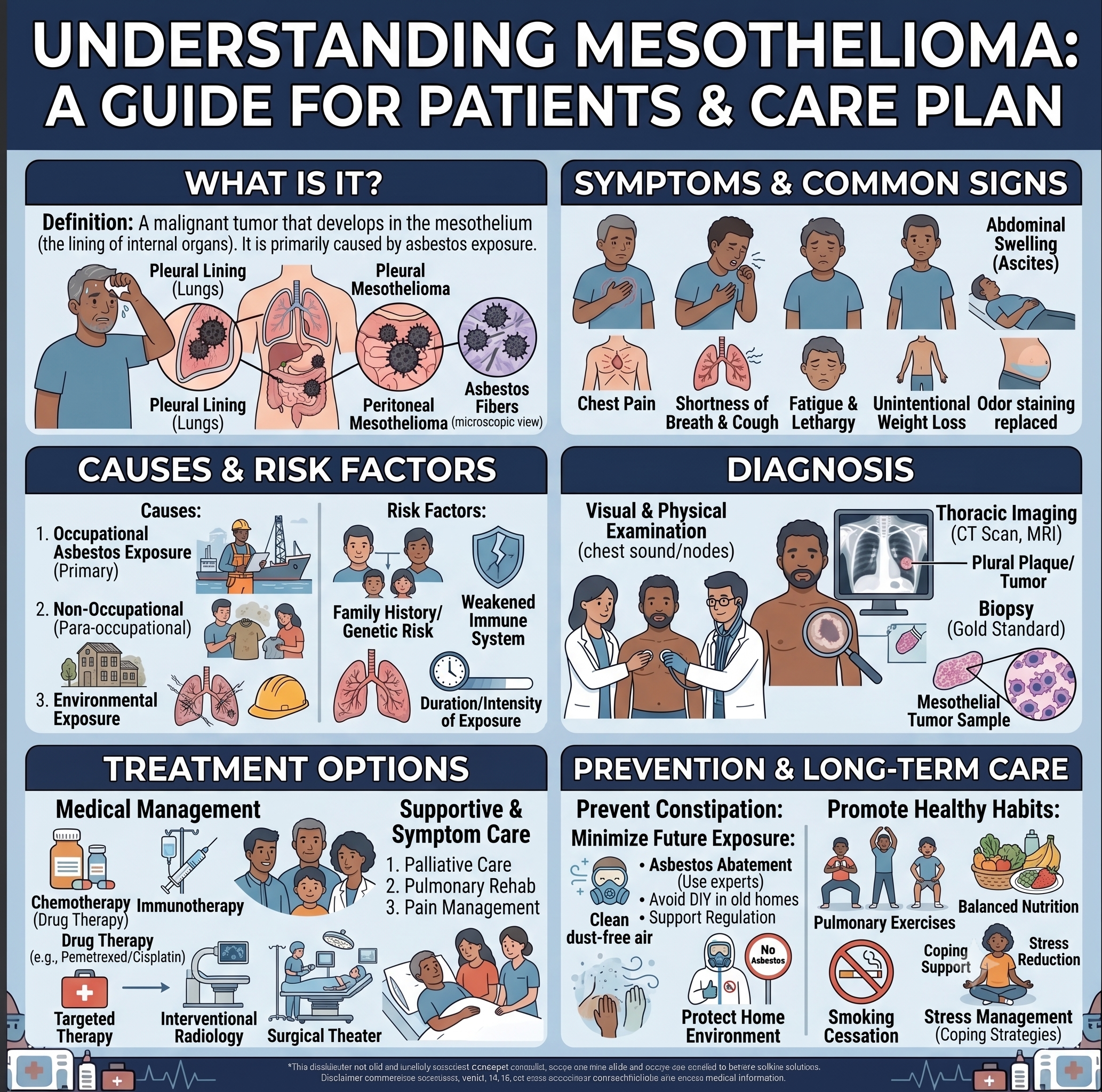
Mesothelioma (pronounced me-zoe-thee-lee-O-muh) is a rare and aggressive cancer that originates in the mesothelium, a protective thin tissue layer covering many internal organs. It most commonly affects the lining of the lungs (pleural mesothelioma), but can also occur in the abdomen, around the heart, or testicles. Often fast-growing and challenging to cure, treatments focus on managing the disease and improving quality of life.
Understanding the Condition
Mesothelioma: Understanding a Rare Cancer
Understanding the Condition
Common Symptoms
Pleural Mesothelioma (affecting lung lining): Symptoms may include persistent chest pain, a painful cough, shortness of breath, noticeable lumps under the skin on the chest, and unexplained weight loss.
Peritoneal Mesothelioma (affecting abdominal lining): Symptoms may include belly pain, swelling in the abdomen, and unexplained weight loss.
Consultation Guide
Which Specialist to Meet
You should consult a primary care physician who can refer you to specialists such as an oncologist (cancer doctor), a pulmonologist (lung specialist), a gastroenterologist (digestive system specialist if abdominal), or a thoracic surgeon (chest surgeon).
Preparations Before Your Visit
Before your visit, prepare a detailed list of your symptoms, including when they started and how often they occur. Be ready to share your complete medical history, any past exposures to asbestos, and your family's medical history. Also, write down any questions you have for the doctor.
Book a doctor visit near me
Regular Follow-ups: After treatment, ongoing medical check-ups are essential to monitor for any recurrence of the cancer or new symptoms. This may include regular imaging scans and blood tests.
Manage Symptoms: Work with your healthcare team to manage any lingering symptoms or side effects from treatment. This can include pain management, breathing exercises, and nutritional support.
Diagnostic Procedures
Mesothelioma (pronounced me-zoe-thee-lee-O-muh) is a rare and aggressive cancer that originates in the mesothelium, a protective thin tissue layer covering many internal organs. It most commonly affects the lining of the lungs (pleural mesothelioma), but can also occur in the abdomen, around the heart, or testicles. Often fast-growing and challenging to cure, treatments focus on managing the disease and improving quality of life.
A common imaging test that uses a small amount of radiation to create pictures of your heart, lungs, blood vessels, airways, and the bones of your chest and spine. It can reveal fluid buildup, collapsed lungs, or unusual masses.
What to Expect
You will stand or sit in front of an X-ray machine. You might be asked to change into a gown and remove any jewelry. The technician will position you and ask you to hold your breath for a few seconds while the X-ray is taken. The process is quick and generally painless.
CT Scan (Computerized Tomography Scan)
A CT scan combines multiple X-ray images taken from different angles to create detailed cross-sectional pictures ('slices') of your bones, blood vessels, and soft tissues. It provides more detailed images than a standard X-ray.
What to Expect
You will lie on a motorized table that slides into a large, donut-shaped machine. You might be given an injection of contrast dye to make certain areas show up more clearly. You'll need to lie still during the scan, which can take 15-30 minutes. You may hear humming or clicking noises.
A procedure where a long, thin needle is inserted through the skin to remove a small sample of tissue or fluid from a suspicious area. This sample is then examined under a microscope by a pathologist to check for cancer cells.
What to Expect
You will lie down, and the area for the biopsy will be cleaned and numbed with a local anesthetic. Imaging techniques like ultrasound or CT may be used to guide the needle precisely. You might feel some pressure or a brief sharp sensation as the needle is inserted. Once the sample is collected, the needle is removed, and pressure is applied to the site. The procedure typically takes 30-60 minutes.
Positron Emission Tomography (PET) Scan
A PET scan is an imaging test that uses a radioactive 'tracer' drug, usually injected into a vein, to highlight areas of increased metabolic activity in your body. Cancer cells often show higher metabolic rates, appearing as bright spots on the scan, which can help detect disease earlier than other imaging methods.
What to Expect
After the tracer is injected, you'll wait for about an hour for it to be absorbed by your body's tissues. Then, you'll lie on a narrow table that slides into a large, donut-shaped scanner. You must remain very still during the scan, which usually lasts 30-60 minutes. The images are often combined with a CT or MRI scan for better detail.
Treatment Options
Surgical Procedures
Surgery: Surgical removal aims to take out as much of the tumor as possible. Depending on the cancer's location and spread, this might involve removing part of the lung lining, affected organs, or surrounding tissues. (Duration: A single procedure, with recovery time varying from weeks to months.)
Medications
Chemotherapy: Drug treatment using powerful chemicals to kill fast-growing cancer cells throughout the body. These medications can be given intravenously or as pills, often in combination. (Duration: Typically given in cycles over several months, depending on the specific regimen and patient response.)
Therapies
Radiation Therapy: Uses high-energy beams, such as X-rays or protons, precisely targeted at the cancer to destroy cancer cells and shrink tumors. It can be delivered externally (from a machine outside the body) or internally (by placing a small radioactive implant near the tumor). (Duration: Usually administered over several weeks, with daily sessions on weekdays.)
Acupuncture: A traditional technique involving the insertion of very thin needles into specific points on the body. It is often used to help manage pain and improve overall well-being, including reducing treatment side effects like nausea. (Duration: Sessions typically last 30-60 minutes, with a course of treatment often involving several sessions over weeks or months.)
Healthy Lifestyle: Maintaining a balanced diet, engaging in light physical activity as tolerated, and avoiding smoking can contribute to overall health and well-being during and after treatment.
Support Systems: Joining support groups or seeking counseling can help cope with the emotional and psychological challenges of living with cancer.
Prevention & Long-Term Wellbeing
Prevention
Avoid Asbestos Exposure: The most crucial step in preventing mesothelioma is to avoid contact with asbestos fibers. If you work in an industry with potential asbestos exposure, adhere to safety protocols, use personal protective equipment, and undergo regular workplace monitoring.
Protect Family from Asbestos: If you live with someone who works with asbestos, ensure they shower and change clothes before entering the home to prevent carrying fibers indoors. Wash work clothes separately to minimize household exposure.
Be Aware of Home Asbestos: If your home was built before the 1980s, it might contain asbestos-containing materials. Do not disturb these materials yourself; consult professionals for safe inspection and removal to prevent fiber release.
Long-Term Monitoring and Support
Tags & Topics
Notice an error or need an update?
Help us keep medical information accurate. Report incorrect info or suggest an edit.


