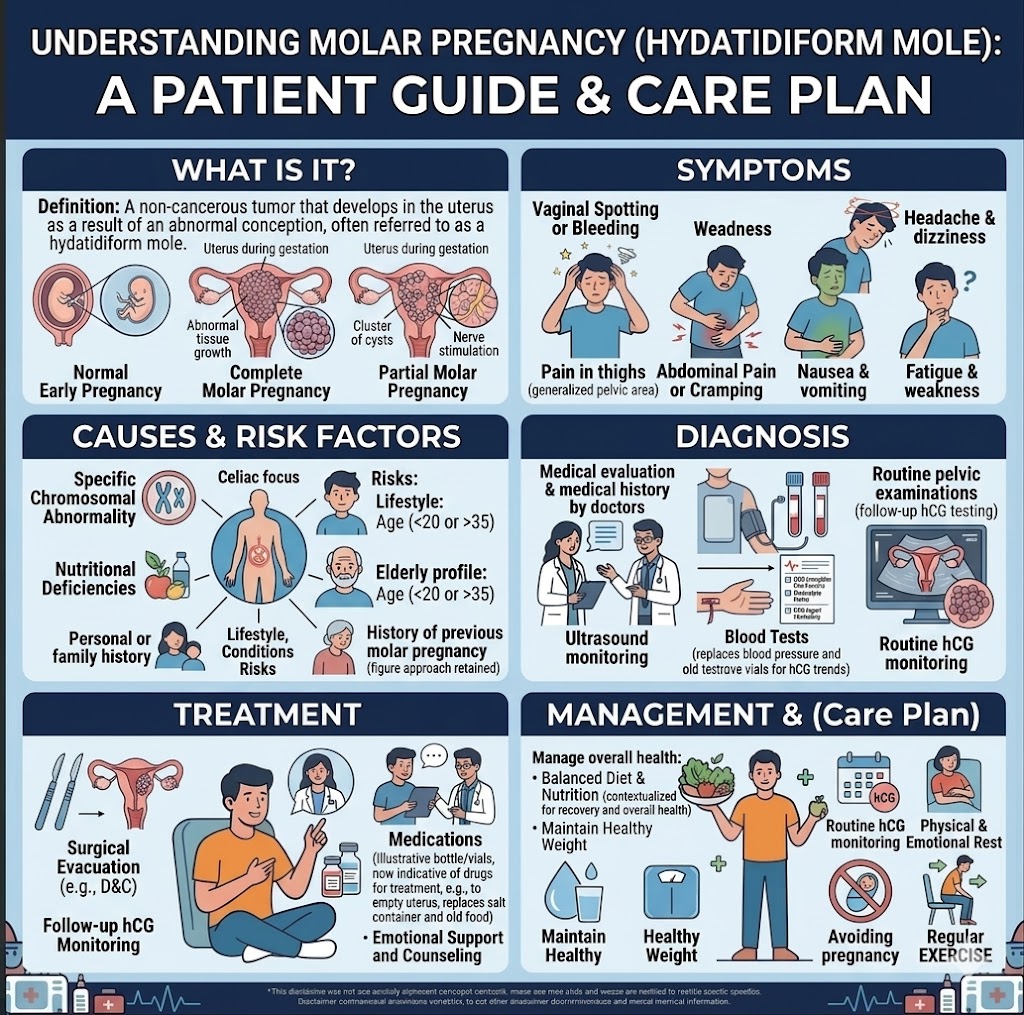
A molar pregnancy is a rare and unusual complication that occurs during early pregnancy. It involves the abnormal growth of cells that typically form the placenta, the organ responsible for nourishing a developing baby. Instead of a normal placenta, these cells (called trophoblasts) grow abnormally. There are two main types: complete molar pregnancy, where there is only abnormal placental tissue with no fetus; and partial molar pregnancy, where there can be both normal and abnormal placental tissue, and sometimes an undeveloped fetus that cannot survive. Molar pregnancies can lead to serious health issues, including a very rare form of cancer, and require prompt medical treatment.
Understanding the Condition
Molar Pregnancy: Understanding a Rare Pregnancy Complication
Understanding the Condition
Common Symptoms
Vaginal Bleeding: Dark brown to bright red vaginal bleeding during the first three months of pregnancy.
Severe Nausea and Vomiting: Severe nausea and vomiting, often worse than typical morning sickness.
Grapelike Cysts: Occasionally, small, fluid-filled cysts resembling grapes may pass from the vagina.
Pelvic Pain: Pressure or pain in the pelvic area.
Rapid Uterine Growth: A uterus that grows much faster than expected for the stage of pregnancy.
Early Preeclampsia: High blood pressure and protein in the urine, a condition called preeclampsia, occurring unusually early (before 20 weeks of pregnancy).
Ovarian Cysts: The presence of cysts on the ovaries.
Overactive Thyroid: Symptoms of an overactive thyroid gland, such as nervousness, fast heartbeat, or unexplained weight loss.
Consultation Guide
Which Specialist to Meet
You should see an obstetrician-gynecologist (OB/GYN), a doctor specializing in women's reproductive health and pregnancy. If complications arise, you may be referred to a gynecologic oncologist, who specializes in reproductive cancers.
Preparations Before Your Visit
Before your appointment, prepare a list of all your symptoms, including when they started and how severe they are. Note any past medical conditions, pregnancies, and current medications. Write down any questions you have. It can also be helpful to bring a trusted friend or family member for support and to help remember information.
Book a doctor visit near me
Consultation Guide
Use of Contraception: During the HCG monitoring period, it is important to use reliable contraception to prevent another pregnancy. A new pregnancy could cause HCG levels to rise, making it difficult to determine if the increase is due to a normal pregnancy or a recurrence of molar tissue.
Diagnostic Procedures
Blood Test (HCG Levels)
This test measures the level of human chorionic gonadotropin (HCG), a hormone produced during pregnancy. In a molar pregnancy, HCG levels are often much higher than expected for the stage of pregnancy or may remain high after a miscarriage.
What to Expect
A healthcare professional will draw a small sample of blood, usually from a vein in your arm. This is a quick procedure, typically causing only a brief pinch or sting.
An ultrasound uses sound waves to create images of the uterus and its contents. For a molar pregnancy, it can show the characteristic abnormal tissue growth in the placenta, and whether a fetus is present or not.
What to Expect
You will lie on an examination table. A gel will be applied to your lower abdomen, and a handheld device (transducer) will be moved across your skin to create images. Sometimes, a transvaginal ultrasound is performed, where a slender wand is gently inserted into the vagina for clearer images. The procedure is generally painless, though you might feel some pressure. You may be asked to have a full bladder for an abdominal ultrasound.
Dilation and Curettage (D&C)
D&C is a minor surgical procedure to remove abnormal tissue from inside the uterus. The tissue is then sent to a laboratory for examination under a microscope to confirm the diagnosis of a molar pregnancy and determine its type.
What to Expect
This procedure is typically performed in an operating room, often under general anesthesia, so you will be asleep and feel no pain. The opening of your uterus (cervix) will be gently widened. Then, a specialized surgical instrument or a suction device will be used to carefully remove the tissue from the uterine lining. You might experience some cramping and light bleeding for a few days after the procedure.
Early Monitoring in Future Pregnancies: If you do become pregnant again after a molar pregnancy, your healthcare provider will likely recommend early ultrasounds and possibly blood tests to monitor the pregnancy closely and ensure normal development.
Regular HCG Level Monitoring: After treatment, regular blood tests to measure HCG levels are crucial. This monitoring continues for several months or longer to ensure the levels return to and stay at zero, indicating no remaining molar tissue. Consistent follow-up is vital to detect any recurrence early.
Treatment Options
A molar pregnancy is a rare and unusual complication that occurs during early pregnancy. It involves the abnormal growth of cells that typically form the placenta, the organ responsible for nourishing a developing baby. Instead of a normal placenta, these cells (called trophoblasts) grow abnormally. There are two main types: complete molar pregnancy, where there is only abnormal placental tissue with no fetus; and partial molar pregnancy, where there can be both normal and abnormal placental tissue, and sometimes an undeveloped fetus that cannot survive. Molar pregnancies can lead to serious health issues, including a very rare form of cancer, and require prompt medical treatment.
Surgical Procedures
Dilation and Curettage (D&C): This is the primary treatment for molar pregnancy, involving the surgical removal of the abnormal tissue from the uterus. It helps prevent complications and allows for tissue analysis. (Duration: A single procedure, typically lasting 15-30 minutes, followed by a recovery period of a few days to weeks.)
Medications
Chemotherapy: If molar tissue remains after D&C and continues to grow (a condition called persistent gestational trophoblastic neoplasia) or if a rare cancerous form develops (choriocarcinoma), specific anti-cancer medications are used to destroy these cells. (Duration: Treatment duration varies greatly, from several weeks to many months, depending on the response and type of condition. It involves regular infusions or oral medication.)
Prevention & Long-Term Wellbeing
Hysterectomy (Uterus Removal): In rare cases, particularly if the molar pregnancy is complete and the woman does not wish for future pregnancies, removal of the uterus may be recommended to prevent recurrence or manage persistent disease. (Duration: A single surgical procedure, with hospital stay and recovery typically spanning several weeks.)
Prevention
Postpone Future Pregnancies: After a molar pregnancy, it is generally recommended to wait at least six months to one year before trying to conceive again. This allows time for full recovery and for healthcare providers to confirm that all molar tissue has been removed and HCG levels have returned to normal.
Tags & Topics
Notice an error or need an update?
Help us keep medical information accurate. Report incorrect info or suggest an edit.


