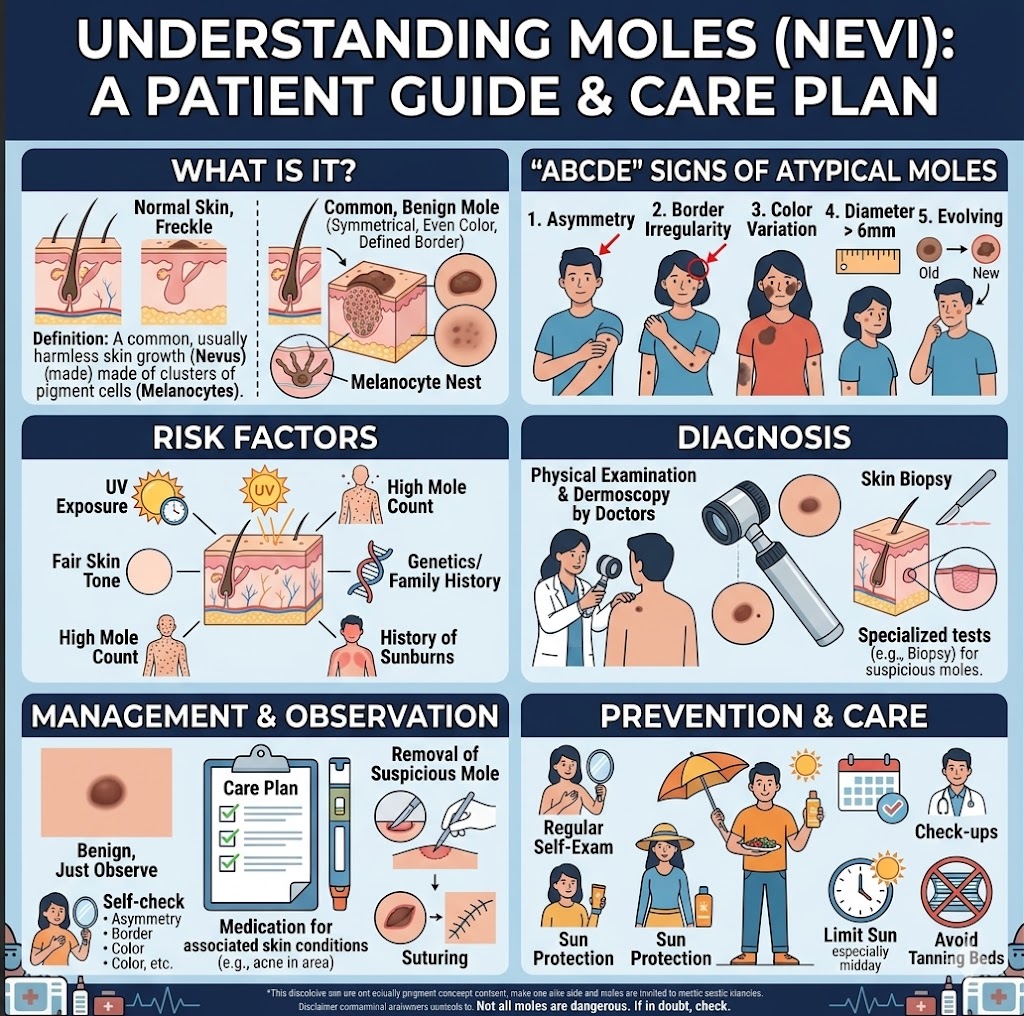
Moles are very common skin growths, typically appearing as small, dark brown spots. They form when pigment-producing cells in the skin grow in clusters. Most people develop 10 to 45 moles during childhood and teenage years. While most moles are harmless and can change or fade over time, it's crucial to monitor them for any changes, as they can rarely become cancerous, a serious form of skin cancer called melanoma.
Understanding the Condition
Understanding Moles and Skin Health
Understanding the Condition
Moles are very common skin growths, typically appearing as small, dark brown spots. They form when pigment-producing cells in the skin grow in clusters. Most people develop 10 to 45 moles during childhood and teenage years. While most moles are harmless and can change or fade over time, it's crucial to monitor them for any changes, as they can rarely become cancerous, a serious form of skin cancer called melanoma.
Common Symptoms
Normal Moles: A typical mole is a small brown spot, but they come in various colors (tan, black, blue, red, pink), textures (smooth, wrinkled, flat, raised, or even hairy), shapes (oval or round), and sizes (usually less than 1/4 inch or about 6 mm in diameter – like a pencil eraser). Moles can appear anywhere on the body, including the scalp, armpits, and between fingers and toes. They may darken or get larger due to hormonal changes, such as during the teenage years or pregnancy.
Dermatoses Papulosa Nigra: These are non-cancerous clusters of waxy, brown, black, or tan spots often found around the eyes, cheeks, and nose. They are not true moles (clusters of pigment-forming cells) and are more common in Black women. While they pose no risk of melanoma, they can be treated for cosmetic reasons if desired.
Warning Signs of Skin Cancer (ABCDE Guide): A mole may be a sign of skin cancer, especially melanoma, if it shows any of the following changes. Use this guide to help you remember what to watch for:* **A is for Asymmetrical shape**: One half of the mole doesn't match the other half.* **B is for Border irregularity**: The edges of the mole are uneven, notched, or scalloped.* **C is for Color changes**: The mole has varying colors, multiple shades, or an uneven color distribution within it.* **D is for Diameter**: A new mole, or an existing one, that grows larger than 1/4 inch (about 6 mm).* **E is for Evolving**: Any change in a mole's size, shape, color, or height. Also, watch for new symptoms like itching, tenderness, or bleeding.
Consultation Guide
Which Specialist to Meet
Consultation Guide
Start by discussing any concerns with your primary care doctor. If they find anything suspicious or if you have many moles or risk factors, they may refer you to a dermatologist, a doctor specializing in skin conditions, for a thorough examination.
Preparations Before Your Visit
Before your appointment, examine your skin from head to toe (using mirrors for hard-to-see areas) and note any moles that concern you, including their location and when you first noticed any changes. Prepare a list of questions about your personal risk factors for skin cancer and how often you should have professional skin exams.
Book a doctor visit near me
Regular Professional Skin Exams: Discuss your personal risk factors for melanoma with your healthcare professional. Based on your risk, they can advise whether you need regular professional skin exams by a dermatologist to monitor your moles and screen for skin cancer.
Diagnostic Procedures
A skin biopsy is a minor procedure where a small sample of a suspicious mole or skin growth is carefully removed. This sample is then sent to a pathology lab to be examined under a microscope by a specialist to check for the presence of cancer cells.
What to Expect
First, the doctor will clean the area and numb it with a local anesthetic injection; you'll feel a brief sting, then pressure but no pain during the removal. Depending on the mole, the doctor might shave off the top layer, use a small circular tool to punch out a section, or surgically cut out the entire mole. If a deeper cut is made, you may receive stitches. The area will be covered with a bandage, and you'll get instructions for wound care. There might be some mild soreness or a small scar after healing.
Excisional Biopsy/Surgical Excision: If a mole is suspicious, bothersome, or diagnosed as cancerous, the doctor will surgically cut out the entire mole along with a small amount of surrounding healthy skin to ensure all abnormal cells are removed. (Duration: A quick outpatient procedure, typically 15-30 minutes. The wound takes 1-2 weeks to heal, with stitches (if used) removed in 1-3 weeks.)
Shave Excision: For moles that are raised above the skin surface and are benign but cosmetically bothersome or irritated, the doctor may use a small, sharp blade to shave off the mole. (Duration: A few minutes per mole. The wound heals like a scrape, usually within 1-2 weeks.)
Treatment Options
Surgical Procedures
Laser Hair Removal (for hair on moles): If a mole has unwanted hair, a concentrated light beam can target the pigment in the hair follicles to damage them and reduce hair growth. This is purely for cosmetic purposes and does not treat the mole itself. (Duration: Each session lasts minutes to an hour. Multiple sessions (typically 4-6 weeks apart) are usually needed for significant hair reduction, and maintenance sessions may be required.)
Prevention & Long-Term Wellbeing
Prevention of Melanoma and New Moles
Practice Sun Protection: Limit your skin's exposure to ultraviolet (UV) radiation from the sun. Stay out of the sun during peak intensity hours, typically between 10 a.m. and 4 p.m. Seek shade whenever possible when outdoors.
Use Sunscreen Year-Round: Apply a broad-spectrum, water-resistant sunscreen with an SPF of at least 30 to all exposed skin 15 minutes before going outdoors, even on cloudy days. Apply generously and reapply every two hours, or more often if swimming or sweating.
Wear Protective Clothing: Cover up with broad-brimmed hats, sunglasses, long-sleeved shirts, and long pants to shield your skin from damaging UV rays. Consider clothing made with fabric specifically designed to block UV radiation.
Avoid Tanning Lamps and Beds: Tanning lamps and beds emit harmful UV rays that significantly increase your risk of skin cancer, including melanoma. They should be avoided entirely.
Long-Term Monitoring
Perform Monthly Self-Skin Exams: Become familiar with the location and appearance of your moles. Once a month, perform a thorough head-to-toe check of your skin. Use mirrors to examine hard-to-see areas like your scalp, armpits, palms, soles, between your toes, and the genital area, looking for any new moles or changes in existing ones.
Tags & Topics
Notice an error or need an update?
Help us keep medical information accurate. Report incorrect info or suggest an edit.


