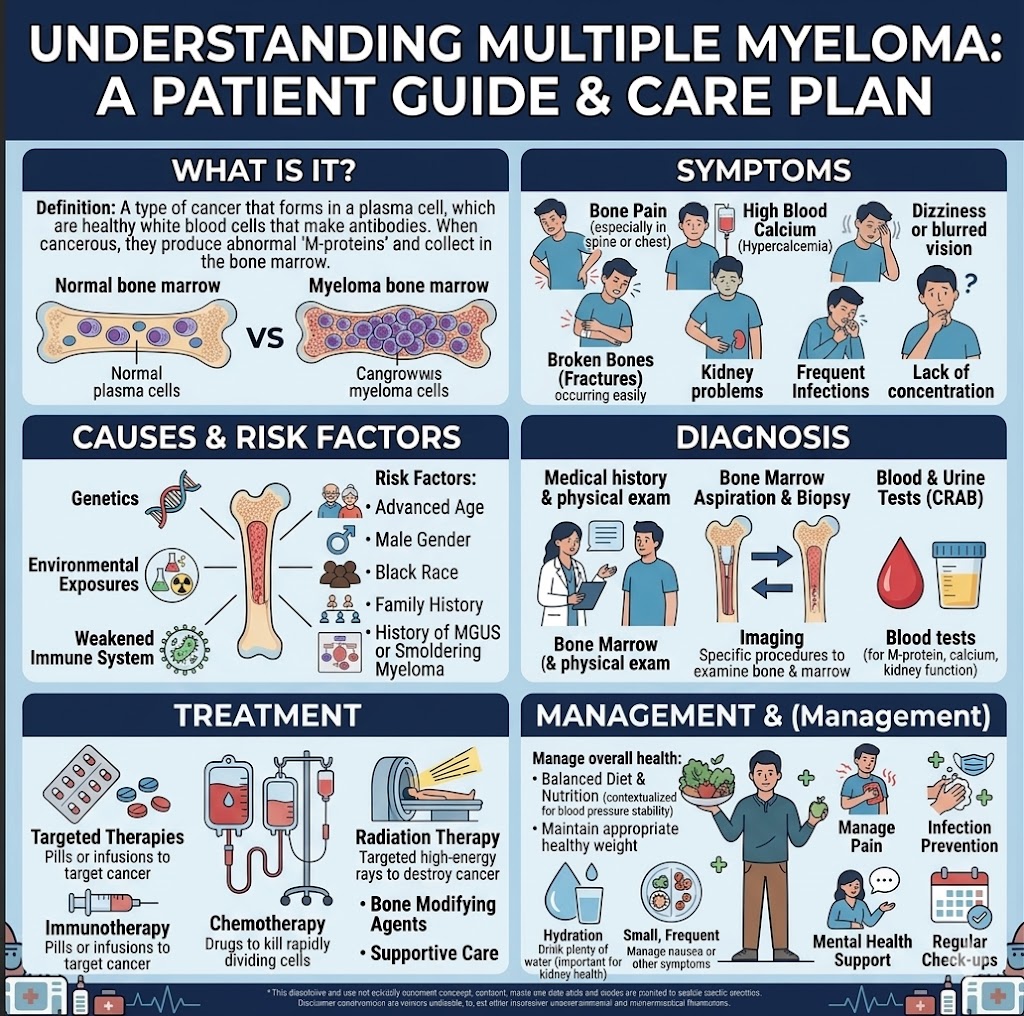
Multiple myeloma is a cancer that affects specific white blood cells called plasma cells, found in the bone marrow. Healthy plasma cells produce antibodies to fight infections. In multiple myeloma, these plasma cells become cancerous, multiplying uncontrollably in the bone marrow. They crowd out healthy blood cells and produce abnormal proteins, known as M proteins, instead of functional antibodies. This leads to various health problems like weakened bones, kidney damage, and a reduced ability to fight infections. The disease sometimes starts as a non-cancerous condition called monoclonal gammopathy of undetermined significance (MGUS). Treatment may not be needed immediately if the cancer is slow-growing; close monitoring can be the initial step.
Understanding the Condition
Multiple Myeloma: A Clear Guide for Non-Medical People
Understanding the Condition
Common Symptoms
Bone Pain: Especially in the spine, chest, or hips, often due to bone damage.
If you experience symptoms, consult your primary care doctor, who may refer you to a hematologist-oncologist, a specialist in blood cancers. Depending on specific complications, you might also see a kidney specialist (nephrologist) or a bone specialist.
Preparations Before Your Visit
Before your visit, make a list of all your symptoms, including when they started and how they affect your daily life. Gather your complete medical history, including any other health conditions and current medications, vitamins, or supplements. Prepare a list of questions for your doctor to ensure all your concerns are addressed.
Book a doctor visit near me
Watchful Waiting: For slow-growing multiple myeloma without symptoms, regular monitoring is performed instead of immediate treatment. (Duration: Ongoing, with periodic blood tests and imaging, ranging from months to several years, until treatment becomes necessary.)
Symptom Management: Work with your healthcare team to manage symptoms like pain, fatigue, and side effects from treatment to maintain quality of life.
Consultation Guide
Constipation: Can be caused by high calcium levels in the blood or certain pain medications.
Loss of Appetite: Feeling full quickly or having a decreased desire to eat.
Mental Fogginess or Confusion: Difficulty concentrating or thinking clearly.
Frequent Infections: A weakened immune system makes the body vulnerable to illnesses.
Unexplained Weight Loss: Losing weight without trying.
Increased Urination: Needing to urinate more often than usual.
Fatigue and Weakness: Feeling very tired and lacking energy, often due to anemia.
Consultation Guide
Which Specialist to Meet
A healthcare professional will draw a small sample of blood, usually from a vein in your arm, using a needle. The process is quick and may cause a brief pinch or sting.
Uses low-dose radiation to create images of the inside of your body, particularly bones. It helps detect bone damage or thinning caused by multiple myeloma.
No Known Prevention: There is currently no known way to prevent multiple myeloma. Risk factors like age, gender, ethnicity, and family history are beyond your control.
Diagnostic Procedures
Complete Blood Count (CBC)
A routine blood test that measures the levels of different types of blood cells, including red blood cells, white blood cells, and platelets. Abnormal levels can indicate disease.
What to Expect
Measures the amount of creatinine, a waste product, in your blood or urine. This helps assess how well your kidneys are filtering waste.
What to Expect
A blood sample will be drawn. For a urine test, you might collect all urine over a 24-hour period. You may be asked to fast or avoid certain foods/supplements beforehand.
What to Expect
You will lie or stand still while a technician positions you and takes images. The process is quick, painless, and involves minimal radiation exposure.
CT Scan (Computerized Tomography)
Combines a series of X-ray images taken from different angles to create detailed cross-sectional views of bones, blood vessels, and soft tissues.
What to Expect
You'll lie on a table that slides into a large, doughnut-shaped machine. You may receive a contrast dye injection to enhance image clarity. You need to remain still during the scan.
PET Scan (Positron Emission Tomography)
An imaging test that reveals the metabolic activity of tissues and organs. It uses a radioactive tracer to highlight areas of increased activity, often indicative of cancer. Often combined with a CT scan (PET-CT).
What to Expect
A small amount of radioactive tracer is injected into your vein. After a waiting period for the tracer to circulate, you will lie on a table that slides into the scanner. You must remain very still for about 30 minutes.
Bone Marrow Biopsy and Aspiration
Involves collecting a small sample of liquid bone marrow (aspiration) and solid bone tissue (biopsy) to examine for cancer cells.
What to Expect
The procedure is usually performed on your hip bone. Local anesthetic will numb the area. A needle is used to collect the samples. You may feel pressure and a brief sharp pain. Afterward, the site may be sore.
Blood and Urine Protein Tests
Specific tests, like serum and urine protein electrophoresis, detect and measure the abnormal proteins (M proteins) produced by myeloma cells, which are key indicators of the disease.
What to Expect
These involve a blood draw and/or a collection of urine, sometimes over a 24-hour period, similar to the creatinine test.
Managing MGUS: If diagnosed with MGUS (monoclonal gammopathy of undetermined significance), close monitoring by a doctor can help detect progression to myeloma early.
Regular Monitoring: Adhere to your treatment plan and attend all follow-up appointments for blood tests, imaging, and physical exams to monitor the disease and treatment effectiveness.
Treatment Options
Multiple myeloma is a cancer that affects specific white blood cells called plasma cells, found in the bone marrow. Healthy plasma cells produce antibodies to fight infections. In multiple myeloma, these plasma cells become cancerous, multiplying uncontrollably in the bone marrow. They crowd out healthy blood cells and produce abnormal proteins, known as M proteins, instead of functional antibodies. This leads to various health problems like weakened bones, kidney damage, and a reduced ability to fight infections. The disease sometimes starts as a non-cancerous condition called monoclonal gammopathy of undetermined significance (MGUS). Treatment may not be needed immediately if the cancer is slow-growing; close monitoring can be the initial step.
Medications
Chemotherapy: Uses powerful drugs to kill rapidly growing cancer cells throughout the body. (Duration: Typically administered in cycles over several weeks or months, depending on the specific drugs and disease response.)
Targeted Therapies: Drugs designed to block specific vulnerabilities within cancer cells, limiting their growth and survival while sparing healthy cells. (Duration: Often administered continuously or in cycles for months or years, as long as the treatment is effective and tolerable.)
Immunotherapies: Medications that boost your body's immune system to recognize and destroy cancer cells. (Duration: Given in cycles over several weeks or months, potentially as ongoing maintenance therapy.)
Corticosteroids: Steroid medications that reduce inflammation and also have anti-cancer effects against myeloma cells. (Duration: Often used in combination with other treatments, typically for several weeks or months during active treatment phases.)
Procedures and Therapies
Radiation Therapy: Uses high-energy beams to kill cancer cells or relieve pain in specific areas, often targeting bone lesions. (Duration: Usually a short course, lasting from a few days to a few weeks, depending on the treatment goal.)
Pain Management: Using prescribed medications and non-drug approaches to alleviate bone pain and discomfort. (Duration: As advised)
Bone Health: Follow recommendations for medications and activities to strengthen bones and prevent fractures, often including calcium and vitamin D supplements.
Kidney Protection: Stay well-hydrated and avoid medications that could strain the kidneys, as advised by your healthcare provider.
Emotional Support: Seek support from family, friends, support groups, or mental health professionals to cope with the emotional challenges of living with cancer.
Prevention & Long-Term Wellbeing
Stem Cell Transplant (Bone Marrow Transplant): Replaces diseased bone marrow with healthy blood-forming stem cells, either from the patient's own body (autologous) or a donor (allogeneic). (Duration: Involves several weeks of intensive preparation (chemotherapy), the transplant procedure itself, followed by a recovery period of several months to a year.)
CAR-T Cell Therapy: A specialized immunotherapy where a patient’s own immune T-cells are genetically modified in a lab to specifically target and destroy cancer cells, then reinfused. (Duration: Requires a collection phase (days), lab processing (weeks), a single infusion, and then ongoing monitoring for several months. Effects are designed to be long-lasting.)
Supportive Care (Home Remedies)
Nutritional Support and Hydration: Maintaining a balanced diet and adequate fluid intake to support overall health and kidney function. (Duration: As advised)
Light Exercise: Engaging in gentle physical activity as advised by your doctor to maintain muscle strength and bone health. (Duration: As advised)
Prevention
Healthy Lifestyle: Maintain a balanced diet, stay hydrated, and engage in regular, gentle exercise as recommended by your doctor to support your body's strength and resilience.
Infection Prevention: Practice good hygiene, avoid sick individuals, and discuss vaccinations with your doctor, as your immune system may be compromised.
Tags & Topics
Notice an error or need an update?
Help us keep medical information accurate. Report incorrect info or suggest an edit.


