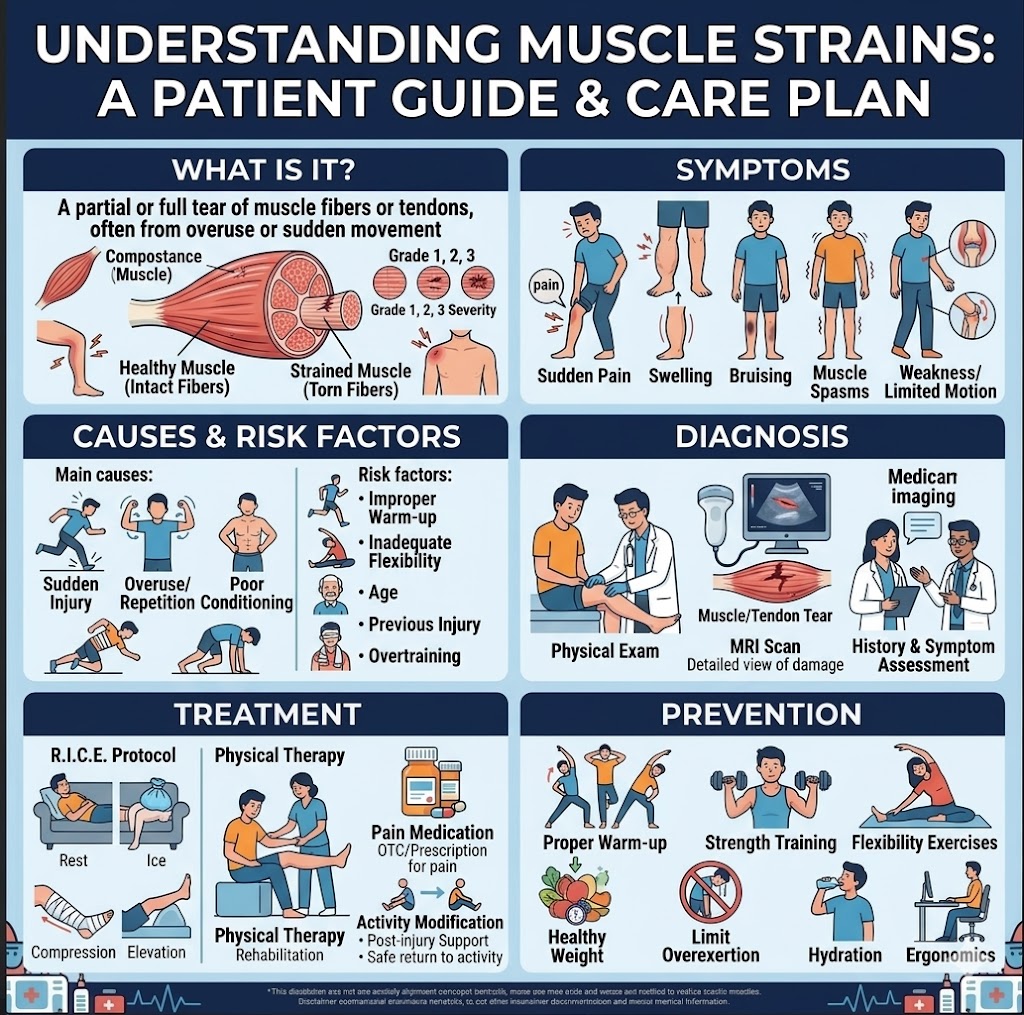
A muscle strain, commonly known as a "pulled muscle," is an injury to a muscle or a tendon. Tendons are the tough, fibrous cords that connect your muscles to your bones. These injuries can range from mild overstretching to more severe partial or complete tears of the muscle fibers or tendon. Strains frequently affect the lower back and the hamstring muscles located at the back of the thigh. It's important to differentiate a strain from a sprain: a strain involves damage to a muscle or its connecting tendon, whereas a sprain impacts ligaments, which are the tissues that connect bones to other bones. Initial management typically involves rest, ice, compression, and elevation. While minor strains often heal with home care, more severe cases may necessitate medical attention, including potential surgery.
Understanding the Condition
Common Symptoms
Pain or Tenderness: Localized discomfort ranging from mild to severe, often made worse by movement or touch.
Redness or Bruising: Discoloration around the injured area, indicating internal bleeding.
Limited Motion: Difficulty or inability to move the affected muscle or joint through its normal range.
Muscle Spasms: Involuntary tightening or cramping of the muscle.
Muscle Weakness: A noticeable reduction in the muscle's ability to exert force or perform its usual function.
Consultation Guide
Which Specialist to Meet
Initially, you should consult your primary care physician. For severe, persistent, or complex muscle strains, your doctor may refer you to a specialist such as an orthopedic surgeon, a sports medicine physician, or a physical therapist.
Preparations Before Your Visit
Before your appointment, prepare to describe your symptoms in detail, including when they started, what activities trigger them, and what provides relief. Bring a list of any current medications and your relevant medical history. Write down any questions you have for the doctor.
Book a doctor visit near me
Diagnostic Procedures
Diagnostic Ultrasound (Sonography)
Diagnostic ultrasound, or sonography, is a safe imaging method that uses high-frequency sound waves to create real-time pictures of internal body structures. Unlike X-rays, it does not use radiation. This allows healthcare professionals to visualize muscles, tendons, ligaments, and other soft tissues, which is helpful in diagnosing injuries like muscle strains and guiding treatment decisions. It's a non-invasive procedure with no known risks, utilizing low-power sound waves. However, sound waves do not penetrate air or bone well, limiting ultrasound's effectiveness for imaging organs with gas (like the lungs) or areas hidden by bone (like the brain). It may also struggle to visualize very deep body structures, in which case your doctor might recommend other imaging tests such as CT scans, MRI scans, or X-rays.
What to Expect
For most ultrasound exams, you will lie on an examination table. A clear gel will be applied to the skin over the area to be examined; this gel helps the sound waves transmit effectively. A small, handheld device called a transducer will then be gently pressed against your skin and moved back and forth over the area. This transducer both emits sound waves and captures the echoes that bounce back, creating images on a monitor. The procedure is usually painless, though you might feel some pressure from the transducer. You should wear loose, comfortable clothing to your appointment. You may be asked to remove jewelry from the area being scanned. Most ultrasound exams do not require special preparation, but always follow any specific instructions given by your healthcare provider.
Treatment Options
Muscle Strains: Understanding, Treatment, and Prevention
Understanding the Condition
A muscle strain, commonly known as a "pulled muscle," is an injury to a muscle or a tendon. Tendons are the tough, fibrous cords that connect your muscles to your bones. These injuries can range from mild overstretching to more severe partial or complete tears of the muscle fibers or tendon. Strains frequently affect the lower back and the hamstring muscles located at the back of the thigh. It's important to differentiate a strain from a sprain: a strain involves damage to a muscle or its connecting tendon, whereas a sprain impacts ligaments, which are the tissues that connect bones to other bones. Initial management typically involves rest, ice, compression, and elevation. While minor strains often heal with home care, more severe cases may necessitate medical attention, including potential surgery.
Home Remedies and Supportive Care
R.I.C.E. Therapy (Rest, Ice, Compression, Elevation): Rest the injured muscle to prevent further damage. Apply ice packs for 15-20 minutes multiple times a day to reduce pain and swelling. Use an elastic bandage to compress the area and minimize swelling. Elevate the injured limb above heart level whenever possible. (Duration: Typically for the first 24-48 hours, or until significant swelling subsides. Continued modified activity and rest may be needed for several days to weeks.)
Medications
Over-the-Counter Pain Relievers: Non-prescription medications can help manage pain and reduce inflammation associated with muscle strains. (Duration: As needed for pain relief, usually for several days to a week. Consult a doctor if pain persists.)
Therapies
Physical Therapy: A physical therapist can guide you through specific exercises to restore strength, flexibility, and full range of motion to the injured muscle, while also teaching techniques to prevent future injuries. (Duration: Typically several weeks to months, depending on the severity of the strain and your individual progress.)
Surgical Procedures
Surgical Repair: For severe muscle strains involving a complete or near-complete tear of the muscle or tendon, surgery may be necessary to reattach the torn tissues. (Duration: Recovery from surgery can take several months, followed by an extensive rehabilitation program to regain full function.)
Prevention & Long-Term Wellbeing
Prevention and Long-Term Wellbeing
Regular Stretching and Strengthening Exercises: Integrate a balanced program of stretching to improve flexibility and strengthening exercises to build muscle resilience, tailored to your specific activities or work demands.
Proper Warm-up and Cool-down: Always perform a dynamic warm-up before physical activity to prepare your muscles, and follow with a gentle cool-down and static stretches afterward to aid flexibility and recovery.
Gradual Increase in Activity: Avoid sudden increases in the intensity, duration, or frequency of your workouts or physical tasks. Allow your body to adapt gradually to new demands.
Use Correct Body Mechanics: Learn and practice proper form and posture for lifting heavy objects, performing sports movements, and carrying out repetitive work tasks to reduce undue strain on muscles.
Listen to Your Body: Do not push through pain. If you feel discomfort or fatigue, rest. Tired muscles are more susceptible to injury. Ensure adequate rest and recovery between intense activities.
Maintain Overall Physical Conditioning: Ensure you are in good physical shape before participating in sports or physically demanding occupations. This proactive approach helps your muscles better handle stress and reduces injury risk.
Hydration and Nutrition: Support muscle health, repair, and overall well-being by staying well-hydrated and consuming a balanced diet rich in essential nutrients.
Tags & Topics
Notice an error or need an update?
Help us keep medical information accurate. Report incorrect info or suggest an edit.


