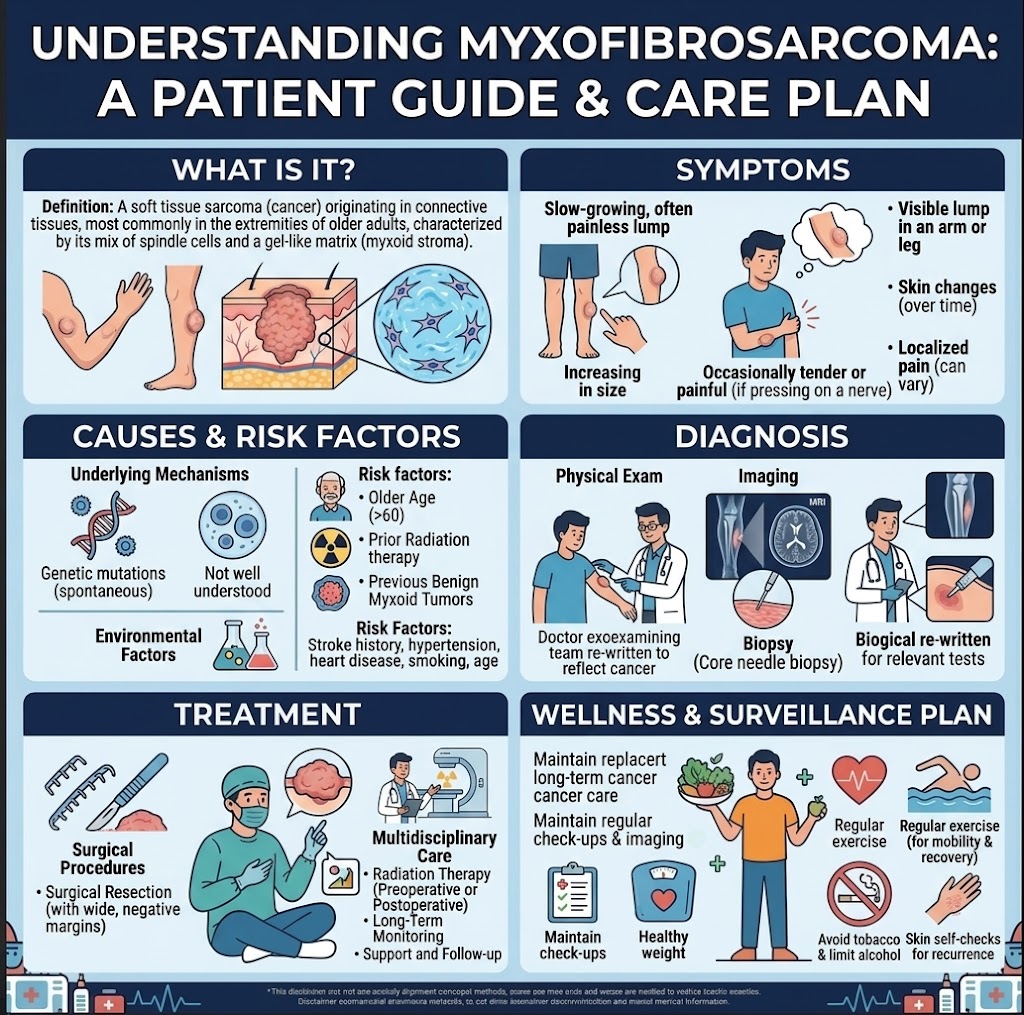
Myxofibrosarcoma is a rare type of cancer that originates in the body's connective tissues, most commonly found in the arms and legs. It starts as an abnormal growth of cells that can slowly form a lump beneath the skin, often without causing pain. This cancer is a type of soft tissue sarcoma, meaning it affects the soft tissues that connect, support, and surround our organs and other body parts. It primarily affects older adults, typically between 50 and 70 years old.
Understanding the Condition
Myxofibrosarcoma: A Guide for Non-Medical Persons
Understanding the Condition
Myxofibrosarcoma is a rare type of cancer that originates in the body's connective tissues, most commonly found in the arms and legs. It starts as an abnormal growth of cells that can slowly form a lump beneath the skin, often without causing pain. This cancer is a type of soft tissue sarcoma, meaning it affects the soft tissues that connect, support, and surround our organs and other body parts. It primarily affects older adults, typically between 50 and 70 years old.
Common Symptoms
Painless Lump: A new, often unnoticed lump or swelling that appears on an arm or leg.
Slow Growth: The lump tends to grow gradually over time. While myxofibrosarcoma most frequently begins in the legs, it rarely develops in the abdomen, a more common site for other types of sarcomas.
Consultation Guide
Which Specialist to Meet
Before your appointment, it's helpful to write down any symptoms you've experienced, including when they started and how they've changed. Also, list your complete medical history, including past illnesses, surgeries, and all medications you are currently taking. Prepare a list of questions you want to ask your doctor. This will help you make the most of your visit and ensure all your concerns are addressed.
Book a doctor visit near me
Symptom Awareness: Remain vigilant for any new lumps, pain, or unusual symptoms in the treated area or elsewhere in your body and report them to your healthcare team promptly. Early detection of recurrence or new issues is vital for effective management.
Consultation Guide
No Known Prevention Method: Currently, there are no specific known ways to prevent myxofibrosarcoma. The exact causes of the DNA changes that lead to this cancer are not fully understood, making specific preventive measures impossible at this time.
Diagnostic Procedures
Your journey typically begins with your primary care doctor. If they suspect myxofibrosarcoma, they will likely refer you to specialists such as an oncologist (cancer doctor), an orthopedic oncologist (bone and soft tissue cancer specialist), or a surgical oncologist. These experts specialize in diagnosing and treating cancers that affect connective tissues.
Preparations Before Your Visit
CT Scan (Computed Tomography)
A CT scan is an imaging test that uses a special type of X-ray equipment and a computer to create detailed cross-sectional images, or 'slices,' of your body. These images provide more detail than standard X-rays and can show bones, blood vessels, and soft tissues. It helps doctors visualize potential tumors, assess their size, and check if they have spread to other areas.
What to Expect
You will lie on a motorized table that slides into a large, donut-shaped machine. During the scan, the table will move through the scanner while an X-ray tube rotates around you. You might hear whirring noises. You may be asked to hold your breath for short periods to ensure clear images. Sometimes, a contrast dye is given orally or through an IV to make certain structures show up more clearly. The procedure is generally painless and takes 10 to 30 minutes.
A needle biopsy is a crucial procedure to confirm a diagnosis of myxofibrosarcoma. It involves using a thin, hollow needle to collect a small sample of cells or tissue from the suspicious lump. This sample is then sent to a laboratory where specialists examine it under a microscope to look for cancer cells and determine the specific type of cancer. Common types include fine-needle aspiration (FNA) and core needle biopsy, which collects a slightly larger tissue sample.
What to Expect
You will lie comfortably on an examination table. The doctor will clean the skin over the lump and inject a local anesthetic to numb the area, minimizing discomfort. Using imaging guidance like ultrasound or CT, the doctor will carefully insert the needle through the skin and into the lump to extract the tissue sample. You might feel some pressure or a brief, sharp sensation. After the sample is taken, the needle is removed, and a bandage is applied. The procedure usually takes 15 to 45 minutes, and you may experience mild soreness or bruising afterward.
Emotional and Psychological Support: Coping with a cancer diagnosis and treatment can be challenging. Seeking support from family, friends, support groups, or mental health professionals can help manage stress, anxiety, and depression, promoting mental and emotional resilience.
Treatment Options
Surgical Procedures
Tumor Removal Surgery: This involves surgically removing the cancerous tumor along with a margin of surrounding healthy tissue to ensure all cancer cells are removed. The goal is to completely excise the tumor while preserving as much function as possible in the affected limb. (Duration: A single procedure, followed by a recovery period of several weeks.)
External Beam Radiation Therapy: This treatment uses high-energy beams, often X-rays, directed precisely at the tumor from a machine outside the body. It works by damaging the genetic material of cancer cells, preventing them from growing and dividing. Healthy cells can usually repair themselves more effectively than cancer cells. (Duration: Typically given daily for several weeks, often five days a week over 5-7 weeks.)
Internal Radiation Therapy (Brachytherapy): For some cases, a small radioactive implant is placed directly inside or very close to the tumor. This delivers a concentrated dose of radiation directly to the cancer while minimizing exposure to surrounding healthy tissues. (Duration: Can range from a few minutes to several days, depending on the type and dose of the implant.)
Medications
Chemotherapy: Chemotherapy uses powerful medications, usually given through an IV or as pills, to kill fast-growing cells in the body, including cancer cells. It can be used to shrink tumors before surgery, kill any remaining cancer cells after surgery, or treat cancer that has spread to other parts of the body. (Duration: Often given in cycles (e.g., a few days of treatment followed by a break) over several months to a year, depending on the specific plan and response to treatment.)
Regular Follow-Up Appointments: After treatment, ongoing medical check-ups and imaging scans (like CT or MRI) are crucial to monitor for any signs of recurrence or new growth. These appointments help ensure long-term health and catch any potential issues early for prompt intervention.
Healthy Lifestyle: Maintaining a balanced diet, engaging in regular physical activity (as advised by your doctor), and avoiding smoking and excessive alcohol can support your overall health and well-being during and after cancer treatment.
Prevention & Long-Term Wellbeing
Prevention
Tags & Topics
Notice an error or need an update?
Help us keep medical information accurate. Report incorrect info or suggest an edit.


