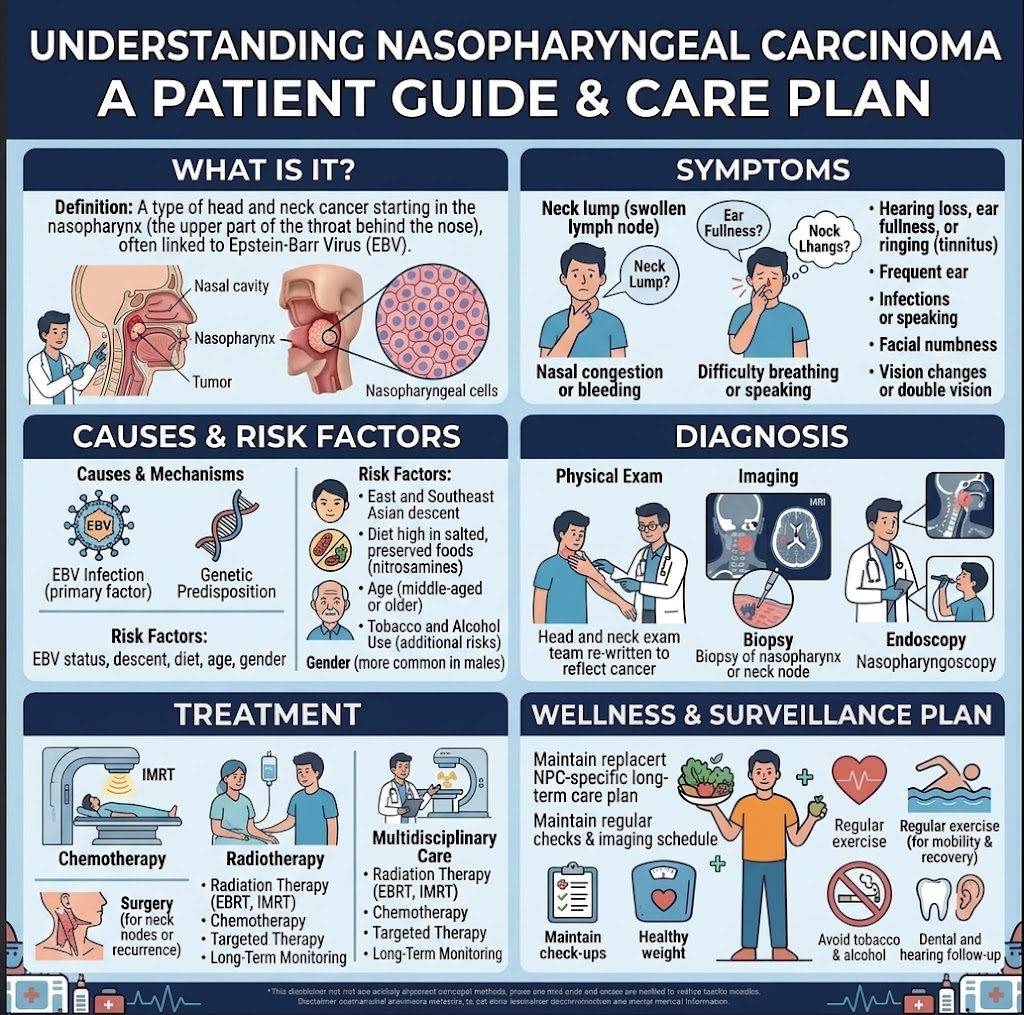
Nasopharyngeal carcinoma is a rare type of cancer that begins in the nasopharynx, the upper part of the throat located behind the nose. While uncommon in the United States, it is much more frequent in regions like Southeast Asia. Early detection can be challenging because the nasopharynx is not easily visible, and initial symptoms may be subtle or absent. Treatment typically involves radiation therapy, chemotherapy, or a combination of both.
Understanding the Condition
Understanding Nasopharyngeal Carcinoma (NPC)
Understanding the Condition
Nasopharyngeal carcinoma is a rare type of cancer that begins in the nasopharynx, the upper part of the throat located behind the nose. While uncommon in the United States, it is much more frequent in regions like Southeast Asia. Early detection can be challenging because the nasopharynx is not easily visible, and initial symptoms may be subtle or absent. Treatment typically involves radiation therapy, chemotherapy, or a combination of both.
Common Symptoms
If you experience any persistent symptoms, start by consulting your primary care doctor. They may refer you to specialists such as an Ear, Nose, and Throat (ENT) doctor (otolaryngologist), an oncologist (cancer specialist), or a radiation oncologist.
Preparations Before Your Visit
Before your visit, be ready to discuss all your symptoms, including when they started and how they have changed. Provide a complete medical history, including any family history of cancer, and information about your lifestyle, such as tobacco or alcohol use and dietary habits (e.g., consumption of salt-cured foods). Prepare a list of questions you have for the doctor.
Book a doctor visit near me
Consultation Guide
Neck Lump: A noticeable lump in the neck, often caused by a swollen lymph node.
Nosebleeds: Unexplained bleeding from the nose.
Bloody Saliva: Spitting out saliva that contains blood.
Double Vision: Seeing two images of a single object.
Ear Infections: Recurrent or persistent ear infections.
Facial Numbness: Loss of sensation or tingling in parts of the face.
Hearing Loss: Decreased ability to hear, especially in one ear.
Nasal Stuffiness: Persistent feeling of a blocked or stuffy nose.
Ringing in the Ears (Tinnitus): Perceiving ringing or buzzing sounds in the ears.
Sore Throat: A persistent or worsening sore throat.
Consultation Guide
Which Specialist to Meet
You will lie on a narrow table that slides into a large, donut-shaped machine. The table moves slowly through the scanner while X-rays are taken from different angles. You may be asked to hold your breath briefly. Sometimes, a special contrast dye is injected into a vein to make certain structures more visible, which might cause a warm flush or a metallic taste. The scan is painless and takes about 10 to 30 minutes.
PET Scan (Positron Emission Tomography Scan)
Avoid Tobacco Use: Refrain from all forms of tobacco, including cigarettes, cigars, pipes, and smokeless tobacco, as these are significant risk factors for various cancers, including NPC.
Limit Alcohol Intake: Reduce or avoid heavy consumption of alcoholic beverages, which can contribute to the risk of NPC.
Reduce Salt-Cured Food Consumption: Minimize the intake of traditional salt-cured fish and preserved vegetables, particularly from an early age, due to potential chemical exposure during cooking that may raise risk.
Diagnostic Procedures
A procedure that uses a needle to collect cells or a small piece of tissue from a suspicious area for laboratory testing to identify cancer.
What to Expect
You will lie down, and the area of the biopsy will be cleaned and numbed with a local anesthetic. The needle is then carefully guided into the target area to collect the sample. You might feel pressure or a brief, sharp sensation. Once the sample is collected, the needle is removed, and a bandage is applied. The procedure is typically quick, usually lasting a few minutes.
CT Scan (Computerized Tomography Scan)
Uses X-rays and computers to create detailed cross-sectional images (slices) of bones, soft tissues, and blood vessels inside the body. It helps doctors locate tumors, determine their size, and check for spread to nearby areas.
What to Expect
An imaging test that reveals the metabolic or biochemical function of the body's tissues and organs. It uses a small amount of a radioactive tracer, which is absorbed by cells with high metabolic activity, like cancer cells, causing them to appear as bright spots. Often combined with CT or MRI for clearer images.
What to Expect
First, a radioactive tracer is injected into a vein, typically in your arm or hand. You'll then wait for about 30 to 60 minutes for the tracer to circulate and be absorbed by your body. After this waiting period, you will lie still on a narrow table that slides into the PET scanner for about 30 minutes. The procedure is painless. You'll be encouraged to drink plenty of fluids afterward to help flush the tracer from your body.
A quick, painless imaging test that uses a small dose of radiation to create pictures of the structures inside your body, particularly bones. Denser materials appear white, while air appears black, and soft tissues appear as shades of gray. It can provide initial information about certain body areas.
What to Expect
You will be positioned (standing, sitting, or lying) depending on the area being examined. A lead apron may be used to protect parts of your body not being X-rayed. An X-ray machine sends beams through your body to a detector. You may be asked to hold your breath briefly. The process is very fast, usually taking only a few seconds per image.
Home Enteral Nutrition (Tube Feeding): Provides liquid nutrition directly to the stomach or small intestine via a feeding tube when natural eating is difficult, often due to cancer treatment side effects or the disease itself. (Duration: Can be short-term (days to weeks) using a tube inserted through the nose (nasogastric or nasojejunal tube) or long-term (weeks to months or longer) with a tube placed directly into the stomach or intestine through the abdominal wall.)
Regular Follow-Up Care: Adhere to all scheduled doctor visits and imaging tests after treatment to monitor for any recurrence of cancer or new health concerns, which is crucial for long-term management.
Screening in High-Risk Areas: In parts of the world where NPC is more common, individuals with a high risk (e.g., certain ancestry, family history) may undergo routine screenings, such as blood tests to detect the Epstein-Barr virus, to aid early detection.
Treatment Options
External Beam Radiation Therapy: Uses high-energy beams (like X-rays or protons) precisely aimed from a machine outside the body to damage the genetic material of cancer cells and stop their growth. Modern techniques allow for very precise targeting, minimizing harm to surrounding healthy tissues. (Duration: Often given daily, five days a week, for several weeks (e.g., 6-7 weeks), depending on the treatment plan and cancer stage.)
Brachytherapy (Internal Radiation): Also known as internal radiation, this procedure involves placing small radioactive sources (like 'seeds' or pellets) directly into or very close to the tumor. This delivers a high dose of radiation locally to the cancer with minimal impact on surrounding healthy tissues. (Duration: Can be a single session or multiple short sessions over several days or weeks, depending on whether it's high-dose-rate (HDR) or low-dose-rate (LDR) brachytherapy.)
Healthy Lifestyle: Maintain a balanced diet, engage in regular physical activity (as advised by your healthcare team), and practice stress management techniques to support overall health and recovery during and after treatment.
Prevention & Long-Term Wellbeing
Chemotherapy: Uses powerful drugs, typically given through an IV or as pills, to kill fast-growing cancer cells by damaging their genetic material. It can be used alone, before radiation (to shrink a tumor), during radiation (to enhance its effect), or after radiation (to eliminate any remaining cancer cells or treat cancer that has spread). (Duration: Administered in cycles over several months, with recovery breaks between cycles. The total duration varies based on the specific drugs, cancer stage, and individual response.)
Prevention Strategies
Tags & Topics
Notice an error or need an update?
Help us keep medical information accurate. Report incorrect info or suggest an edit.


