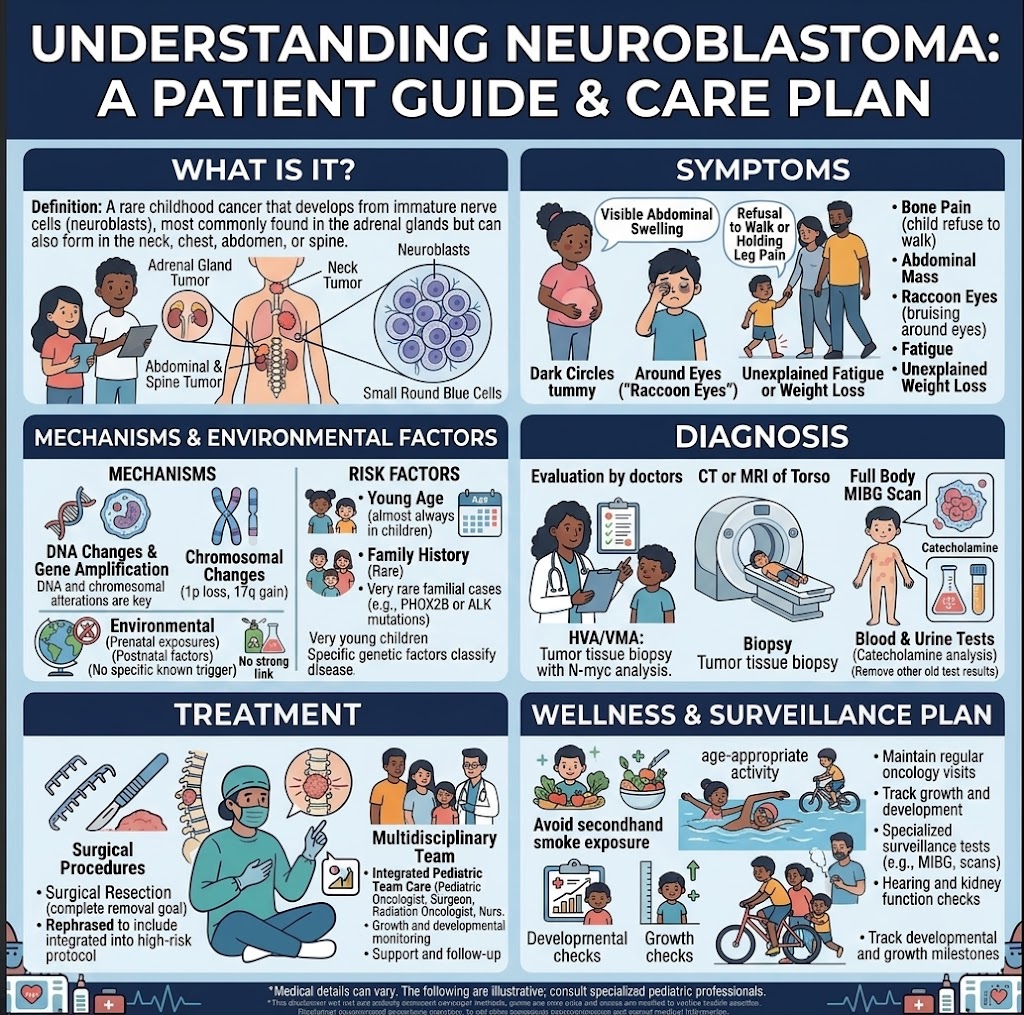
Neuroblastoma is a type of cancer that begins in very early nerve cells, called neuroblasts. These immature cells are found in several parts of the body. Most often, neuroblastoma starts in the adrenal glands, which sit atop the kidneys and produce vital hormones. It can also develop in neuroblasts found along the spine, in the belly, chest, or neck. This cancer primarily affects young children, typically those aged 5 or younger. Symptoms vary depending on where the cancer is located. Some forms of neuroblastoma may disappear on their own, while others require treatment, which can include surgery, chemotherapy, radiation therapy, and bone marrow transplant. It's important to know that neuroblastoma is different from other similarly named cancers, though they all involve 'blast' cells, meaning cells that haven't fully matured.
Understanding the Condition
Neuroblastoma: Understanding Childhood Cancer
Understanding the Condition
Neuroblastoma is a type of cancer that begins in very early nerve cells, called neuroblasts. These immature cells are found in several parts of the body. Most often, neuroblastoma starts in the adrenal glands, which sit atop the kidneys and produce vital hormones. It can also develop in neuroblasts found along the spine, in the belly, chest, or neck. This cancer primarily affects young children, typically those aged 5 or younger. Symptoms vary depending on where the cancer is located. Some forms of neuroblastoma may disappear on their own, while others require treatment, which can include surgery, chemotherapy, radiation therapy, and bone marrow transplant. It's important to know that neuroblastoma is different from other similarly named cancers, though they all involve 'blast' cells, meaning cells that haven't fully matured.
Common Symptoms
General Symptoms: When neuroblastoma is localized (only where it started), it may not cause obvious symptoms. Symptoms are more likely if the cancer grows into nearby areas or spreads to distant parts of the body.
Symptoms in the Belly or Adrenal Glands: These may include belly pain, a lump felt under the skin that usually isn't painful to touch, and changes in bowel habits like diarrhea or constipation.
Symptoms in the Chest or Neck: These can cause difficulty breathing or noticeable changes in the eyes, such as a drooping eyelid or pupils of different sizes.
Symptoms Near the Spine: Neuroblastoma near the spine can cause problems with movement, weakness, or pain.
Consultation Guide
Which Specialist to Meet
If neuroblastoma is suspected, you would typically consult with a pediatrician for initial evaluation. They may then refer you to a pediatric oncologist (a doctor specializing in childhood cancers), a pediatric surgeon, or other specialists depending on the location and stage of the cancer. A team approach often provides the best care.
Preparations Before Your Visit
Before your visit, make a list of all your child's symptoms, including when they started and how often they occur. Write down any medications your child is taking, their full medical history, and any questions you have for the doctor. Bringing a family member or friend for support and to help take notes can also be helpful.
Book a doctor visit near me
Managing Side Effects: Treatments can have lasting effects. Healthcare teams will help manage any ongoing physical or developmental challenges, pain, or other symptoms to improve quality of life.
Consultation Guide
Your child will be positioned between an X-ray machine and a plate that captures the image. They will need to stay very still for a few seconds while the X-ray is taken. The procedure is usually very fast and doesn't cause any discomfort.
Diagnostic Procedures
Needle Biopsy (including Bone Marrow Biopsy/Aspiration)
A needle biopsy involves using a thin needle to remove a small sample of cells or tissue from a suspicious area for examination under a microscope. This is crucial for confirming a cancer diagnosis. Bone marrow aspiration removes a liquid sample from inside the bone, while a bone marrow biopsy takes a small piece of the solid bone marrow tissue.
What to Expect
For a needle biopsy, the skin over the area will be numbed. The doctor will then insert a thin needle to collect a sample. For bone marrow, this is typically done from the back of the hip bone. You might feel some pressure or a brief, sharp pain. For children, sedation or general anesthesia is often used to ensure comfort and minimize distress. The samples are then sent to a lab for analysis.
CT Scan (Computed Tomography Scan)
A CT scan uses special X-ray equipment and a computer to create detailed cross-sectional images (slices) of bones, blood vessels, and soft tissues inside the body. It provides more detail than standard X-rays and helps locate tumors and assess their size and spread.
What to Expect
Your child will lie on a narrow table that slides into a large, doughnut-shaped machine. They will need to lie still during the scan, which takes several minutes. Sometimes, a special dye (contrast medium) is given intravenously or orally to make certain areas show up more clearly. This might involve a brief, warm sensation. Sedation may be used for younger children to help them remain still.
PET Scan (Positron Emission Tomography Scan)
A PET scan is an imaging test that helps reveal how well tissues and organs are functioning. It uses a radioactive tracer that is injected into the body and collects in areas of high metabolic activity, such as cancer cells, making them appear as bright spots on the scan. PET scans are often combined with CT scans (PET-CT) or MRI scans (PET-MRI) for better detail.
What to Expect
A small amount of a radioactive tracer will be injected, usually into a vein in the arm. There will be a waiting period (often an hour or so) for the tracer to distribute throughout the body. Then, your child will lie on a table that slides into a large scanning machine. The scan itself takes about 30 minutes. As with CT scans, sedation might be necessary for young children.
Ultrasound (Sonography)
An ultrasound uses high-frequency sound waves to create live images of structures inside the body. It's a safe procedure that doesn't use radiation and is often used to examine soft tissues and organs, like those in the abdomen.
What to Expect
Your child will lie on an examination table. A gel will be applied to the skin over the area to be examined. A small handheld device (transducer) is then moved across the skin, sending out sound waves and capturing their echoes to create images on a monitor. The procedure is typically painless, though there might be some pressure from the transducer.
An X-ray is a quick, painless imaging test that uses a small amount of radiation to create pictures of the inside of the body, particularly bones. Dense structures like bones appear white, while air appears black, and soft tissues in shades of gray.
What to Expect
A urinalysis is a test of urine that can help detect and manage various disorders, including those that might be linked to neuroblastoma (such as certain chemicals produced by the tumor cells). It involves checking the appearance, concentration, and content of the urine.
What to Expect
A sample of urine will be collected. For older children, they may be asked to urinate into a sterile cup. For infants or very young children, a collection bag or a catheter may be used. The urine sample is then sent to a lab for analysis.
Regular Follow-up Care: Children who have been treated for neuroblastoma will require regular check-ups and imaging tests for many years to monitor for any recurrence of the cancer or long-term side effects from treatment.
Treatment Options
Surgical Procedures
Surgery: Surgery aims to remove as much of the tumor as possible. For small, localized tumors, surgery might be the only treatment needed. For larger tumors, it may be performed after other treatments have shrunk the tumor. (Duration: A single surgical procedure, with recovery typically lasting several days to a few weeks, depending on the complexity.)
Chemotherapy: Chemotherapy uses powerful medications to kill fast-growing cancer cells throughout the body. It can be given before surgery to shrink a tumor or after surgery to kill any remaining cancer cells. (Duration: Typically given in cycles over several months, depending on the specific regimen and response to treatment.)
Radiation Therapy: Radiation therapy uses high-energy beams, most often X-rays, to destroy cancer cells or shrink tumors. Modern techniques precisely target the tumor while minimizing damage to surrounding healthy tissue. Proton therapy is a specialized type of radiation that uses positively charged particles (protons) to deliver a more targeted dose. (Duration: Usually administered daily over several weeks, depending on the dose and area being treated.)
Emotional and Psychological Support: Cancer treatment can be very challenging for children and their families. Support groups, therapy, and counseling can provide valuable emotional and psychological support during and after treatment.
Prevention & Long-Term Wellbeing
Bone Marrow Transplant (Stem Cell Transplant): This procedure replaces diseased bone marrow with healthy blood-forming stem cells. It's often used after very high doses of chemotherapy to allow the body to produce new, healthy blood cells. The cells can come from the child's own body (autologous) or a donor (allogeneic). (Duration: The preparation (high-dose chemotherapy) takes days to weeks, followed by the infusion of stem cells. Recovery and close monitoring can last for several months to a year or more.)
Biological Therapy (Immunotherapy): Biological therapy helps the body's own immune system fight cancer. It can work by making cancer cells easier for the immune system to find and destroy, or by boosting the immune system's ability to attack cancer. CAR-T cell therapy is an example where a patient's own immune cells are genetically modified to better target cancer. (Duration: Can be ongoing for several months or longer, depending on the specific therapy and how the child responds.)
Prevention
No Known Prevention: Currently, there are no known ways to prevent neuroblastoma, as it typically arises from random genetic changes in developing cells. Only a small number of cases are linked to inherited genetic conditions.
Long-Term Monitoring and Support
Nutritional Support: Maintaining good nutrition is crucial for recovery and overall health. A dietitian may provide guidance on healthy eating habits for your child.
Healthy Lifestyle: Encouraging a healthy lifestyle, including regular physical activity (as appropriate) and a balanced diet, can contribute to overall well-being and recovery.
Tags & Topics
Notice an error or need an update?
Help us keep medical information accurate. Report incorrect info or suggest an edit.


