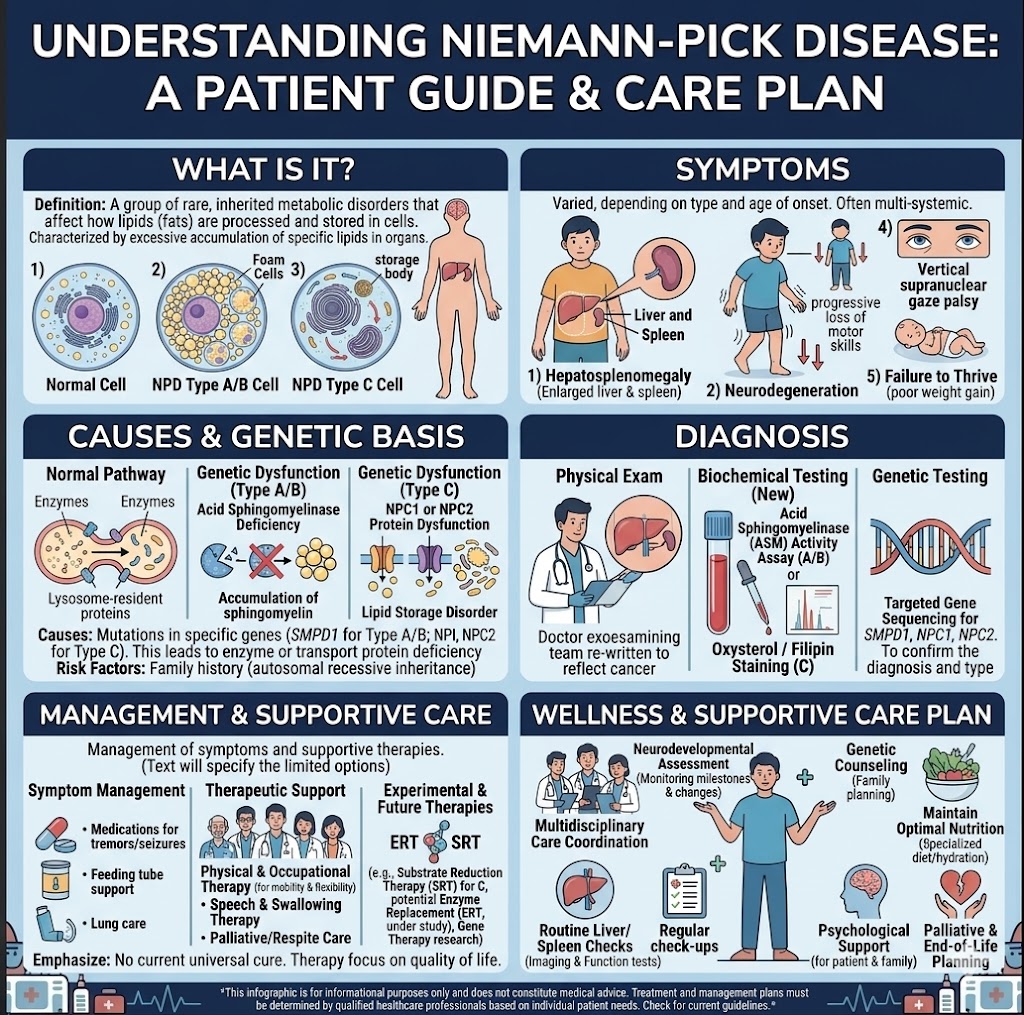
Niemann-Pick disease is a group of rare, inherited conditions where the body struggles to break down and use fats, such as cholesterol and lipids, inside cells. This leads to a harmful fat buildup, causing cells to malfunction and eventually die. The disease mainly affects the brain, nerves, liver, spleen, and bone marrow, and sometimes the lungs. Symptoms worsen over time, reflecting progressive organ damage. It primarily impacts children, though it can occur at any age. There's no cure; treatment focuses on managing symptoms to improve quality of life.
Understanding the Condition
Understanding the Condition
Niemann-Pick disease is a group of rare, inherited conditions where the body struggles to break down and use fats, such as cholesterol and lipids, inside cells. This leads to a harmful fat buildup, causing cells to malfunction and eventually die. The disease mainly affects the brain, nerves, liver, spleen, and bone marrow, and sometimes the lungs. Symptoms worsen over time, reflecting progressive organ damage. It primarily impacts children, though it can occur at any age. There's no cure; treatment focuses on managing symptoms to improve quality of life.
Common Symptoms
Motor Control Difficulties: Clumsiness, poor coordination, trouble walking.
Muscle Weakness: Reduced strength, leading to floppiness or movement difficulty.
Stiff Movements: Rigid, awkward body movements.
Vision Problems: Vision loss and uncontrolled eye movements.
Hearing Loss: Diminished ability to hear.
Touch Sensitivity: Increased discomfort when touched.
Sleep Disturbances: Difficulty falling or staying asleep.
Swallowing and Eating Difficulties: Trouble chewing or swallowing, risking choking or poor nutrition.
Slurred Speech: Unclear articulation of words.
Cognitive Decline: Progressive problems with learning, memory, and thinking.
Mental Health Changes: Mood swings, depression, paranoia, behavioral issues.
Enlarged Organs: Abnormally large liver and/or spleen.
Recurrent Infections: Frequent infections like pneumonia, due to weakened immunity.
Consultation Guide
Which Specialist to Meet
A team including a geneticist, neurologist, hepatologist, pulmonologist, ophthalmologist, and various therapists (physical, occupational, speech). Palliative care provides comfort.
Preparations Before Your Visit
Prepare a detailed symptom list (onset, progression) and family medical history. Write down questions for the doctor. Consider bringing a family member or friend for support.
Book a doctor visit near me
Symptomatic Relief: Drugs manage seizures, muscle stiffness, sleep, anxiety, depression, or pain. Improves comfort/function. (Duration: Ongoing, adjusted as needed.)
Palliative Care: Specialized medical care relieving symptoms and stress, improving quality of life for patient and family. (Duration: Ongoing, throughout disease course.)
Assistive Devices: Use of wheelchairs, walkers, communication aids to enhance mobility and daily function. (Duration: As needed, long-term.)
Regular Medical Check-ups: Consistent visits to monitor progression, manage symptoms, adjust treatment.
Comprehensive Symptom Management: Proactive management of pain, sleep, mental health for daily comfort.
Consultation Guide
Local anesthetic applied. Needle extracts marrow; may cause pressure/brief sharp pain. Takes 15-30 mins.
Liver Biopsy (if liver involvement)
Removes small liver tissue to detect fat accumulation and assess damage.
Diagnostic Procedures
Analyzes blood or saliva for gene changes (SMPD1, NPC1, NPC2) to confirm diagnosis and disease type.
What to Expect
A blood draw from your arm or a saliva swab. Quick, minimal discomfort. Results take weeks.
Enzyme Activity Test (Types A and B)
Measures sphingomyelinase enzyme activity in blood. Low activity indicates Types A or B.
What to Expect
A standard blood draw.
Bone Marrow Biopsy (Types A and B)
Small bone marrow sample from the hip checks for fat-filled 'foam cells.'
What to Expect
What to Expect
Local anesthetic used. Needle obtains tissue; you might feel pressure. Takes 15-20 mins, followed by rest.
Imaging Scans (MRI, CT)
MRI or CT visualizes brain, abdomen (liver/spleen), and chest (lungs) for damage or enlargement.
What to Expect
Lie still on a table. MRI is loud; CT is quieter. Scans last 20-60 mins.
Exam checks for specific eye changes like a 'cherry-red spot' or uncontrolled eye movements.
What to Expect
Eye drops may dilate pupils. Doctor uses a special microscope with light. Non-invasive, painless.
Developmental and Neurological Assessments
Evaluates cognitive skills, motor development, and overall neurological function.
What to Expect
Age-appropriate questions, tasks, and physical exams. Non-invasive, 30-60 mins.
Preconception Genetic Testing: For at-risk couples to identify gene mutations before/during pregnancy.
Long-Term Monitoring and Support
Treatment Options
Medications
Substrate Reduction Therapy: For Type C, treatments reduce production of accumulating fatty substances. (Duration: Long-term, ongoing.)
Therapies
Physical Therapy: Maintains muscle strength, flexibility, balance, coordination, improving mobility. (Duration: Ongoing, as prescribed.)
Occupational Therapy: Adapts daily tasks and environment for independence in activities like eating, dressing. (Duration: Ongoing, as needed.)
Speech and Swallowing Therapy: Improves communication and safe swallowing to prevent choking and ensure nutrition. (Duration: Ongoing, as needed.)
Prevention & Long-Term Wellbeing
Nutritional Support: Dietitian guidance for proper nutrition, specialized diets, or feeding tubes if needed. (Duration: Ongoing, regular monitoring.)
Gastrostomy Tube Placement: Tube surgically placed into stomach for nutrition if swallowing is severely impaired. (Duration: One-time procedure, device stays long-term.)
Splenectomy: Rarely, surgical removal of an extremely enlarged spleen causing significant problems. (Duration: One-time procedure, with recovery period.)
Supportive and Comfort Care
Prevention
Genetic Counseling: For families with history, to understand inheritance and risks for future children.
Nutritional and Hydration Support: Ensuring adequate intake, with dietary adjustments or assistive feeding.
Physical and Cognitive Support: Continued therapies and cognitive activities to maintain function.
Palliative and Hospice Care: Early palliative care for comfort; hospice for quality of life in later stages.
Family and Caregiver Support: Connect with support groups and resources for managing demands.
Safe and Adaptive Environment: Modify home for safety, accessibility, and ease of movement.
Tags & Topics
Notice an error or need an update?
Help us keep medical information accurate. Report incorrect info or suggest an edit.


