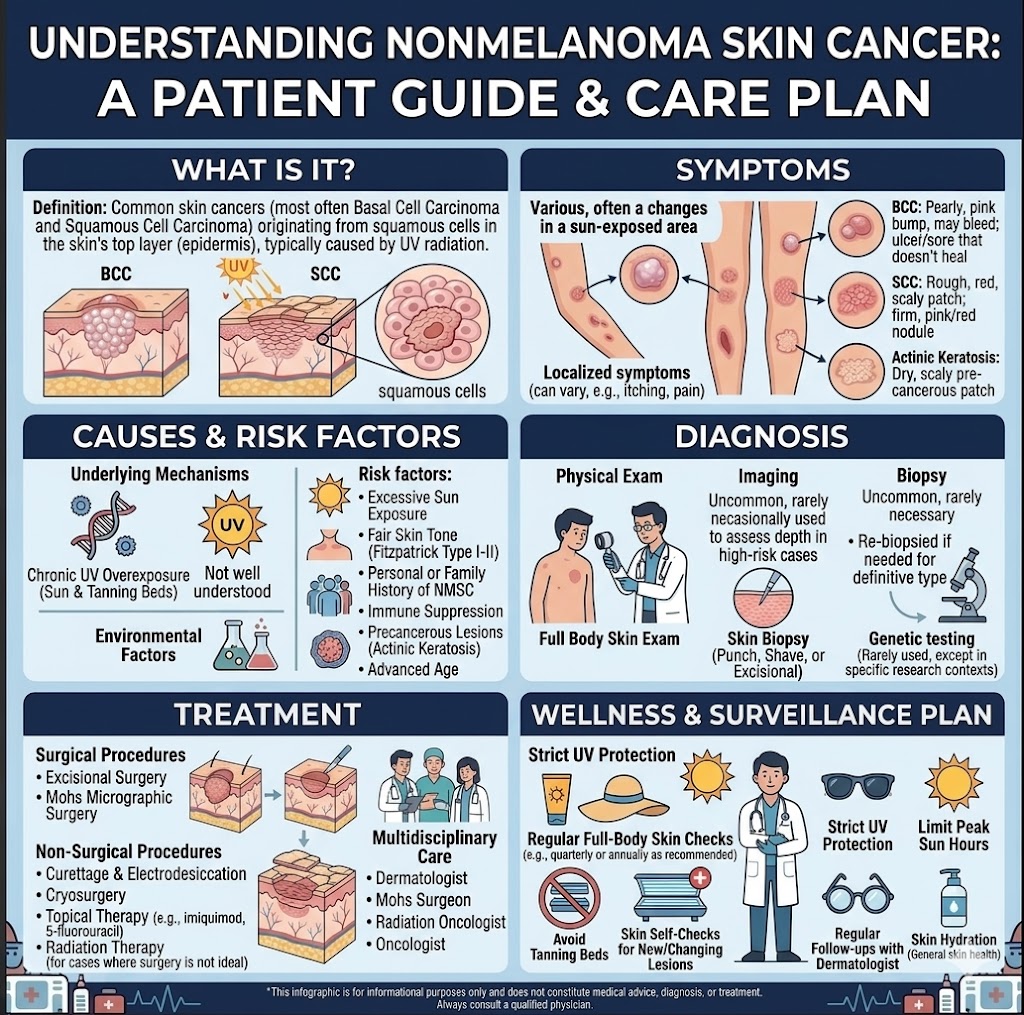
Nonmelanoma skin cancer is an umbrella term for types of skin cancer that are not melanoma. The vast majority of these cancers are classified as either basal cell carcinoma or squamous cell carcinoma. They most commonly develop on skin frequently exposed to the sun, though they can occur anywhere on the body. When detected early, nonmelanoma skin cancers are highly treatable, typically through outpatient surgical procedures.
Understanding the Condition
Understanding Nonmelanoma Skin Cancer
Understanding the Condition
Nonmelanoma skin cancer is an umbrella term for types of skin cancer that are not melanoma. The vast majority of these cancers are classified as either basal cell carcinoma or squamous cell carcinoma. They most commonly develop on skin frequently exposed to the sun, though they can occur anywhere on the body. When detected early, nonmelanoma skin cancers are highly treatable, typically through outpatient surgical procedures.
Common Symptoms
A New Skin Growth: An unusual growth, bump, or patch that appears on the skin and does not go away over several weeks.
Changes to Existing Spots: Any change in the size, shape, color, or texture of an existing mole, freckle, or birthmark.
Irritated or Bleeding Spots: A spot or growth that chronically itches, hurts, crusts, or bleeds spontaneously.
Non-healing Sores: An open sore or scab that does not heal, or heals temporarily and then returns.
Consultation Guide
Which Specialist to Meet
Consultation Guide
The area will be numbed with a local anesthetic injection, which may cause a brief stinging sensation. Once numbed, you will feel only mild pressure as the sample is scraped. Stitches are not needed; the wound will be bandaged and heals like a scraped knee.
A circular, pen-like cutting instrument is used to remove a tiny cylinder of skin, capturing both the surface and deeper layers.
After numbing the area with a local anesthetic, the doctor gently presses and rotates the punch tool. You will feel pressure but no pain. Because this removes a deeper plug of skin, one or two stitches may be placed to close the small wound, which will be covered with a bandage.
The doctor uses a scalpel to remove the entire skin growth along with a small safety margin of surrounding healthy skin.
Diagnostic Procedures
You should consult a board-certified dermatologist, who specializes in diagnosing and treating skin conditions. For advanced cases, a surgical oncologist or a radiation oncologist may join your care team.
Preparations Before Your Visit
The doctor uses a small, thin blade or scalpel to gently scrape off the outermost surface layers of the suspicious skin growth for laboratory testing.
What to Expect
What to Expect
What to Expect
The doctor will administer local anesthesia to numb the entire area. You will feel pressure and tugging, but no pain during the procedure. The resulting wound will be closed with stitches, and a protective dressing will be applied. Stitches are typically removed in 1 to 2 weeks.
Treatment Options
Before your appointment, perform a full-body skin self-exam to identify any spots of concern. Note when you first noticed them and if they have changed. Prepare a list of your medical history, including past sunburns, skin cancer history, and any immune-suppressing medications you take.
Book a doctor visit near me
Surgical Procedures
Standard Surgical Excision: The surgeon cuts out the cancerous tissue along with a margin of healthy skin to ensure all cancer cells are removed. (Duration: The outpatient procedure takes 30 to 90 minutes. Wound healing typically takes 1 to 3 weeks.)
Mohs Micrographic Surgery: A specialized technique where the surgeon removes skin layers one at a time, immediately examining each under a microscope until no cancer cells remain. This preserves the maximum amount of healthy tissue. (Duration: Completed in a single day, taking several hours depending on how many layers must be analyzed.)
Therapies and Medications
Topical Therapy: Prescription creams or ointments applied directly to the skin to stimulate the immune system or deliver localized chemotherapy to destroy superficial cancer cells. (Duration: Applied daily at home for a period of 2 to 6 weeks.)
External Beam Radiation Therapy: High-energy X-ray beams are precisely targeted at the tumor from an external machine to destroy cancer cells. (Duration: Typically administered in short daily sessions over 2 to 6 weeks.)
Photodynamic Therapy (PDT): A specialized, light-activated liquid drug is applied to the skin and allowed to absorb. A specific laser light is then shone on the area, activating the medicine to kill the abnormal cells. (Duration: Usually completed in 1 to 2 clinical sessions, spaced a few weeks apart.)
Systemic Biological Therapy: Intravenous medications designed to help your body's own immune system identify and destroy advanced cancer cells that cannot be treated locally. (Duration: Administered in clinical cycles every few weeks for several months up to 2 years.)
Prevention & Long-Term Wellbeing
Prevention Strategies
Broad-Spectrum Sunscreen: Apply a broad-spectrum sunscreen with an SPF of 30 or higher every day, even on cloudy days. Reapply every two hours when outdoors or after swimming.
Protective Clothing: Wear tightly woven, dark-colored clothing, wide-brimmed hats, and UV-blocking sunglasses to shield your skin from direct sunlight.
Avoid Peak Sun and Artificial UV: Seek shade between 10 a.m. and 4 p.m. when UV rays are strongest, and completely avoid tanning beds and sunlamps.
Long-Term Monitoring
Monthly Self-Examinations: Regularly check your entire skin surface, including hard-to-reach areas like your back and scalp (using a mirror), for any new or changing spots.
Annual Dermatologist Visits: Schedule a professional full-body skin exam at least once a year, or more frequently if you have a personal or family history of skin cancer.
Tags & Topics
Notice an error or need an update?
Help us keep medical information accurate. Report incorrect info or suggest an edit.


