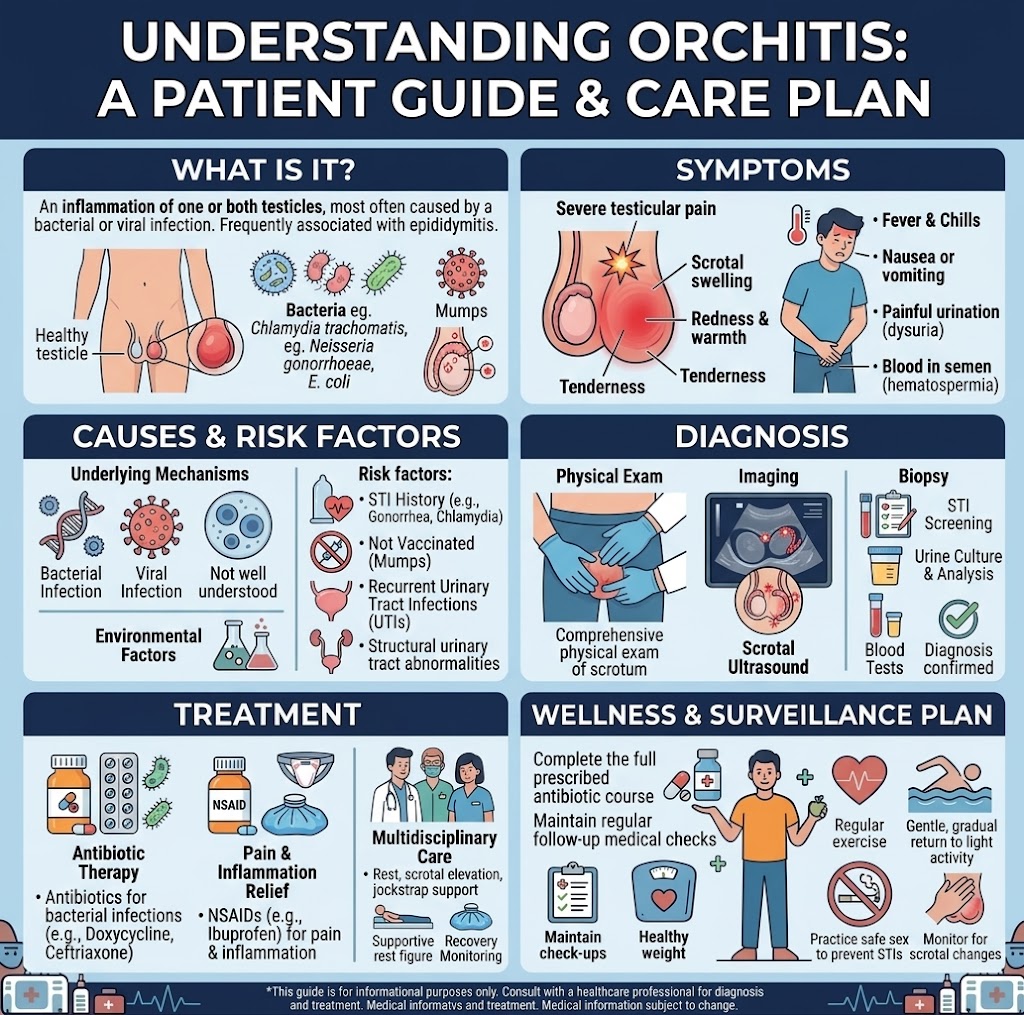
Orchitis (pronounced or-KIE-tis) is a medical condition characterized by inflammation or swelling of one or both testicles. It is commonly caused by infections, which can include sexually transmitted infections (STIs) or the mumps virus. Often, orchitis occurs alongside epididymitis, an inflammation of the epididymis—the coiled tube located behind the testicle that stores and transports sperm. When both conditions are present, it is termed epididymo-orchitis.Bacterial orchitis typically arises from an infection in the epididymis, often spreading from the urethra or bladder. STIs can also be a cause. Viral orchitis is most frequently linked to the mumps virus, usually appearing 4 to 7 days after the initial mumps symptoms. The incidence of mumps-related orchitis has significantly decreased due to routine childhood vaccinations.Risk factors for orchitis include untreated blockages in the urinary tract, such as an enlarged prostate or scar tissue in the urethra (urethral stricture). Medical procedures involving the urethra, like the insertion of a catheter or scope, also increase the risk. For mumps orchitis, not being vaccinated is the primary risk factor. Behaviors that increase STI risk, such as having multiple sexual partners, sex with an STI-infected partner, unprotected sex, or a personal history of STIs, elevate the risk for sexually transmitted orchitis.
Understanding the Condition
Orchitis (pronounced or-KIE-tis) is a medical condition characterized by inflammation or swelling of one or both testicles. It is commonly caused by infections, which can include sexually transmitted infections (STIs) or the mumps virus. Often, orchitis occurs alongside epididymitis, an inflammation of the epididymis—the coiled tube located behind the testicle that stores and transports sperm. When both conditions are present, it is termed epididymo-orchitis.Bacterial orchitis typically arises from an infection in the epididymis, often spreading from the urethra or bladder. STIs can also be a cause. Viral orchitis is most frequently linked to the mumps virus, usually appearing 4 to 7 days after the initial mumps symptoms. The incidence of mumps-related orchitis has significantly decreased due to routine childhood vaccinations.Risk factors for orchitis include untreated blockages in the urinary tract, such as an enlarged prostate or scar tissue in the urethra (urethral stricture). Medical procedures involving the urethra, like the insertion of a catheter or scope, also increase the risk. For mumps orchitis, not being vaccinated is the primary risk factor. Behaviors that increase STI risk, such as having multiple sexual partners, sex with an STI-infected partner, unprotected sex, or a personal history of STIs, elevate the risk for sexually transmitted orchitis.
Common Symptoms
Before your visit, be prepared to discuss your symptoms thoroughly, including when they started, their intensity, and any recent illnesses or sexual activity. Provide a comprehensive list of all medications you are currently taking. You may also be asked to provide a urine sample.
Book a doctor visit near me
Rest and Scrotal Elevation: Resting in bed and elevating the scrotum can help reduce swelling and discomfort. (Duration: Continuous as needed during acute symptoms.)
Cold Packs: Applying cold packs to the affected area can help relieve pain and reduce swelling. (Duration: Apply for 15-20 minutes at a time, several times a day.)
Supportive Underwear: Wearing an athletic supporter or firm, supportive underwear helps reduce discomfort by providing support to the testicles. (Duration: Wear until symptoms subside, which may take several weeks to months.)
Anti-inflammatory Medications: Over-the-counter or prescription medications are used to reduce pain and inflammation. (Duration: As prescribed, typically for the duration of acute symptoms.)
Adherence to Treatment: Complete any prescribed antibiotic courses entirely, even if symptoms improve, to ensure complete eradication of bacterial infections and prevent recurrence or complications.
Consultation Guide
You should initially consult your primary care physician or a general practitioner. They can provide an initial diagnosis and treatment. Depending on the cause and severity, you may be referred to a urologist, a doctor specializing in the male reproductive and urinary systems.
Preparations Before Your Visit
Antibiotics: If the orchitis is caused by a bacterial infection, including STIs, antibiotics will be prescribed. It is crucial to complete the entire course of medication, and sexual partners may also require treatment. (Duration: Varies based on the type of infection, typically 7-14 days.)
Mumps Vaccination: Getting vaccinated against mumps is the most effective way to prevent viral orchitis caused by the mumps virus.
Diagnostic Procedures
Orchitis: Understanding Testicular Inflammation
Understanding the Condition
Testicular Swelling: Swelling in one or both testicles.
Testicular Pain: Pain in the testicles, which can range from mild to very severe.
Nausea and Vomiting: Feeling sick to your stomach and throwing up.
Malaise: A general feeling of being unwell or ill.
Consultation Guide
Which Specialist to Meet
A urinalysis is a test of your urine used to detect and manage a wide range of disorders, including urinary tract infections, kidney disease, and diabetes. It involves checking the appearance, concentration, and content of your urine for any abnormalities, such as cloudiness or increased protein levels.
What to Expect
You will be given a sterile cup and instructed to provide a 'clean-catch' urine sample. This involves cleaning the genital area, beginning to urinate into the toilet, then collecting a midstream portion of urine in the cup, and finally finishing urination into the toilet. The sample is then sent to a laboratory for analysis. The procedure itself is quick and painless.
An ultrasound, also known as sonography, uses high-frequency sound waves to create live images of structures inside the body. For suspected orchitis, an ultrasound helps doctors visualize the testicles and surrounding tissues to identify inflammation, fluid accumulation, or other issues, and to rule out other conditions like testicular torsion. It is a safe procedure with no known risks, using low-power sound waves.
What to Expect
You will lie on an examination table. A clear, water-based gel will be applied to the skin over your scrotum. A small, handheld device called a transducer will be gently pressed against your skin and moved around the area. This transducer emits and receives sound waves, which are then used to create images on a monitor. You may feel a slight pressure from the transducer and a cool sensation from the gel, but the procedure is generally painless. It typically takes about 15-30 minutes. You may be asked to remove jewelry and wear loose clothing.
Safe Sexual Practices: To prevent sexually transmitted orchitis, consistently use condoms, limit your number of sexual partners, and ensure partners are tested for STIs.
Address Urinary Issues: If you experience difficulty urinating or have underlying conditions like an enlarged prostate or urethral narrowing, consult your doctor. Addressing these issues can prevent infections that may lead to orchitis.
Long-Term Monitoring & Management
Follow-up Care: Attend all scheduled follow-up appointments with your doctor to ensure the infection has completely cleared and to monitor for any lasting effects or complications.
Monitor for Complications: Be aware of potential rare complications such as testicular shrinkage (atrophy) or issues with fertility. Discuss any concerns with your healthcare provider. Early detection and management can improve outcomes.
Treatment Options
Home Remedies and Supportive Care
Medications
Prevention & Long-Term Wellbeing
Abscess Drainage: In rare cases where a pus-filled pocket (scrotal abscess) develops, a minor surgical procedure to drain the abscess may be necessary. (Duration: One-time procedure; followed by a recovery period.)
Prevention
Tags & Topics
Notice an error or need an update?
Help us keep medical information accurate. Report incorrect info or suggest an edit.


