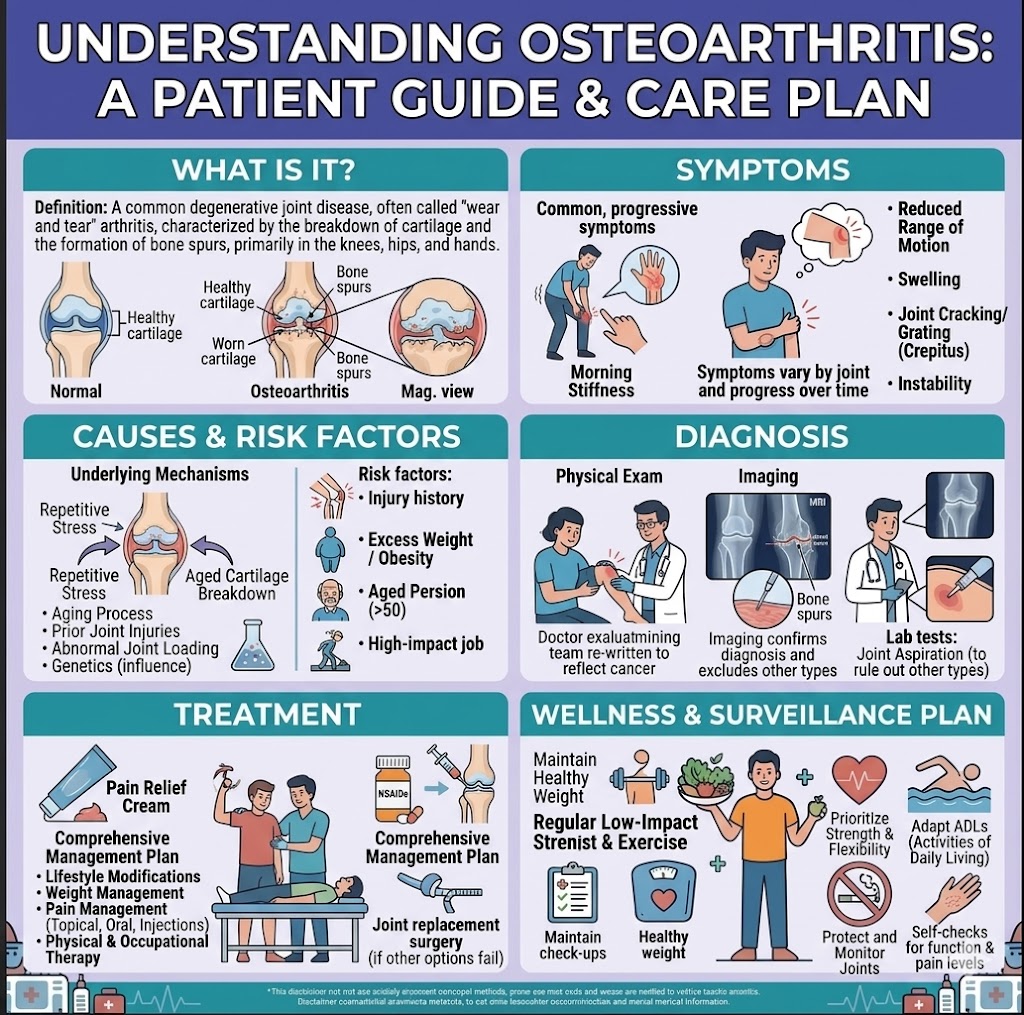
Osteoarthritis is the most common form of arthritis, affecting millions globally. It occurs when the protective cartilage that cushions the ends of bones within joints gradually wears away over time. While any joint can be affected, it most commonly impacts the hands, knees, hips, and spine. Although the damage to joints cannot be reversed, symptoms can usually be managed, and maintaining an active lifestyle, a healthy weight, and specific treatments can help slow the disease's progression and improve pain and joint function.
Understanding the Condition
Osteoarthritis: Understanding Joint Wear and Tear
Understanding the Condition
Osteoarthritis is the most common form of arthritis, affecting millions globally. It occurs when the protective cartilage that cushions the ends of bones within joints gradually wears away over time. While any joint can be affected, it most commonly impacts the hands, knees, hips, and spine. Although the damage to joints cannot be reversed, symptoms can usually be managed, and maintaining an active lifestyle, a healthy weight, and specific treatments can help slow the disease's progression and improve pain and joint function.
Common Symptoms
Joint Pain: Pain in the affected joint that often worsens with activity and improves with rest.
Stiffness: Joint stiffness that is most noticeable after waking up or after periods of inactivity.
Tenderness: The joint might feel tender when you apply light pressure to or near it.
Loss of Flexibility: An inability to move the joint through its full range of motion.
Grating Sensation: You might feel or hear a grating, popping, or crackling sensation when using the joint.
Bone Spurs: Small, hard lumps (bone spurs or osteophytes) can form around the affected joint, especially in the knees and hands.
Before your visit, list all your symptoms, including when they started and what makes them better or worse. Bring a list of all medications, vitamins, and supplements you take. Be prepared to discuss your medical history, any past injuries, and your family's medical history. Also, write down any questions you have for your doctor.
Book a doctor visit near me
Adhere to Treatment Plan: Consistently follow your doctor's recommendations for medication, physical therapy, and other treatments to effectively manage symptoms and slow disease progression.
Regular Medical Check-ups: Schedule routine appointments with your healthcare provider to monitor your condition, adjust treatments as needed, and discuss any new symptoms or concerns.
Stay Active and Flexible: Continue with a regular exercise routine, including flexibility and strengthening exercises, as advised by your physical therapist, to maintain joint function and reduce pain.
Learn Pain Management Techniques: Explore strategies such as mindfulness, relaxation techniques, and heat/cold therapy to cope with pain and improve your overall quality of life.
Consultation Guide
Swelling: Inflammation of the soft tissues around the joint can cause swelling.
Consultation Guide
Which Specialist to Meet
If you experience persistent joint pain or stiffness, start by consulting your general practitioner. They may refer you to a specialist such as a rheumatologist (a doctor specializing in joint conditions) or an orthopedist (a surgeon specializing in bones and joints). A physical therapist may also be part of your care team.
Preparations Before Your Visit
You will lie on a movable table that slides into a large, tunnel-like machine. The machine can be noisy, so you might be offered headphones or earplugs. It's crucial to remain very still during the scan, which can last from 30 to 60 minutes or longer. In some cases, a contrast dye might be injected into a vein to enhance image detail, which may cause a cool sensation or metallic taste.
While blood tests cannot diagnose osteoarthritis, they can help rule out other causes of joint pain, such as rheumatoid arthritis or gout.
Diagnostic Procedures
Your doctor will examine your affected joint for tenderness, swelling, redness, and assess your range of motion.
What to Expect
The doctor will gently move your joint and press on areas around it to check for pain, tenderness, and swelling. They will observe how you move and assess the flexibility of your joint. This is a quick and non-invasive part of the diagnostic process.
X-rays can show cartilage loss by revealing a narrowing of the space between the bones in your joint. They can also reveal bone spurs around the joint.
What to Expect
You will be asked to lie or sit in various positions so that the X-ray machine can capture images of your joint. You may need to hold still for a few seconds during each image. The procedure is quick, generally painless, and involves minimal radiation exposure. You might be asked to remove jewelry or clothing items covering the area being examined.
Magnetic Resonance Imaging (MRI)
An MRI uses radio waves and a strong magnetic field to produce detailed images of bone and soft tissues, including cartilage.
What to Expect
What to Expect
A healthcare professional will draw a small sample of blood, usually from a vein in your arm, using a needle. You might feel a brief pinch or sting. The sample is then sent to a lab for analysis. The process is quick and generally takes only a few minutes.
Treatment Options
Medications
Pain Relievers (Topical and Oral): Over-the-counter or prescription medications to manage pain and inflammation. (Duration: As needed or daily, depending on severity and type)
Corticosteroid Injections: Strong anti-inflammatory medication injected directly into the joint to relieve pain and swelling. (Duration: Pain relief typically lasts several weeks to a few months; injections are usually limited to 3-4 per year per joint.)
Hyaluronic Acid Injections: Injections of a gel-like substance that mimics a natural component of joint fluid, intended to lubricate the joint and reduce pain. (Duration: Effects can last several months; a series of injections may be given over a few weeks.)
Therapies
Physical Therapy: A physical therapist can design an individualized exercise program to strengthen muscles around the joint, improve range of motion, and reduce pain. They may also use other techniques like ultrasound or electrical stimulation. (Duration: Typically several weeks to a few months of guided sessions, with ongoing home exercises.)
Occupational Therapy: An occupational therapist can help you learn ways to perform daily tasks without putting extra stress on your painful joint, suggesting adaptive tools or changes to your environment. (Duration: Several sessions as needed, with ongoing application of learned strategies.)
Surgical Procedures
Joint Replacement (Arthroplasty): Damaged joint surfaces are removed and replaced with artificial parts, typically made of metal and plastic. This is most common for hips and knees. (Duration: Surgery involves a hospital stay, followed by several months of rehabilitation and recovery.)
Prevention & Long-Term Wellbeing
Home Remedies and Lifestyle Adjustments
Regular Exercise: Low-impact exercises like walking, swimming, or cycling can strengthen muscles around the joint, increase flexibility, and reduce pain. Specific exercises might be recommended by a physical therapist. (Duration: Ongoing, daily or most days of the week)
Weight Management: Losing excess weight reduces stress on weight-bearing joints like the knees and hips, which can decrease pain and slow disease progression. (Duration: Ongoing)
Heat and Cold Therapy: Applying heat (e.g., warm compress, shower) can relax muscles and ease stiffness, while cold packs can relieve pain and reduce swelling. (Duration: As needed for 15-20 minutes per application)
Joint Fusion (Arthrodesis): In severe cases, especially for smaller joints, the bones of the joint may be permanently fused together. This eliminates pain but also flexibility in that joint. (Duration: Recovery takes several months, and the joint will remain immobile thereafter.)
Osteotomy: A surgeon cuts into the bone above or below a knee or hip joint to realign the joint and shift weight away from the damaged part of the cartilage. (Duration: Typically involves a hospital stay and several months of recovery and rehabilitation.)
Prevention
Maintain a Healthy Weight: Excess body weight increases stress on weight-bearing joints. Keeping a healthy weight reduces this pressure and may help prevent or slow the progression of osteoarthritis.
Regular, Low-Impact Exercise: Engage in activities like walking, swimming, cycling, or yoga to strengthen muscles, improve joint flexibility, and maintain cartilage health without excessive impact.
Protect Joints from Injury: Be mindful of proper form during exercise, use protective gear during sports, and avoid activities that place repetitive stress or high impact on joints to prevent injuries that can lead to OA.
Practice Good Posture and Body Mechanics: Correct posture and ergonomic practices reduce strain on joints during daily activities, whether sitting, standing, or lifting.
Long-Term Management and Wellbeing
Tags & Topics
Notice an error or need an update?
Help us keep medical information accurate. Report incorrect info or suggest an edit.


