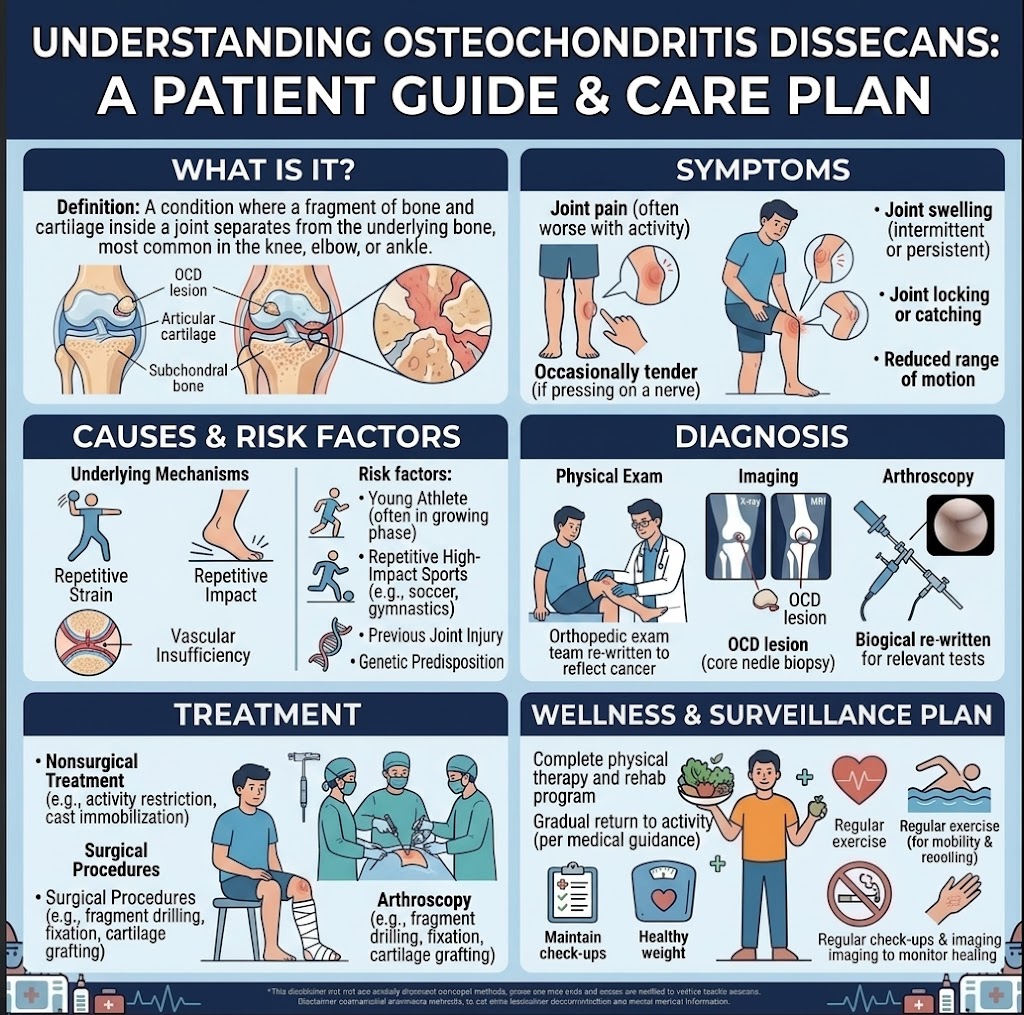
Osteochondritis dissecans (OCD) is a joint condition where the bone just beneath the cartilage loses its blood supply and dies. This affected bone and its overlying cartilage can then loosen or break away, causing pain and restricted joint movement. OCD primarily affects children and adolescents, often linked to repetitive stress or injury, especially from high-impact sports. It most commonly occurs in the knee but can also affect elbows and ankles. In young children, mild cases may heal naturally. However, if a bone or cartilage fragment detaches and causes persistent pain or joint locking, surgical intervention might be necessary.
Understanding the Condition
Osteochondritis Dissecans: Understanding a Joint Condition
Understanding the Condition
Common Symptoms
Pain: Common, often triggered by physical activity like climbing stairs or playing sports.
Swelling and Tenderness: Around the affected joint.
Joint Popping or Locking: Loose fragments can get caught, causing a popping sensation or the joint to stick.
Joint Weakness: A feeling of the joint 'giving way' or becoming unstable.
Decreased Range of Motion: Inability to fully straighten or bend the affected limb.
Consultation Guide
Which Specialist to Meet
If you experience ongoing pain, soreness, swelling, or limited movement in a joint, consult an orthopedic surgeon. For children and adolescents, a specialist in pediatric orthopedics or sports medicine is often recommended.
Preparations Before Your Visit
Before your visit, list your symptoms, including when they started, what makes them better or worse, and any previous treatments. Document all medications, supplements, and relevant family medical history. Bring any prior imaging reports or films related to the joint.
Book a doctor visit near me
Pain Management: Over-the-counter pain relievers for discomfort and inflammation, used as needed under medical guidance. (Duration: As needed for symptoms, usually short-term.)
Debridement and Removal of Loose Bodies: Surgical removal of unfixable detached fragments that cause mechanical symptoms, with defect edge smoothing. (Duration: Recovery typically ranges from a few weeks to a few months.)
Consultation Guide
Osteochondritis dissecans (OCD) is a joint condition where the bone just beneath the cartilage loses its blood supply and dies. This affected bone and its overlying cartilage can then loosen or break away, causing pain and restricted joint movement. OCD primarily affects children and adolescents, often linked to repetitive stress or injury, especially from high-impact sports. It most commonly occurs in the knee but can also affect elbows and ankles. In young children, mild cases may heal naturally. However, if a bone or cartilage fragment detaches and causes persistent pain or joint locking, surgical intervention might be necessary.
Diagnostic Procedures
A quick, painless imaging test using radiation to create pictures of bone structures. Dense materials like bone appear white, helping identify fragments or structural changes in OCD.
What to Expect
You'll be positioned on a table or in front of an X-ray plate. A technician will ensure correct positioning, possibly using lead shields. You must remain still for a few seconds. The process is quick and painless.
CT Scan (Computerized Tomography Scan)
A CT scan uses advanced X-ray technology to produce detailed cross-sectional 'slices' of bones, blood vessels, and soft tissues. This provides a comprehensive view for assessing fragment size, stability, and subtle OCD changes, offering more detail than standard X-rays.
What to Expect
You will lie on a motorized table that slides into a large, donut-shaped scanner. You must lie very still; you may be asked to hold your breath. The machine makes humming or clicking sounds. Contrast dye may be given intravenously or orally, causing a brief warm sensation. The scan typically takes 10-30 minutes.
Treatment Options
Conservative Management and Therapy
Rest and Activity Modification: Avoid painful activities (especially high-impact) to allow natural healing of bone and cartilage. (Duration: Typically several weeks to months.)
Physical Therapy: Exercises to strengthen muscles, improve stability, and restore joint movement, including proper technique guidance. (Duration: Usually 6-12 weeks, with ongoing home exercises.)
Bracing or Splinting: Immobilizes the joint to reduce stress and promote healing, especially for knee or ankle lesions. (Duration: Typically worn for a few weeks to several months.)
Cartilage Repair or Transplantation: For large defects, procedures to replace or stimulate new cartilage growth, sometimes using tissue from other joint areas. (Duration: These are more extensive surgeries, with recovery often lasting 6-12 months or longer.)
Prevention & Long-Term Wellbeing
Arthroscopic Drilling: Tiny holes drilled into the bone beneath stable lesions to stimulate blood flow and new cartilage/bone growth. (Duration: Recovery typically involves 3-6 months of restricted activity and physical therapy.)
Internal Fixation: Reattaching detached bone/cartilage fragments with pins, screws, or implants to promote healing. (Duration: Recovery can take 6 months or more, with gradual return to activity.)
Prevention
Education on Overuse Risks: Understanding repetitive stress dangers in sports, particularly for young athletes, promotes safer training.
Proper Sport Mechanics and Technique: Learning and applying correct form for activities to distribute forces evenly and reduce joint stress.
Use of Protective Gear: Wearing appropriate equipment to cushion impacts and prevent direct joint trauma.
Strength and Stability Training: Exercises to strengthen muscles around joints and improve overall stability, reducing injury risk.
Gradual Increase in Activity: Avoid sudden, intense increases in training duration or intensity; build up gradually to allow adaptation.
Adequate Rest and Recovery: Ensure sufficient rest days and recovery periods between strenuous activities for tissue repair and joint health.
Long-Term Monitoring
Regular Follow-up Appointments: Consistent check-ups with your healthcare provider are important to monitor healing, assess joint function, and address any new concerns.
Monitoring for Osteoarthritis: Individuals with a history of OCD have an increased risk of developing osteoarthritis later. Watch for persistent joint pain, stiffness, or decreased function and report to your doctor.
Joint-Friendly Lifestyle: Maintain a healthy weight. Engage in low-impact exercises (e.g., swimming, cycling). Avoid activities causing pain or discomfort.
Tags & Topics
Notice an error or need an update?
Help us keep medical information accurate. Report incorrect info or suggest an edit.


