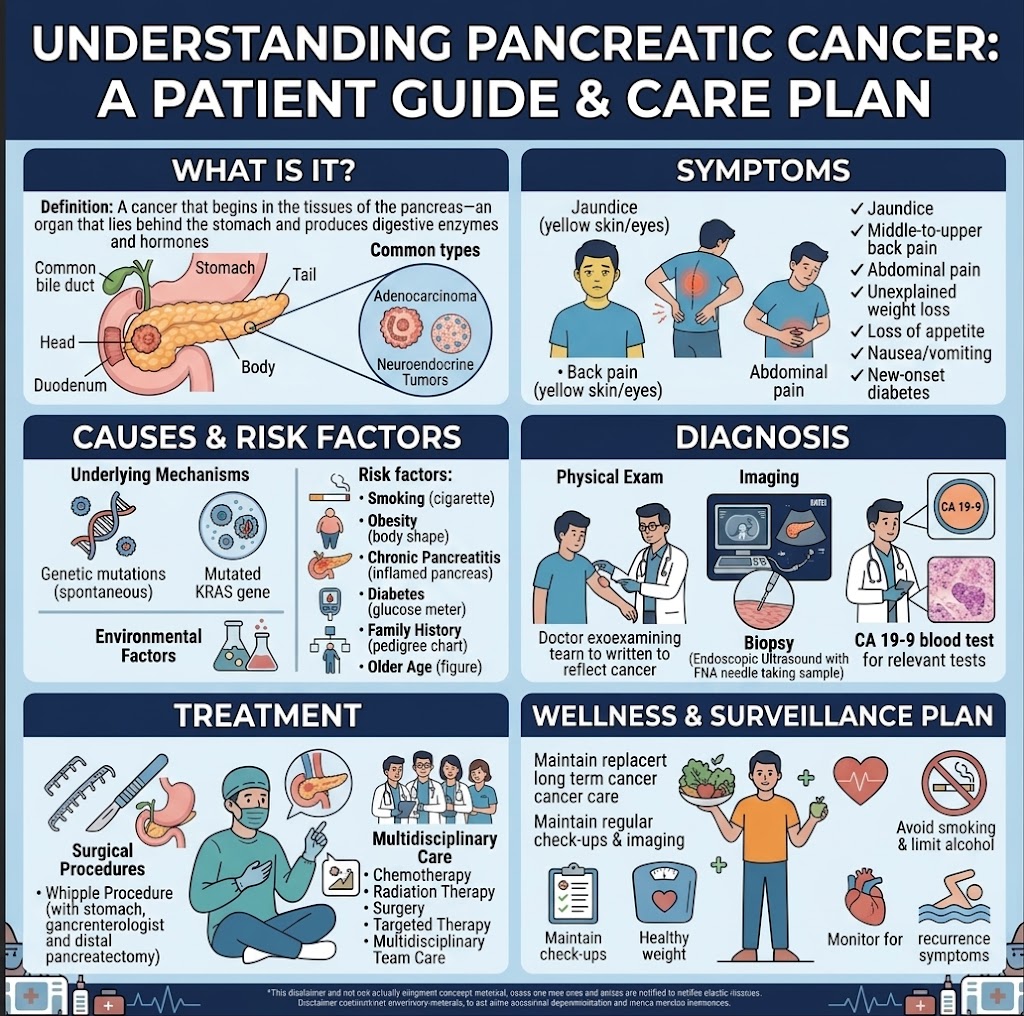
Pancreatic cancer begins with uncontrolled cell growth in the pancreas, an organ located behind the stomach. The pancreas plays a vital role in digestion by producing enzymes and managing blood sugar with hormones like insulin. The most common form, pancreatic ductal adenocarcinoma, starts in the ducts that carry digestive enzymes. This cancer is often detected at advanced stages because symptoms typically don't appear until it has spread, making early diagnosis and cure challenging. Treatment plans are tailored and may involve surgery, chemotherapy, radiation therapy, or a combination.
Understanding the Condition
Pancreatic Cancer: A Guide for Non-Medical Persons
Understanding the Condition
Pancreatic cancer begins with uncontrolled cell growth in the pancreas, an organ located behind the stomach. The pancreas plays a vital role in digestion by producing enzymes and managing blood sugar with hormones like insulin. The most common form, pancreatic ductal adenocarcinoma, starts in the ducts that carry digestive enzymes. This cancer is often detected at advanced stages because symptoms typically don't appear until it has spread, making early diagnosis and cure challenging. Treatment plans are tailored and may involve surgery, chemotherapy, radiation therapy, or a combination.
Common Symptoms
Abdominal Pain: Pain in the belly that may extend to the sides or back.
Loss of Appetite: Feeling full quickly or having a decreased desire to eat.
Before your visit, gather your medical history, including any existing health conditions, current medications, and a detailed list of your symptoms and when they started. Be prepared to discuss your family's medical history, especially any instances of cancer. Write down any questions you have to ensure all your concerns are addressed.
Book a doctor visit near me
Pain Management Medication: Prescribed medications, from over-the-counter options to stronger prescription pain relievers, to help control severe abdominal pain. (Duration: Taken as needed, potentially long-term for ongoing symptom relief.)
Radiation Therapy: Uses high-energy beams (like X-rays or protons) precisely aimed at the tumor to destroy cancer cells or shrink tumors. (Duration: Typically given in daily sessions over several weeks.)
Palliative Care: Specialized medical care focused on providing relief from the pain, symptoms, and stress of a serious illness, improving quality of life for both the patient and family. (Duration: Ongoing throughout the illness, alongside other medical treatments.)
Integrative Medicine: Complementary approaches such as acupuncture, massage therapy, or yoga used alongside conventional treatments to manage symptoms and improve overall well-being. (Duration: As needed, ongoing, tailored to individual preferences and benefits.)
Symptom Relief and Palliative Care: Ongoing medical care focused on relieving symptoms like pain, jaundice, and digestive issues to improve comfort and quality of life.
Consultation Guide
Limit Alcohol Consumption: Reducing or avoiding excessive alcohol intake can lower the risk of chronic pancreatitis, a risk factor for pancreatic cancer.
Manage Chronic Conditions: Effectively managing conditions like Type 2 diabetes and chronic pancreatitis can help reduce associated cancer risks.
Diagnostic Procedures
New or Worsening Diabetes: A new diagnosis of diabetes, or existing diabetes that becomes harder to control.
Blood Clots: Pain, swelling, or redness in an arm or leg, which could indicate a blood clot.
Fatigue and Weakness: Persistent tiredness or a general feeling of weakness.
Consultation Guide
Which Specialist to Meet
Initially, you would typically meet with your primary care provider. If pancreatic cancer is suspected, you may be referred to specialists such as a gastroenterologist (digestive system specialist), an oncologist (cancer specialist), a surgeon, or a genetic counselor if there's a family history of cancer.
Preparations Before Your Visit
Computed Tomography (CT) Scan
A CT scan uses X-rays from multiple angles and a computer to create detailed cross-sectional images of internal organs, bones, and soft tissues.
What to Expect
You will lie still on a table that slides into a large, doughnut-shaped scanner. You might receive a contrast dye, either through an IV or orally, to enhance the visibility of certain structures. The scan is usually quick and painless.
Magnetic Resonance Imaging (MRI)
An MRI uses powerful magnetic fields and radio waves to generate detailed images of soft tissues and organs without using X-rays.
What to Expect
You will lie on a movable table that slides into a large, tube-shaped machine. The machine can be noisy, and you may receive earplugs. You might also receive a contrast dye intravenously to improve image clarity. It's crucial to remain very still during the scan.
Ultrasound uses high-frequency sound waves to create real-time images of internal body structures, helping visualize the pancreas and surrounding areas.
What to Expect
A gel will be applied to your skin over the area to be examined. A handheld device called a transducer will be gently pressed and moved over the skin, sending and receiving sound waves. You might feel slight pressure, but it is generally painless.
Positron Emission Tomography (PET) Scan
A PET scan uses a small amount of radioactive sugar (tracer) to highlight areas of increased metabolic activity in the body, which can indicate cancer cells.
What to Expect
You will receive an injection of a radioactive tracer into a vein. After a waiting period for the tracer to circulate, you will lie still on a table while the scanner takes images. PET scans are often combined with CT scans for more precise localization.
Endoscopic Ultrasound (EUS)
EUS combines endoscopy (a flexible tube with a camera) with ultrasound, allowing close-up images of the pancreas and nearby lymph nodes from inside the digestive tract.
What to Expect
You will receive sedation to help you relax. A thin, flexible tube with a tiny camera and ultrasound probe will be guided down your throat. The probe emits sound waves to create images, and a tiny needle might be passed through the tube to collect tissue samples (biopsy).
A procedure where a long, thin needle is inserted to remove a small sample of cells or tissue from a suspicious area for laboratory analysis.
What to Expect
The area will be numbed with a local anesthetic. The needle is then guided into the target area, often with the help of imaging (like ultrasound or CT scan), to collect the sample. You might feel some pressure but minimal pain.
Endoscopic Retrograde Cholangiopancreatography (ERCP)
ERCP is a procedure that combines endoscopy and X-rays to diagnose and treat problems in the bile ducts and pancreatic ducts, such as blockages.
What to Expect
You will be sedated. An endoscope is passed down your throat, through the stomach, and into the small intestine. A thin tube is then inserted into the bile or pancreatic ducts, and a special dye is injected, making the ducts visible on X-rays. If a blockage is found, a small tube (stent) might be placed.
This test analyzes your DNA (from a blood or saliva sample) to identify inherited genetic changes that may increase your risk of pancreatic cancer.
What to Expect
A healthcare professional will collect a small blood sample from your arm or a saliva sample. This sample is then sent to a lab for analysis. The results can help assess your personal and family risk for certain cancers.
Whipple Procedure (Pancreaticoduodenectomy): A complex operation to remove the head of the pancreas, part of the small intestine (duodenum), gallbladder, and bile duct. The remaining organs are reconnected. (Duration: Major surgery requiring several weeks to months for full recovery.)
Total Pancreatectomy: Involves removing the entire pancreas, along with parts of the stomach, small intestine, gallbladder, bile duct, and spleen. (Duration: Extensive surgery requiring long-term recovery and lifelong management of diabetes and digestion.)
Bypass Surgery: If a tumor blocks the bile duct or small intestine, this surgery creates a new pathway to allow digestive fluids or food to flow around the blockage. (Duration: Surgical procedure with several weeks of recovery.)
Stent Placement (Endoscopic): A small tube (stent) is inserted endoscopically into a blocked bile duct or section of the bowel to hold it open and restore flow. (Duration: A relatively quick procedure; stents can be temporary or long-term solutions.)
Genetic Counseling and Testing: If you have a strong family history of pancreatic cancer or other related cancers, consult a genetic counselor to assess your risk and discuss genetic testing options.
High-Risk Screening: For individuals with a very high risk (e.g., strong family history or known genetic mutations), regular surveillance with imaging tests like MRI or ultrasound may be recommended.
Long-Term Wellbeing and Management
Regular Monitoring: Consistent follow-up appointments, imaging, and blood tests are crucial to monitor treatment effectiveness, detect any recurrence, or manage complications early.
Emotional and Psychological Support: Seek support through counseling, support groups, or mental health professionals to cope with the emotional challenges of a cancer diagnosis and treatment.
Treatment Options
Surgical Procedures
Distal Pancreatectomy: Removes the body and tail (left side) of the pancreas, often along with the spleen. (Duration: Major surgery with typical recovery ranging from weeks to a few months.)
Medications
Chemotherapy: Uses powerful drugs, given orally or intravenously, to kill cancer cells or slow their growth throughout the body. (Duration: Administered in cycles over several months, depending on the specific regimen and response.)
Celiac Plexus Block: An injection of medication, often alcohol, into nerves that control pain in the belly to block pain signals from reaching the brain. (Duration: A procedure providing pain relief that can last for several months.)
Prevention & Long-Term Wellbeing
Unexplained Weight Loss: Losing weight without trying or making changes to diet/exercise.
Jaundice: Yellowing of the skin and the whites of the eyes, often accompanied by itchy skin.
Changes in Stool: Stools that are light-colored, greasy, or float in the toilet.
Dark Urine: Urine that appears unusually dark, like tea or cola.
Prevention
Quit Smoking: Stopping all forms of tobacco use significantly reduces the risk of developing pancreatic cancer.
Maintain a Healthy Weight: Achieve and maintain a healthy body weight through a balanced diet rich in fruits, vegetables, and whole grains, combined with regular physical activity.
Nutritional Support: Work with a dietitian to manage weight loss, nausea, and poor nutrient absorption, often including digestive enzyme supplements and a modified diet.
Lifestyle Adjustments: Incorporate gentle exercise (as tolerated), stress-reduction techniques, and complementary therapies to support overall physical and mental well-being.
Tags & Topics
Notice an error or need an update?
Help us keep medical information accurate. Report incorrect info or suggest an edit.


