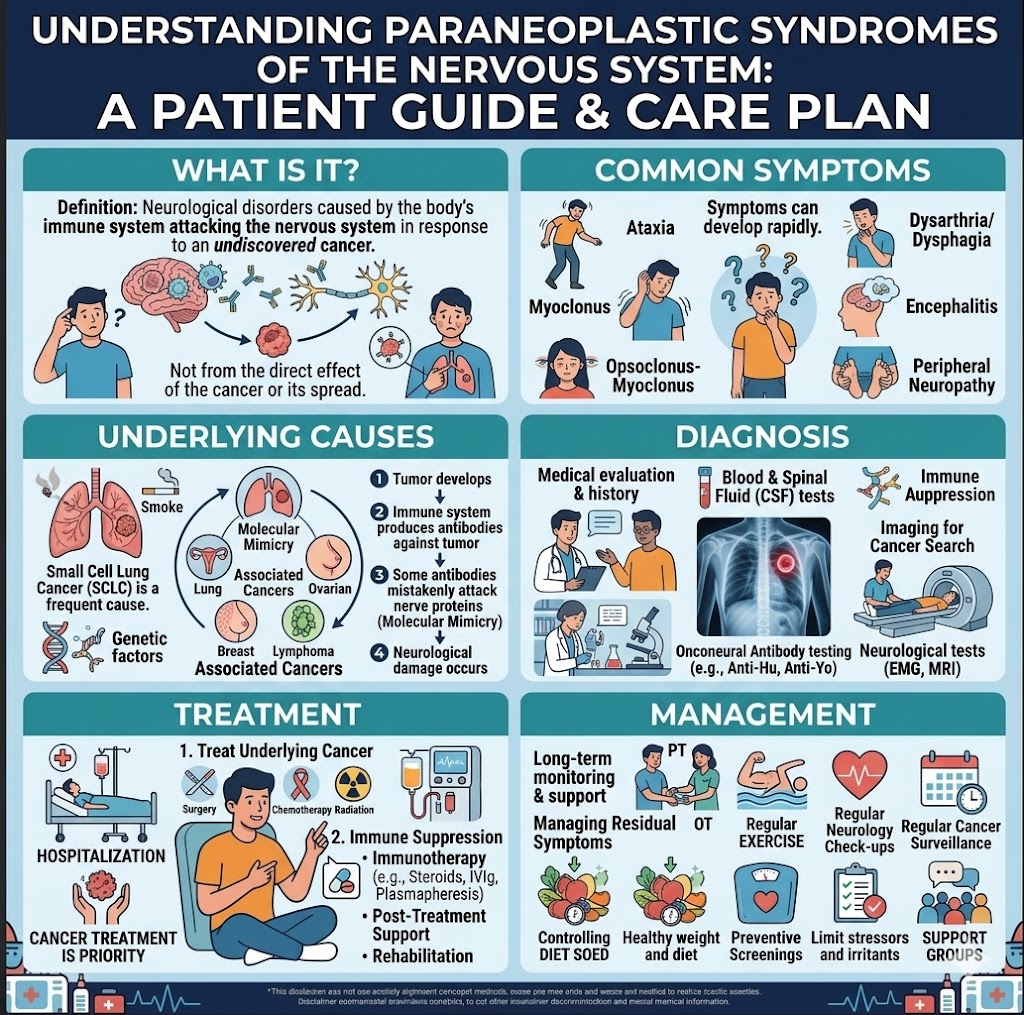
Paraneoplastic syndromes of the nervous system are rare conditions occurring in some people with cancer. They happen when the immune system, activated to fight cancer, mistakenly attacks healthy parts of the brain, spinal cord, peripheral nerves, or muscles. This can lead to issues with movement, coordination, sensation, memory, thinking, or sleep. Unlike direct cancer spread, these syndromes are an immune reaction. While treatment for the underlying cancer and immune modulation can sometimes reverse or improve symptoms, permanent damage can occur.
Understanding the Condition
Paraneoplastic Syndromes of the Nervous System
Understanding the Condition
Paraneoplastic syndromes of the nervous system are rare conditions occurring in some people with cancer. They happen when the immune system, activated to fight cancer, mistakenly attacks healthy parts of the brain, spinal cord, peripheral nerves, or muscles. This can lead to issues with movement, coordination, sensation, memory, thinking, or sleep. Unlike direct cancer spread, these syndromes are an immune reaction. While treatment for the underlying cancer and immune modulation can sometimes reverse or improve symptoms, permanent damage can occur.
Common Symptoms
Difficulty Walking: Trouble with gait.
Balance Issues: Unsteadiness.
Loss of Coordination: Clumsiness or lack of smooth movement.
Muscle Weakness: Reduced strength.
Fine Motor Skill Problems: Difficulty with precise hand movements.
Swallowing Difficulties: Trouble eating or drinking.
Speech Difficulties: Slurred speech or stuttering.
Memory/Thinking Impairment: Problems with memory or cognitive function.
Vision Changes: Blurred or double vision.
Sleep Disturbances: Insomnia or irregular sleep.
Hallucinations: Seeing or hearing non-existent things.
Uncontrolled Movements: Involuntary jerking or spasms.
Consultation Guide
Which Specialist to Meet
A neurologist (nervous system specialist) and an oncologist (cancer specialist) are key. A neuroimmunologist may also be involved.
Preparations Before Your Visit
Detail all symptoms, their onset, and impact. List current medications and medical history. Prepare questions.
Book a doctor visit near me
Symptomatic and Supportive Care
Physical, Occupational, and Speech Therapy: Targeted rehabilitation to improve strength, coordination, balance, daily living skills, and communication/swallowing. (Duration: Ongoing, potentially for months or years.)
Medications for Symptom Management: Treat specific symptoms like pain, sleep disturbances, anxiety, or uncontrolled movements. (Duration: As needed, potentially long-term.)
Vigilant Symptom Monitoring: Report any new or worsening neurological symptoms promptly for early intervention.
Effective Symptom Management: Collaborate with your team to address pain, sleep, or mood changes for comfort.
Consultation Guide
Regular Medical Check-ups: Maintain routine health exams, especially with cancer risk factors.
Diagnostic Procedures
Neurological Examination
Assesses brain, spinal cord, nerve, and muscle function to identify nervous system conditions.
What to Expect
Doctor reviews history, then checks mental status, coordination, reflexes, strength, and balance through various physical tests. Takes minutes to over an hour.
CT Scan (Computerized Tomography)
Uses X-rays and computer to create detailed cross-sectional images of internal body structures like bones, vessels, and tissues.
What to Expect
You lie on a table that moves into a donut-shaped scanner. May require holding breath. Contrast dye might be used. Painless, but can be noisy. Takes 10-30 minutes.
Lumbar Puncture (Spinal Tap)
A needle collects cerebrospinal fluid (CSF) from the lower back for analysis. CSF surrounds brain and spinal cord, and its analysis helps diagnose infections, inflammation, or cancer.
What to Expect
You lie on your side, knees up, or sit leaning forward. The area is numbed. A thin needle is inserted between vertebrae to collect fluid. You may feel pressure. Takes 30-60 minutes. May need to lie flat afterward.
PET Scan (Positron Emission Tomography)
An imaging test revealing metabolic activity using a radioactive tracer. Highlights areas of high activity (e.g., cancer cells), often combined with CT or MRI for detailed views.
What to Expect
A tracer is injected, followed by a waiting period for absorption. You then lie still on a table inside a scanner. Scan lasts 30-60 minutes. Generally painless.
Treatment Options
Cancer-Directed Therapies
Systemic Anti-Cancer Medications: Drugs to kill or slow cancer growth throughout the body, reducing overall cancer burden and immune reaction. (Duration: Cycles over months to a year or more.)
Radiation Therapy: High-energy rays target and destroy cancer cells in specific areas, shrinking tumors and potentially lessening immune response. (Duration: Daily sessions over several weeks.)
Immune-Modulating Therapies
Immunosuppressive Medications: Reduce immune system activity to prevent attacks on healthy nervous system cells. (Duration: Often long-term, months to years.)
Corticosteroids: Powerful anti-inflammatory agents suppressing immune response and reducing nervous system damage. (Duration: Initial high-dose, then tapered over weeks/months.)
Plasma Exchange (Plasmapheresis): Removes harmful antibodies from blood plasma and replaces it, quickly reducing immune system agents. (Duration: Several sessions over a few weeks, sometimes repeated.)
Intravenous Immunoglobulin (IVIG) Therapy: Infusion of donor antibodies to neutralize harmful self-attacking antibodies. (Duration: Cycles over several days, repeated monthly or as needed.)
Consistent Medical Follow-up: Regular appointments with neurologists and oncologists are crucial for ongoing monitoring and treatment adjustments.
Rehabilitation & Supportive Therapies: Continue physical, occupational, and speech therapy to maintain function, adapt, and improve quality of life.
Prevention & Long-Term Wellbeing
Surgical Tumor Removal: Removes localized cancer, potentially reducing the immune trigger. (Duration: Single procedure; recovery weeks to months.)
Early Detection & Monitoring
Healthy Lifestyle: A balanced diet, gentle exercise, adequate sleep, and avoiding harmful substances support overall health.
Emotional & Psychological Support: Seek professional help or support groups to cope with stress, anxiety, or depression.
Tags & Topics
Notice an error or need an update?
Help us keep medical information accurate. Report incorrect info or suggest an edit.


